Menu
The First BELAZ: What It Was Like and How It Became a Symbol of the Era
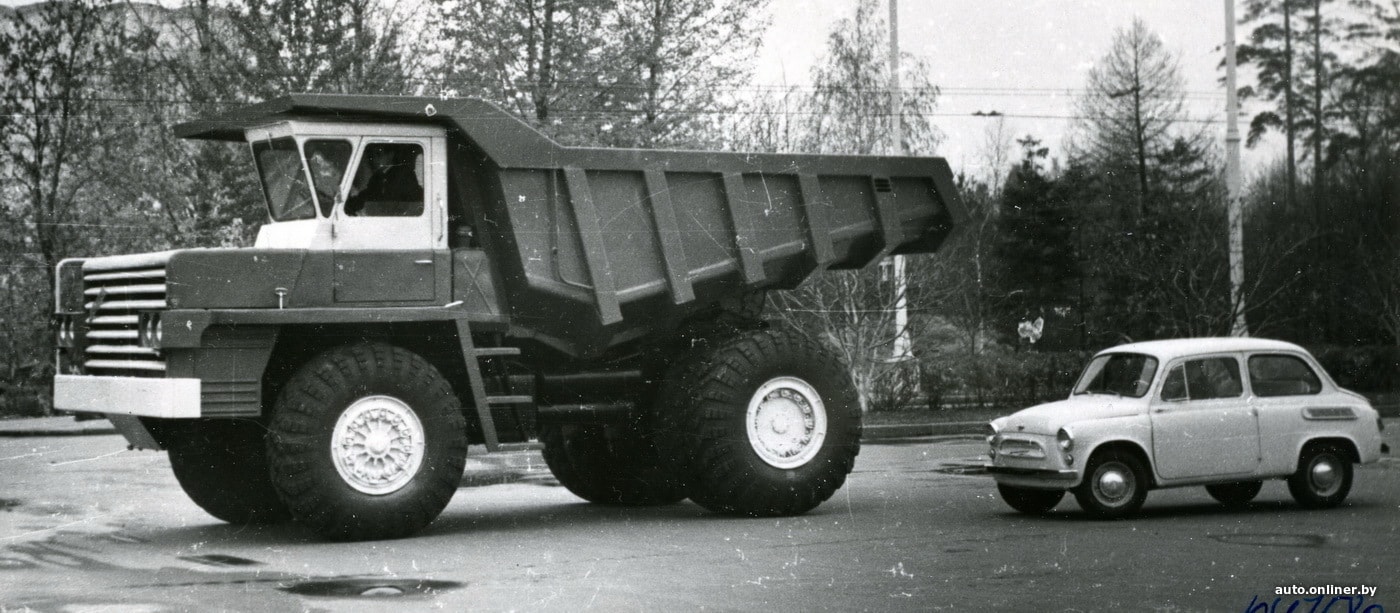
The BELAZ‑540 is one of the most iconic Soviet dump trucks. It was assembled in less than a year at the young plant in Zhodino, and it quickly became a symbol of the 1960s: powerful, brutal, recognizable. Over time, this model became firmly embedded in the visual language of the USSR—as a symbol of a country confidently exploiting its subsoil and building an industrial future. Today we look back at how this machine was created.
What this article is about
What the BELAZ‑540 was like — the first domestic quarry truck
BELAZ on screen: how the dump truck became a movie star
Serial production of the BELAZ‑540: how the era of quarry giants began
How BELAZ became more powerful and economical
BELAZ for export: sales geography
Unusual machines based on BELAZ: from cafeteria to blower
The legacy of the BELAZ‑540: what succeeded it
This article has already been published on Onlíner, and we decided to share it with you again — because the stories and events it reveals continue to remain important and interesting.
What the BELAZ‑540 was like — the first domestic quarry truck
In September 1961, at the automobile plant in Zhodino, the assembly of the first prototype BELAZ‑540 was completed. At that time, the dump trucks MAZ‑525 produced in Zhodino, although they had the stamp “Belarusian Automobile Plant” on their side panels, were still called MAZs. The brand‑new machine was officially given the name BELAZ.
[photo]
The quarry dump truck BELAZ‑540 was, at the time, a technically advanced freight vehicle. It was the first domestic truck with a hydro‑pneumatic suspension, as well as a combined hydraulic system for steering
After a series of trials, serial production of the BELAZ‑540 began in September 1965.
For the first four years the truck was produced alongside the MAZ‑525. For example, in 1962 the Belarus Automobile Plant assembled five pre‑series BELAZ‑540s and 1,005 MAZ‑525s. The following year, production of the BELAZ‑540 model was doubled—10 pre‑series machines versus 1,090 MAZ‑525s. In 1964, they produced already two dozen pre‑series machines, and in 1965 full‑scale serial production began, with 300 BELAZ‑540s assembled. However, in the final year of its production, more MAZ‑525 dump trucks were assembled—820. From 1966 onward, the Belarus Automobile Plant fully switched to producing the BELAZ‑540.
They immediately began considering increasing payload capacity. Production of 45‑ton train sets with BELAZ‑540V‑5271 semi‑trailers was planned. The machines passed trials but ultimately did not enter serial production. Preference was given to the “single” BELAZ‑548 model with a 40‑ton capacity. But that is a separate story.
Serial BELAZs differed from the experimental machines—primarily in their reconfigured headlights, which noticeably altered the appearance. Initially, the dump trucks were equipped with the D12A‑375B engine—a “civilian” version of the legendary V‑2 tank diesel. However, this motor was considered a temporary solution: the focus was on the more modern YAZ‑240, which the Yaroslavl plant was just preparing for mass production.
On the eve of May Day 1967, the first batch of BELAZ‑540A rolled off the line—equipped with the new, more economical and easier‑to‑repair YAZ‑240 (V12, 22.3 L, 360 hp). But due to a shortage of engines from Yaroslavl, the “pure” BELAZ‑540 with the tank diesel continued to be assembled in parallel—at least until 1973. From 1974 onward, only the 540A version remained on the line. On average, the plant produced 2,000–2,500
By 1986 the BELAZ‑540A had been noticeably upgraded. The machine was thoroughly modernized to become more powerful, reliable, and economical. All key components and assemblies were updated, which increased the payload to 30 tons. The new variant was named BELAZ‑7522 and was equipped with a more economical YAZM‑240M1 diesel engine, as well as an LG‑470 hydro‑transmission with higher efficiency.
The transmission was updated, the main gear was strengthened, and the brakes were refined. The parking brake became easier to maintain, and stone ejectors were added for the rear tandem wheels. The platform was also redesigned — it was now made of stronger metal and had a new shape. As a result, the machine consumed less fuel (by 2–3 %), lasted longer (by 13–15 %), and required less frequent maintenance (the interval increased by a quarter).
The cab was also updated. New seats appeared, a dashboard with a crash‑safe coating, a more powerful heater, and an electric windshield washer were added. Sound insulation was tightened as well. The externally modernized 30‑tonners were easy to recognize by the new radiator cladding — it not only enhanced airflow but also simplified washing. The mirrors became larger, and with them the visibility improved.
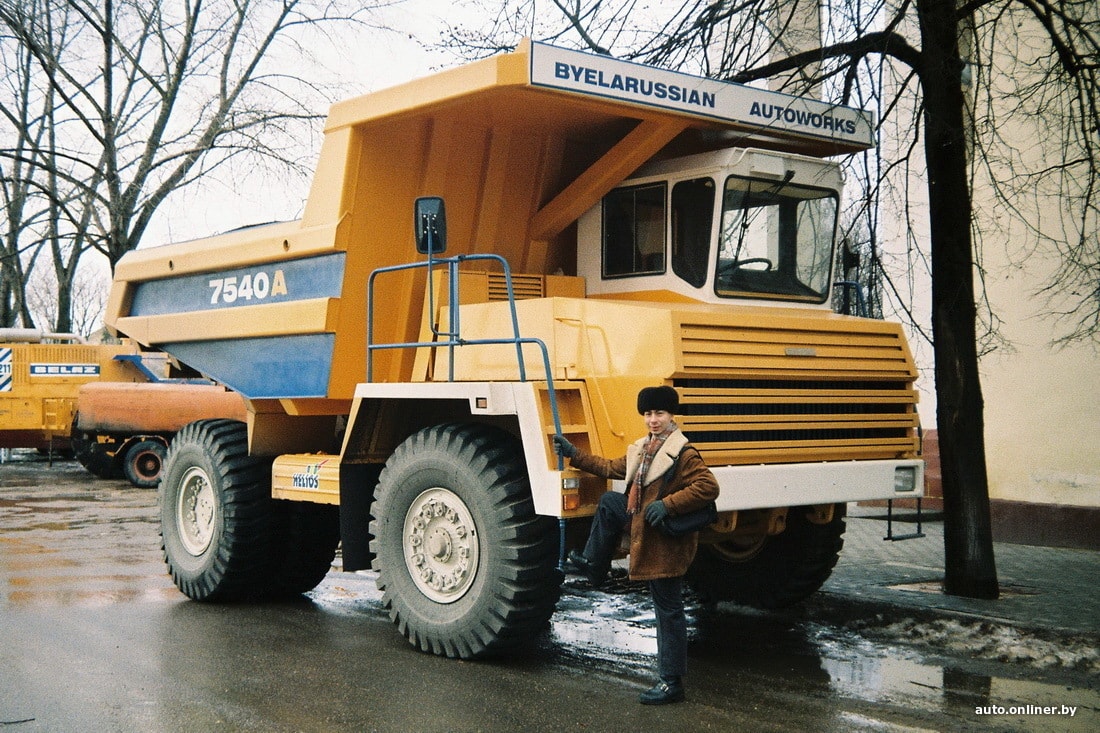
At the end of the 1980s the classic BELAZ was upgraded for the third time. At the same time, the first prototype, designated BELAZ‑7540, appeared. Its appearance did not change, but many structural improvements were made. For example, a more powerful engine was installed — a 420‑horsepower YAZM‑240NM instead of the 360‑horsepower YAZM‑240M.
In this form, the BELAZ‑540 survived the collapse of the Soviet Union. But they were
This shot, for example, was taken in the United Kingdom, in Wales. It is reliably known that from 1970 to 1980 the UK purchased 43 BelAZ trucks. Belgium, Italy, Cyprus, West Germany, and Sweden also bought them from the capitalists.
Moreover, in the 1970s Belarusian quarry dump trucks of the BelAZ‑540 family were purchased by Algeria, Afghanistan, Burma, Bulgaria, Hungary, East Germany, Egypt, Zambia, India, Iran, Cuba, Mongolia, Pakistan, Poland, Romania, Syria, Turkey, Czechoslovakia, and Yugoslavia. China was the largest buyer. In the 1980s other countries were added to this list.
Unusual machines based on the BelAZ: from dining cars to blowers
The BelAZ‑540 became the basis for unusual special equipment.
For example, there were fire‑fighting BelAZ‑540s. One served in Dnipro, another in Yakutsk. The firefighters themselves converted them.
But there was also a “professional” production of special machines based on BelAZs. Organizations such as CKPTB Transchermet, GIPRONIKEL, NPO “Chermetmechanization”, and NIICKMA developed technical documentation, and specialized repair plants built special equipment according to this documentation.
The most exotic were, of course, the “blowers” of quarries. Gas accumulation was a colossal problem, and engineers tried to solve it using aircraft engines installed on BelAZs. Both jet and turboprop engines were used.
The favorite special machine of all BelAZ drivers working in quarries was these mobile dining cars. They were serially produced by Kafan’s ARZ in Armenia and the Belgorod plant “Avtoremgormash”. Inside the insulated
The BELAZ‑7540A, which appeared in the 1990s, was already considered a new model. Yes, it used a completely different cab, different rigging, and a modified body. However, structurally this dump truck still traced its roots back to the classic BELAZ‑540. This family remains part of the plant’s lineup to this day.
In 2013, a truly new generation of BELAZ “little ones” emerged — the BELAZ‑75440 family. Under the hood, these machines house a Cummins QSX15‑C435 engine with an electronic control system. The hydro‑mechanical transmission also features electronic control.