Menu
What an agronomist at Druzhba-Agroproduction LLC dreams about
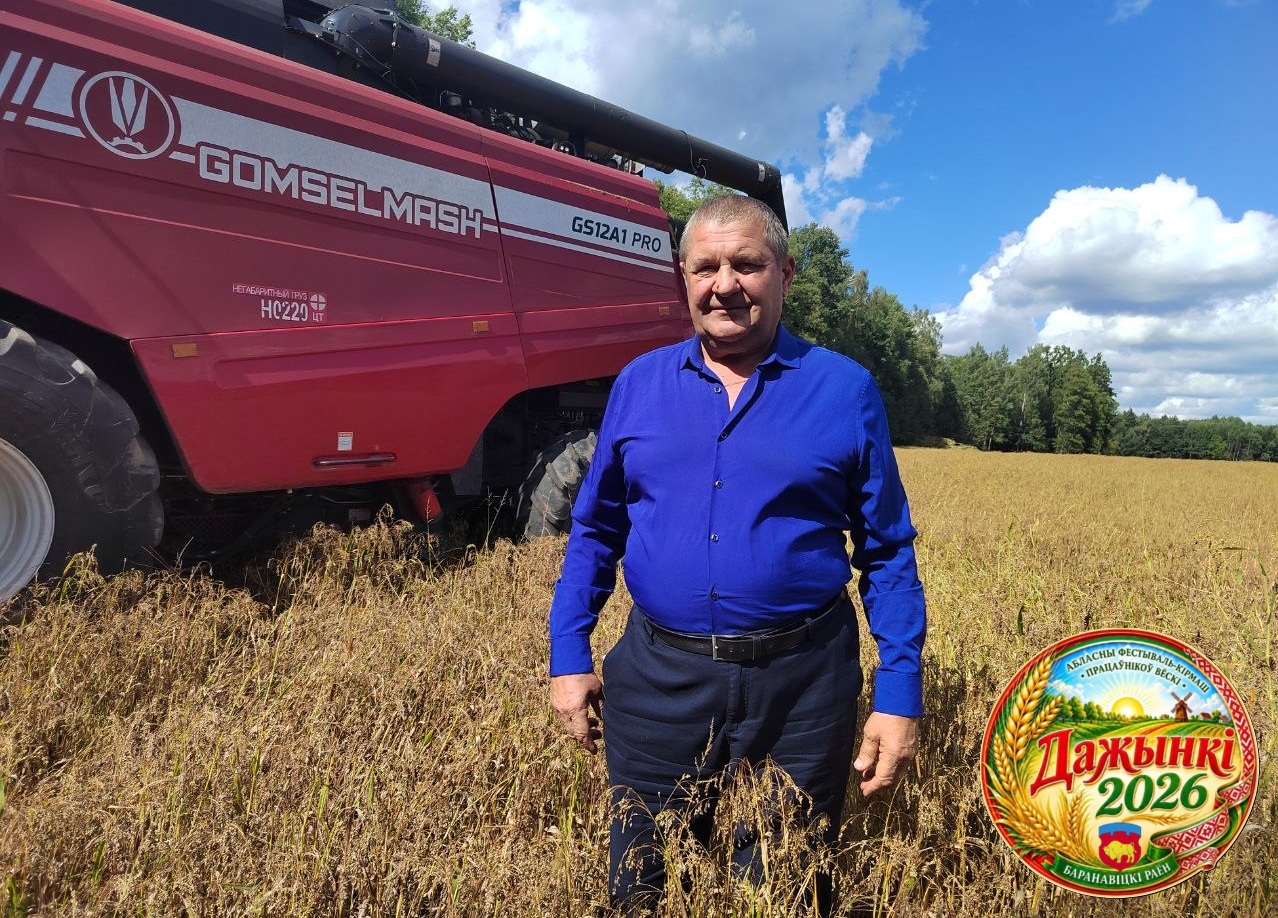
We are talking with the chief agronomist of Druzhba-Agroproduction LLC in Kobrin District to the hum of a combine harvester. While a powerful Gomselmash machine is harvesting millet in the field, Anatoly Dobrinets talks about the current harvesting campaign and plans for the next harvest.
Anatoly Dobrinets has been recognized as the best in Kobrin District three times, and the chief agronomist was also honored at the regional level. This year was no exception. Such impressive achievements are a well-deserved result for a professional who loves his work and has devoted 43 years to it.
Anatoly Nikolaevich was born in the village of Lyadets in the Stolin region. The school graduate had no doubts about his choice of future profession: he saw himself only in agriculture, following his parents' example. He studied to become an agronomist at the Lyakhovichi state farm technical school and arrived in Kobrin District by assignment with honors. He worked as a brigade leader and agronomist at the Pravda collective farm, then "grew" to become the chief agronomist at the already reorganized and renamed agricultural enterprise. Without leaving his job, he graduated from the Grodno Agricultural Institute, and, notably, defended his thesis on flax cultivation with distinction.
Anatoly Dobrinets recalls that his parents instilled in him a love for the land. From childhood he knows the value of bread and how much labor it takes, so he always approaches each new sowing or harvesting with a special feeling. Anatoly Nikolaevich passed on the same respectful attitude toward the work of a grain grower to his two sons and daughter, and his wife Maria Stepanovna understands the intense work schedule of her husband.
About his work he says: it is hard and responsible, but the result is worth it. When the harvest is good, one forgets about the early rises and late returns home, sometimes without days off or holidays. "Everything needs to be done on time: cultivate the land properly, sow the crops, carry out crop care — observe all technological processes. Then you can count on a result. But I don't do all this myself — it's a whole team — machine operators, field workers..." — the interviewee lists, adding: — "Better write less about me, but be sure to mention Alexander Pashchenko, Mikhail Voron, Andrey Davidyuk, Vladimir Moshko, Vitaly Ptushko, Nikolai Nivodchik, Viktor Gorudko, Alexander Dorosh, Dmitry Frankov. Thank our machine operators for their work. I know I can rely on them and everything will be done conscientiously."
This year's harvest also demanded coordinated and diligent work from everyone. Three crews at the farm threshed over a thousand tons of grain. "This year there was a very intense period in spring, when the crops were hit by frost three times. And you need to understand that roughly 70 percent of the farm's land is peatland. We fed the crops with fertilizer – they started growing, then we supported them with micronutrients. As a result, we got a good harvest. We had about 930 hectares, threshed 4,950 tons of grain with a yield of 53.4 centners per hectare. We added 850 tons compared to last year," said Anatoly Nikolaevich.
The agricultural conveyor belt knows no stops: as soon as the harvest campaign ended, the chief agronomist was already thinking through plans for the coming year – the laying of a new harvest was beginning. At the same time, many factors are taken into account – from the prospects of particular crops to the vagaries of the weather.
At OOO "Druzhba-Agroproduction," the winter crop area is about 800 hectares – this includes winter rye, triticale, wheat, and barley. "We have already brought in more than 20 percent of elite and super-elite seeds. We have started sowing winter barley on 100 hectares. We are sowing 300 hectares of winter rapeseed and plan to sow 100 hectares of spring rapeseed – this is a quite profitable crop," adds the chief agronomist.
After so many years working at the farm, Anatoly Dobrinets knows the "character" of every field and has studied every hectare of land inside and out. It would seem that with such impressive practical experience, one could rest on one's laurels, as the saying goes. But he continues to learn new things and introduce modern approaches in his work. "Science does not stand still – new varieties, fertilizers appear, approaches change. To keep up with progress, you need to constantly move forward," the specialist believes.
When asked about the components of success in agronomy, Anatoly Nikolaevich, along with strict adherence to technology and competent crop rotation planning, names love for the land. The chief agronomist of OOO "Druzhba-Agroproduction" is confident: you need to put your heart into what you do. Then the work will bring satisfaction and the land will reward you with a good harvest. And the dreams of this publication's hero are very simple and important: for there to be peace on our land and for the weather to favor the grain growers.
Alyona SATSUTA
Photo by the author