Menu
New Engine and More: We Looked at Lada Niva Legend and Found Out the Prices
On the eve of its 50th anniversary (which will be celebrated next year), the famous Tolyatti SUV was seriously modernized. In total, more than 350 new or redesigned parts and components were introduced. The suspension was refined, ergonomics were improved, some body panels received galvanization, and most importantly, the Niva Legend now has a completely new engine under the hood. Let's examine all the changes during the presentation organized by the official Lada importer in Belarus.
The main novelty
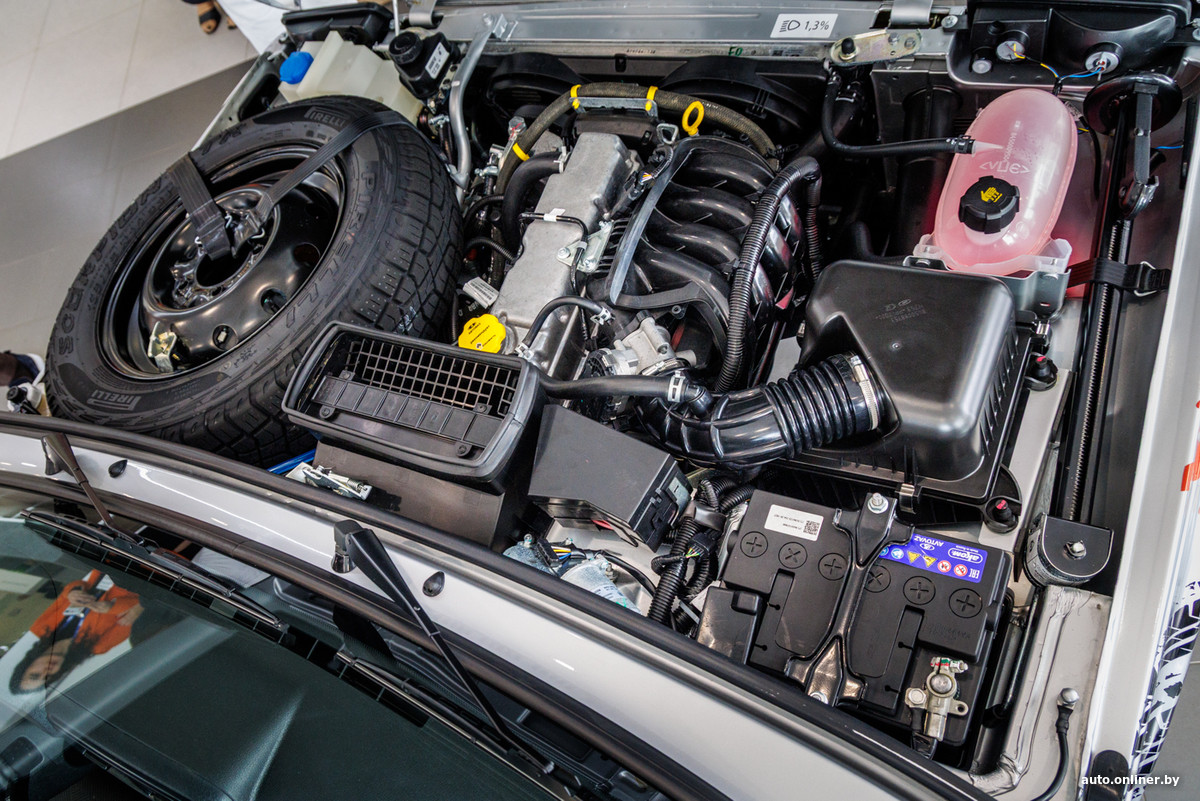
Of course, this is the completely new 1.8-liter 8-valve VAZ-11184 engine, producing 90 hp and 153 N·m of torque, compared to the 83 hp and 129 N·m of its predecessor, which had a 1.7-liter displacement. It might seem like a modest increase—just 11 hp and 24 N·m—but the engine's character has changed. According to the manufacturer, 80% of the torque is available from just 1000 rpm, and specific fuel consumption has decreased by 3–30% depending on the driving mode. The average figure is 9 liters versus 9.9 liters for the predecessor, meaning the new engine is 10% more fuel-efficient.
The introduction of this engine necessitated an original intake and exhaust system, as well as a fuel delivery system. The cooling system was also significantly improved. The Niva Legend received a more efficient radiator. The manufacturer claims the reliability of the fans has been enhanced and their placement has been altered. The crankcase ventilation system was also upgraded.
In the engine compartment, new brackets for several components (gearbox lever, radiator, expansion tank, air filter) have appeared, along with a larger windshield washer fluid reservoir. However, the spare wheel under the hood remains unchanged. Vehicle maintenance has been simplified; for example, changing the air filter is now easier.
Acceleration performance has improved: the car now reaches 100 km/h from a standstill in 15 seconds, compared to 17 seconds for the previous version with the 1.7-liter engine. Consequently, the brakes required modification—the vehicle now features ventilated front disc brakes. It also uses single-piston brake mechanisms, unified with the Niva Travel. The front suspension was modernized. The stabilizer bar was moved forward, which is intended to improve handling and ride smoothness. I hope to soon find out how the updated car drives by taking it for a test drive. For now, let's continue listing the modifications and changes.
The "rejuvenation" program
Do you see the air intake on the hood? This is one of the upgrades to the heating and ventilation system, along with the cabin filter and the brushless motor of the "stove" fan.
They also worked on comfort, ergonomics, and safety.
The exterior hasn't changed significantly, but it's now refreshed with original two-tone 16-inch alloy wheels. The interior features a steering wheel from the Lada Granta, and the steering column now has a tilt adjustment. Accordingly, the column cover has changed. And note the position of the ignition switch—it's now on the right side of the steering column, whereas before, like on the "Zhiguli," it was on the left. The key is now a single unit—previously, there was a separate key for the door locks.
Additionally, there is now one less lever in the cabin for the transmission: controlling the transfer case (engaging the low gear and forced center differential lock) is now done with a single handle instead of two. Shifting gears should also be more convenient—the gear shifter has been moved closer to the driver. The transmission itself was seriously overhauled, featuring new half-shafts for the rear axle, differential satellites, differential side gears, and so on.
During the modernization, they tried to reduce the noise and vibration levels that the Niva has suffered from since its birth. No, there is no talk yet of a new gearbox integrated into a single unit with the transfer case. However, the latter received a third mount, designed to reduce vibrations. To improve acoustic comfort, a molded hood soundproofing was applied.
How the Body Was Upgraded
Finally, this SUV has a driver's airbag. This required modernizing the body's structural frame (additional reinforcements were added under the dashboard and under the driver's feet). Furthermore, for the first time in its history, the Niva received a number of parts made from double-sided galvanized steel. In particular, this includes the front panel, hood, roof, rear door, and rear bumper.
What About the Prices?
The car will be available in four trim levels. The base Classic already includes a driver's airbag, central locking, and power windows, but air conditioning is available only in the higher trims. The price starts at 43,900 rubles without discounts. For now, the previous version with the 1.7-liter engine remains on sale, with prices starting from 36,900 rubles.