Menu
Modernization, professionalism, and innovation: how the work of the Grodno Regional Customs is organized
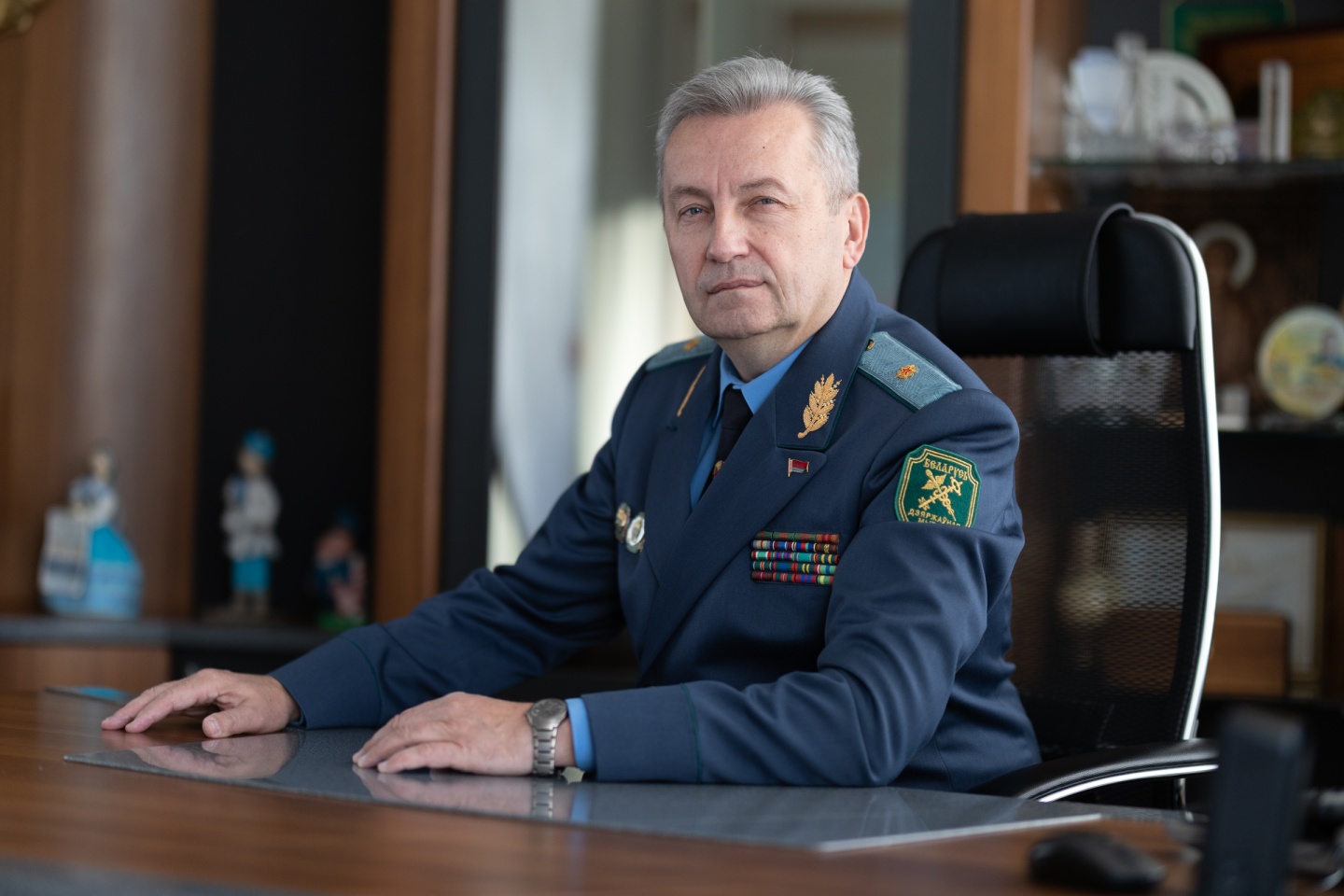
Alexander Pikhun, head of the Grodno Regional Customs: “The history we are proud of. The future we are creating today”
– 35 years is a significant milestone. Behind it lies an entire era of customs service development, the formation of professional traditions, the adoption of new technologies, and, most importantly, the work of several generations of people who have devoted themselves to customs.
For the Grodno Regional Customs, this date holds a special meaning. Our history began much earlier – this year we mark the 81st year of service. Over this time many things have changed: state borders, the economy, the nature of foreign trade, technologies. But the core remained unchanged – responsibility to the state, reliability, and professionalism of people.
Modern customs is a very different service than it was decades ago. It is first and foremost about technology, analytics, digital solutions. We strive to make customs procedures as clear and convenient as possible for those conducting legitimate foreign economic activity, while simultaneously ensuring effective control and protection of the state's economic interests.
Behind every modern information solution, behind every automated procedure, there is still a person – a specialist whose knowledge, experience, and responsibility determine the outcome. Therefore, when we talk about modern customs, we are first and foremost talking about top‑tier specialists.
Today at the Grodno Regional Customs, people of different generations work. Some have devoted decades to service, while others are just beginning their professional journey. And this is very important: the experience of veterans and the energy of young specialists complement each other, allowing us to preserve the best traditions while moving forward.
I am convinced that continuity is one of the main components of our service. We do not merely preserve history – we continue it every day through our work.
New tasks lie ahead, and I am confident that we will meet them. Because we have what matters – experience, a professional team, and an understanding of why we work.
In this anniversary year, first and foremost I want to thank those who created and developed the customs service, who have faithfully served for many years, passing on their experience to subsequent generations.
And of course, to express gratitude to the current employees of the Grodno Regional Customs for their daily work, responsibility, perseverance, and loyalty to the profession.
Continuity of generations, professionalism, innovation
The Customs Service of the Republic of Belarus is celebrating a significant date this year - 35 years since its establishment. Over this time, a significant path of development has been traversed. Today, it is a crucial state institution that ensures the protection of the country's economic interests.
The history of the Grodno Regional Customs dates back to 1945. Today, it is one of the largest in the system of customs authorities. Here, long-standing experience is combined with cutting-edge technologies. Over the past few decades, border crossing points have been consistently modernized: infrastructure has been improved, equipment has been updated, and information systems have been introduced, allowing for the acceleration of customs operations and the enhancement of customs control effectiveness.
The continuity of generations, the professionalism of employees, and the constant improvement of work enable the Grodno Regional Customs to keep pace with the times.
The recent history of the Grodno Regional Customs began after the Republic of Belarus gained sovereignty. A significant milestone was September 20, 1991, when the State Customs Committee of the Republic of Belarus was established. At that time, it consisted of four customs offices: Minsk, Grodno, and two in Brest - Brest and Western Bug.
In late 1991, the process of creating customs infrastructure began. New customs offices were established on the border with Lithuania - Ostravets, Oshmyany, and Voronovo. On October 27, 1992, the Grodno Customs was reorganized into a regional one, and by December, it already had 7 customs posts: "Bruzgi", "Berestovitsa", "Privalka", "Lida", "Svisloch", "Porechye", and "Obukhovo".
Over the past three decades, new border crossing points have been opened, new departments have been created, and customs offices have been reorganized. After the Oshmyany Customs joined the Grodno Regional Customs in 2017, it became one of the largest in the system of customs authorities. Today, the Grodno Regional Customs consists of 16 republican customs clearance points (7 road, 6 rail, 2 river, and 1 air), 4 departmental customs clearance points, and 25 basic departments.
Expansion of Infrastructure
During the years of independence, the customs system has been actively modernized, and modern infrastructure that meets international standards has been created.
Over the past few years, the border crossing points "Privalka" was reconstructed and modernized in 2014, "Bruzgi" in 2020, "Kotlovka" and "Benyakoni" in 2022.
The simplified border crossing point "Loshka" acquired the status of a republican customs clearance point in 2017, and in 2024, its reconstruction was carried out.
By the 80th anniversary of the Grodno Regional Customs in February 2025, the reconstruction of the "Berestovitsa" border crossing point was completed.
In the near plans is the reconstruction of the "Kamenny Log" border crossing point, which will begin this year and is expected to be completed by 2029. The work will be carried out in stages, without stopping the movement of transport. It is planned to increase the number of lanes (channels) for passing vehicles through the border. The throughput capacity will increase threefold and amount to about 6 thousand cars per day.
In the immediate vicinity of the border crossing points "Bruzgi", "Berestovitsa", "Kamenny Log", "Benyakoni", transport and logistics centers have been built, which allows for their effective use for customs clearance of goods near the border.
Waiting Areas
Special attention is paid to creating conditions for citizens waiting to cross the border.
"In all border crossing points of the Grodno Regional Customs, an electronic queue system operates, and waiting areas have been built," said Konstantin Trotsiuk, First Deputy Head of the Grodno Regional Customs. "The possibility of remote registration for passenger vehicles has been provided. This service is in high demand among citizens, with more than half of users registering remotely. You can do this without leaving your home or car, and after receiving a notification, arrive for border crossing."
In addition, from January 1 of this year, a service for booking a border crossing date has been introduced for passenger cars, and from April 1, for trucks. Booking can be done on site or online.
Innovations in Work
In the border crossing points of the Grodno Regional Customs, modern equipment has been installed, and systems have been introduced that contribute to the acceleration of customs control operations.
The process of clearing goods and vehicles is focused on using electronic forms of clearance and automatic release. In 2015, the first batch of goods was automatically released under the customs transit procedure at the republican customs clearance point "Bruzgi-2".
Since 2010, electronic prior notification of imported goods has been implemented in customs authorities. Initially, notification was applied when importing goods by road and rail, and since 2014, it has become available to individuals. From 2024, the customs authorities of Belarus were the first in the Eurasian Economic Union to introduce an electronic passenger customs declaration.
"The customs authorities have switched to remote clearance of goods at the Electronic Declaration Center. Within the framework of the EDC, customs operations related to the placement of goods under customs procedures for release for internal consumption, temporary import, customs warehouse, re-export, and export are carried out," says Konstantin Leonidovich. "The EDC allows for the even distribution of declarations on goods between customs clearance points. This significantly reduces the time it takes to release goods. Moreover, for the convenience of business entities, customs clearance points operate at the Center, including in a round-the-clock mode."
From manual control to modern technologies
A significant part of the work is helped by modern technical means of control. One example is inspection and inspection complexes for scanning cargo and passenger vehicles. All customs clearance points located in the zone of activity of the Grodno Regional Customs are equipped with them. In addition to stationary complexes, 5 mobile inspection and inspection complexes are used. In 2025, new mobile complexes manufactured on the basis of the Minsk Automobile Plant were purchased for the Belarusian customs authorities, one of which is used in the Grodno Regional Customs.
The use of inspection and inspection complexes significantly reduces the time spent on customs control. On average, 10-15 minutes are spent on scanning, studying the scan, documents, and releasing the vehicle. The application of this technology makes it possible to detect even in the most hard-to-reach places goods that are being moved illegally.
At the same time, scanning does not mean that every cargo undergoes physical inspection. Specialists analyze the obtained image, compare it with information from documents, and assess possible risks. Further control measures, including cargo inspection, are only carried out if signs of violations or other grounds are detected.
From electronic customs to intelligent customs
The Belarusian customs service is moving to a new stage of digital development. For 2026-2030, the implementation of the "Intelligent Customs" project is planned. The new project is a key vector for the development of customs authorities in the Republic of Belarus, aimed at large-scale digitalization, automation of clearance processes, and transition to digital control in real-time.
Digital transformation includes two key tracks: the use of artificial intelligence systems (in particular, machine vision) and analytics based on big data.
- New technologies will allow processing significant amounts of information, improving risk management, and increasing the effectiveness of customs control, - noted Konstantin Trotsiuk. - But at the same time, the final decision still remains with the customs officer.
Prepared by Tatyana Mostovskaya, Tatyana Kuznetsova