Menu
"Buying at 3.4 and selling at 2.7 is very irrational." Alpha Bank on sanctions and more
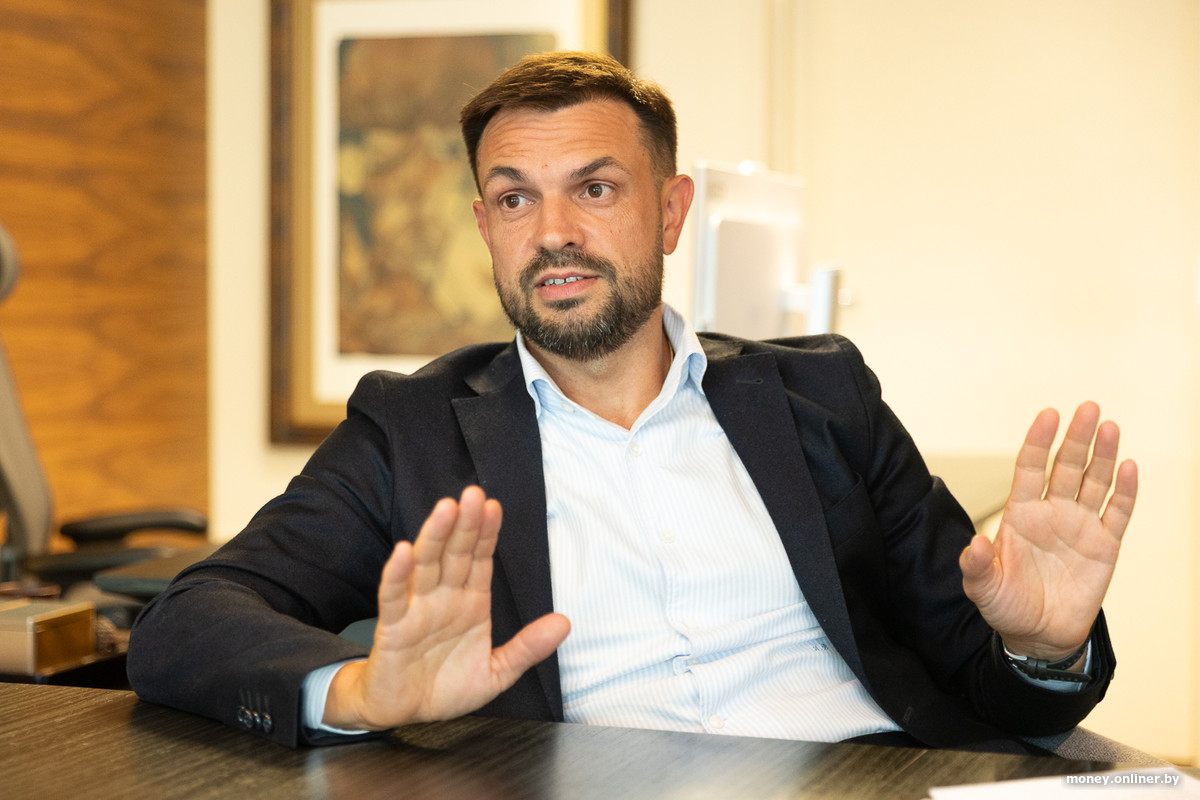
"Buying at 3.4 and selling at 2.7 is very irrational." Alpha Bank on sanctions and more
Author: Olga Lenskaya. Photo: Vlad Borisevich
Add to main sources Google
"My son is eight. We were abroad recently, and he pointed at a price sign and asked me, 'How much is that in Belarusian rubles?' — you know? Our new generation no longer thinks in dollars," says Alexander Bobko, the new chief executive officer of Alpha Bank in Belarus. According to our interviewee, in recent years Belarusians have lost interest in this currency, but does that mean new reliable ways of saving have emerged? In the interview with Alexander we talk not only about currency: the bank is under sanctions, cards don't work in Europe, the app initially required geolocation, then it was removed from the App Store, and the client base, according to the bank, is still growing. How? The interviewee explains why this happens, what complaints the bank responds to with product improvements, why it sends clients to the bank, what will happen with the web version of the app (PWA) for iPhone owners, and how the bank’s strategy looks for the coming years.
"The leader should not be the smartest in the room"
— In your new role you’ve only been here a couple of months and you’re already giving interviews. How well do you know the bank from the inside?
— I’ve been in the banking system since 2004, starting as a student. Back then the EBRD was actively supporting small business — they needed people with an unshackled, flexible mind. I turned out to be such a person and began working with small business. My career then unfolded in such a way that I built processes from scratch in several banks, until 13 years ago I ended up at Alpha — here too I had to launch a new small‑business line. Later I switched to retail. So I know the bank inside and out, and I’ve known it for a long time.
— What kind of leader are you? What can subordinates expect?
— The team decides, that’s for sure. I’m not the type who has to be the smartest in the room. If a boss is convinced that he knows everything better than everyone else, he won’t have the breadth of vision for sound decisions. When every member of the team is a strong expert in their field, you have a full palette of opinions at your fingertips — you can make balanced decisions.
This doesn’t absolve the leader of responsibility, but he definitely needs a team that helps, not just executes orders.
— You don’t fire people for uncomfortable questions?
— On the contrary, I welcome it. This is, by the way, a big problem: few people are ready to ask uncomfortable questions. I try to encourage that. And to fire someone, you need serious reasons. Usually I give a second chance, even if an employee really messed up.
But if I see that a person is a great expert, an excellent specialist, but at the same time toxic and unable to work in a team, I won’t work with them. In the end they will undermine the whole team’s work.
— What falls within your sphere of influence? What are your daily tasks?
— I talk to people — that takes up 90% of my time. Probably that’s the main task of any manager. I also answer for the bank’s well‑being as a business, shape understanding of what we do and where we’re headed. I remove barriers between teams if they arise. If you look at my day, communication is the foundation. So when my kids ask what I do at work, I say: I talk.

“We’re all here under the same conditions”
— In December 2025 Alfa Bank in Belarus, like several other banks, fell under the EU’s 19th sanctions package. Did you expect that?
— We’ve been preparing for such a scenario since 2022. In Russia it’s simple: all major banks got hit with sanctions at once. In Belarus it was different: some banks were sanctioned much earlier. Alfa Bank wasn’t under sanctions for a long time, so we had a plan B, C, and D, if you want.
— What does plan B consist of, which, if I understand correctly, is being implemented now?
— We had the opportunity to assess how sanctions affected other banks and figure out what to do so that our clients hardly notice anything.
— Which services have clients stopped receiving because of sanctions?
— Yes, our cards don’t work in Europe. But they work in other countries. Many counterparties simply refuse to work with Belarus on a country basis. So all banks here are roughly in the same situation. Clients aren’t leaving us. Since 2022, our client base has grown more than twofold.
— And the bank’s financial performance as a business?
— The same: after the European sanctions package we still see growth. Every month we get many new clients. I’m sure many banks in Belarus don’t know such an influx. We’re chosen for our digital solutions, for simplicity, for convenience.
Yes, some things are currently unavailable — for example, Apple Pay
— Not yet, but we have grand plans. The global trend suits us, especially since there are still a few months left in the year.
— How exactly have the sanctions affected ordinary people who receive their salaries onto your bank's card?
— We see our clients' transactions and can compare periods. We see that the majority of our clients spend money in Belarus, and only a small portion of transactions go abroad.
An ordinary person who receives a salary in Belarusian rubles and spends it in Belarus does not experience any difficulties.
«Those who are satisfied are significantly more.»
— How many users does the INSNC mobile app have on iOS and Android right now?
— The distribution roughly matches market statistics on device ownership: about 40 to 60. Although four or five years ago our iOS share was higher than the market average. Now the numbers have evened out.
— In early July, the App Store revoked the certificates for INSNC, and since then the app has been unavailable for download on iPhone. The bank recommends the web version to iPhone owners. But people complain that it is inconvenient, hangs, and lacks features. What are you doing about it?
— For iOS users we have a web version, or a PWA app. People are already using it, even though it looks unfamiliar. Complaints do exist, but those who are satisfied are significantly more. That doesn't mean we are doing nothing. Our goal is to bring the PWA's visual design and functionality in line with the overall look of the mobile app.
The PWA version has all the basic functionality, although it may lack familiar “buttons.” We understand that a native app is much more convenient. But for now the real working version of INSNC is the web version.
If you follow the news, Yandex Pay was also removed from the App Store —
— What do users complain about in the web version?
— Strangely enough, it’s mostly about UX: people find the navigation unfamiliar. I repeat: all the basic functionality is available in the web version. You can make a transfer, issue a card, make a payment, take a loan, view transaction history. But people are used to us providing more than just the basics.
— Are there any user questions about the security of the web version?
— No one has doubts about its security. After all, it’s not even a new channel to the bank. All protocols are observed.
— Do you measure the level of trust in the bank and its individual services?
— Of course. We annually measure the Net Promoter Score (NPS), and we dive deeply into research on specific areas. The NPS itself has risen significantly over recent years.
Customers note high satisfaction with our products, service (especially loans and cards), and the competence of call‑center and branch staff. Moreover, we always ask customers how convenient they find the new services, and we do a lot based on that feedback. If we see, say, 2,000 support messages saying something is unsatisfactory, the product goes into refinement. If it’s only 10 out of 200,000, it’s more of an exception—we provide personal explanations.
Sometimes we even ban clients, but rarely: when they cross lines, act aggressively, curse, etc.
— Your bank has an interesting position—client advocate. What role do these people play?
— Their job is to understand why a particular problem arose: whether it was an employee error, a client mistake, or a process failure. For example, a client deposits money into an ATM, but it doesn’t credit the account. This happens rarely, but it does, and the investigation usually takes some time: you need to review cameras, send in the cash, check logs. Clients complain: they’re not at fault, yet we created problems for them out of nothing. Then the client advocate looked at the process and suggested: first refund the money, then investigate. We accepted that as a risk and potential loss. But, you know, there has never been a case where a client deceived us.
Such changes that truly help people are personally very
— Alpha Bank was the first in Belarus to announce that users would need to provide geolocation to access the app. How does this help protect money? And who is responsible for safeguarding personal data?
— We released the news before anyone else because we didn't want to surprise customers on July 1. We needed the transition to go as smoothly as possible. We told people: guys, here's what will happen, turn on geolocation. Naturally, we received backlash: people thought we were passing data to someone.
We consciously took this risk. Support load increased, there were hundreds of comments: people were outraged, thinking it was solely our initiative and that we were collecting data for unclear purposes. They said, “someone will be watching me, who I am and what I do.” At some point, the National Bank saw the wave and also gave detailed comments. Then other banks joined in.
What does knowing your geolocation give us? Starting from a distance: the problem of fraudsters is very relevant, and they constantly evolve. In the past, it was keypads on ATMs, but today it's pure social engineering, where you're convincingly asked to give your data, and then they can do anything with your money.
The advantage of digital banking is convenience. The flip side is the possibility of stealing money.
Therefore, global anti‑fraud practices are also evolving.
What does a person do when they're scammed? First, they call the bank: “Everything, I've been scammed, save me.” And we look and see that they transferred the money themselves. Therefore, from the perspective of the evolution of anti‑fraud measures in many countries, and now here as well, a digital fingerprint of your device is created, and geolocation is part of it. We're definitely not inventing a wheel. And it's important to note again that the bank will not disclose this data to anyone. I think this fear is somewhat irrational.
In fact, geolocation is one of more than 20 parameters we analyze. Over roughly six months, we had to learn to collect information about the phone model, operating system, and other data.
All of this is needed so that banks can confirm at the hardware level that you are the one making the transaction, not a fraudster who has gained access to your data.
We need to translate the Russian fragment into natural English, preserving paragraph breaks, not translating URLs or proper nouns. Output only the translation.
Let's translate.
Paragraphs:
-
"Например, вы в Минске, только что оплатили покупку или подтвердили вход в приложение, а через 10 минут платеж пытаются провести из ЮАР — система это видит. Мы сопоставляем параметры и выявляем аномалии. Если система замечает отклонение, например вход с необычного устройства или из другой страны, мы можем запросить дополнительное подтверждение — скажем, SMS-код. При этом есть разные уровни риска: зеленая, желтая и красная зоны."
-
"Если человек уехал в командировку и оплачивает покупки картой в другой стране, блокировки не будет. Мы просто попросим подтвердить еще один параметр, максимум — код через SMS. Случаев, когда реального клиента блокировали из-за поездки, не было. Это очень демонизированная история."
-
"И важно понимать: банки собирают и обрабатывают ваши параметры сами. Мы никуда и никому их не передаем."
-
Image line: "
 " – we keep as is (not translate). Should we keep the markdown? The instruction: "Do not translate the article link, url, or any proper nouns you cannot render." The image line includes alt text in Russian "фото". Should we translate? It's not a proper noun; it's just description. The rule: "Do not translate the article link, url, or any proper nouns you cannot render." It doesn't forbid translating alt text. But we might keep as is? Usually we translate everything except URLs. The alt text is not a URL, it's just text. I'd translate it to English:
 . However the instruction says "Do not translate the article link, url, or any proper nouns you cannot render." It doesn't say not to translate other text. So we should translate the alt text. But we need to keep the markdown syntax? The fragment includes markdown image syntax. We should preserve it but translate the alt text. So:
-
Then a quote: «Купить по 3,4, а продать по 2,7 — это очень нерационально» — translate to English quotes? Usually we keep the quote marks as is? The instruction: "Do not translate the article link, url, or any proper nouns you cannot render." The quote marks are not proper nouns. We can translate the content inside. Use English quotation marks? Probably keep the original guillemets? Safer to translate the content and keep the guillemets? The instruction didn't say to keep punctuation. I'd translate the sentence and keep the guillemets as they are part of the original text. But we could replace with English quotes. I'd keep the guillemets as they are not URLs. I'd translate inside: "Buy at 3.4, sell at 2.7 — that's very irrational". Keep guillemets? I'll keep them.
-
Then a dialogue:
"— Какие изменения в сберегательном поведении белорусов вы наблюдаете?
— Каждый месяц мы видим рекордные остатки в белорусских рублях на счетах. Что это значит? Допустим, у вас есть счет, на котором просто лежат деньги. Мы называем это остатками на текущих счетах. А есть депозит — когда вы положили деньги под проценты на какой-то срок. В динамике растут и текущие остатки, и депозиты.
Остатки на счетах в иностранной валюте и депозиты в валюте уменьшаются — помимо прочего, потому, что там, условно, нет ставок.
Некоторые банки, и мы в том числе, когда-то вообще брали плату за остатки на валютных счетах. Мне понятна эта «родовая травма» белорусов: каждый месяц или каждый новый год надо покупать доллары. Так было, потому что курс все время рос. Но последние два года сильно поломали тренд. Раньше ты понимал, что он рано или поздно вырастет, сейчас же гарантии нет. Можно было купить по 3,4, а продать по 2,7, и это очень нерационально.
Мы видим, что сейчас люди в основном рассчитываются в белорусских рублях. Это возвращает нас в нормальную цивилизованную историю, когда остатки валюты у населения снижаются. На мой взгляд, причина еще и в том, что доллар тоже девальвируется, его покупательная способность падает."
-
Another image line: "
 " translate alt to photo.
 -
Then final question: "— Как посоветуете белорусам хранить деньги?" translate.
We need to preserve paragraph breaks. So each block separated by blank line.
Let's produce translation.
Be careful with numbers: "по 3,4" means "at 3.4". In English we use decimal point. So "buy at 3.4, sell at 2.7". Keep commas? Use period.
Now translate.
Paragraph 1:
"For example, you are in Minsk, you have just paid for a purchase or confirmed login in the app, and ten minutes later someone tries to process a payment from South Africa — the system sees this. We compare parameters and detect anomalies. If the system notices a deviation, for example a login from an unusual device or from another country, we can request additional confirmation — say, an SMS code. At the same time, there are different risk levels: green, yellow, and red zones."
Paragraph 2:
"If a person is on a business trip and pays with a card in another country, there will be no block. We will simply ask to confirm one more parameter, at most — an SMS code. There have been no cases where a real client was blocked due to travel. This is a very demonized story."
Paragraph 3:
"It is also important to understand: banks collect and process your parameters themselves. We do not transfer them anywhere or to anyone."
Image line: translate alt: ""
Paragraph with quote:
«Купить по 3,4, а продать по 2,7 — это очень нерационально»
Translate inside: "Buy at 3.4, sell at 2.7 — that's very irrational". Keep guillemets? I'll keep them: «Buy at 3.4
— Obviously, Belarusians have once again come to believe in the Belarusian ruble. Even over a long horizon, investing in ruble deposits is more profitable than in foreign currency. That's a fact. And the last two years have shown just how much more advantageous it is.
However, despite the high yield of ruble deposits, from a personal finance management perspective it is best to diversify assets. In a nutshell, you should keep money in different “baskets,” allocating funds among ruble deposits, foreign currency, and other instruments. This approach not only maximizes returns but also reduces risks associated with potential currency fluctuations or changes in interest rates. In the end, diversification helps ensure a more stable and protected financial outcome.
— How much vr