Menu
How to set up a student's workspace to preserve posture and vision: doctors' recommendations
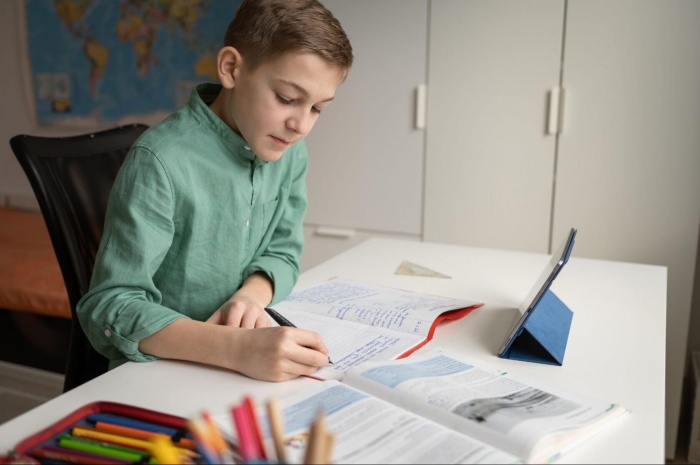
An improperly chosen desk, slouching, and long hours sitting at a computer can affect not only a child's grades but also their health. Belarusian doctors have explained how to organize a student's home workspace to reduce strain on the spine and eyes.
The desk and chair should "grow" with the child
The main rule when choosing furniture is that it must match the child's height. The child should sit so that their feet are flat on the floor, and the angles at the knees, hips, and elbows are approximately 90 degrees.
"It is important that the elbows are above the level of the desk, and the feet are fully on the floor. If the student's height does not yet allow them to lower their feet to the floor, a special footrest can be used," said orthopedic traumatologist Artem Simonenko.
The specialist advises choosing adjustable desks and chairs. This will allow the height of the furniture to be changed as the child grows, preventing excessive strain on the lower back, neck, and shoulders.
The chair should have a backrest that supports the lumbar and thoracic spine. At the same time, a seat that is too soft is not suitable: the child should not sink into it and lose proper body posture.
"The lower back and buttocks should be in tone," noted Artem Simonenko.
Pediatric orthopedic traumatologist Yulian Putik explained in detail how to seat a child at a desk.
"It is essential that the chair has a backrest: we sit as close to it as possible, and the chair is moved closer to the desk. It is important that the legs do not dangle; they should reach the floor or have a special platform under them. The feet must be at a right angle," the doctor noted.
The doctor advises not to overload the work surface. If there is enough space on the desk for both hands and elbows, it is easier for the child to maintain proper posture and not twist while writing.
The specialist separately warns against the independent use of posture correctors. According to him, without a doctor's prescription, such devices can weaken muscles. A corrector is usually needed for injuries or specific medical indications.
Breaks are needed every hour
Even a properly organized workspace does not eliminate the need for movement. According to the orthopedist, after 45 minutes of study, the child needs to take a 10-15 minute break: stand up, walk around, and do a few simple exercises.
Long periods in one position increase the load on the spine and can contribute to the development of posture disorders. Doctors note that the first signs of problems sometimes appear as early as 5-7 years of age, with adolescence being a particularly vulnerable period.
We studied for 45 minutes straight, then walked for 10-15 minutes, rested – and we can return to lessons again," the specialist explained.
During the break, it is useful to do a few bends, stretch, walk, or perform exercises to strengthen the back muscles. As options, the doctor mentions the reverse plank, "boat," and hyperextension.
How to prevent scoliosis
For preventing posture disorders, not only furniture and seating are important, but also regular physical activity. Ilya Kravtsov, a traumatologist-orthopedist at the 25th City Children's Polyclinic in Minsk, recommends swimming and bodyweight exercises.
"Among strengthening methods, we offer the pool twice a week, bodyweight exercises: pull-ups, push-ups, abdominal work, plank,
Even if a child takes a break from studying, you shouldn't immediately give them a phone. Victoria Krasilnikova, the chief external pediatric ophthalmologist at the Ministry of Health, notes that proper rest for the eyes involves changing the type of activity.
“A break implies switching visual strain to another activity. Physical activity is an effective means of preventing the development of myopia,” noted the specialist.
When working at the table, it is important to consider not only the height of the furniture but also the position of the legs, back, and arms. Pediatric trauma orthopedist Yulyан Putik advises placing a platform under the child's feet if they do not reach the floor, and not cluttering the table with unnecessary items.
This way, the workspace will help the schoolchild maintain proper posture, and regular breaks, walks, and check-ups with an ophthalmologist will reduce the strain on vision.
Computer – by time
Computer work also needs to be limited. The Minsk City Center for Hygiene and Epidemiology notes that for school-age children, continuous visual strain should be alternated with rest, and the time spent in front of the screen