Menu
How to choose waterproof laminate for the kitchen, hallway, and other rooms
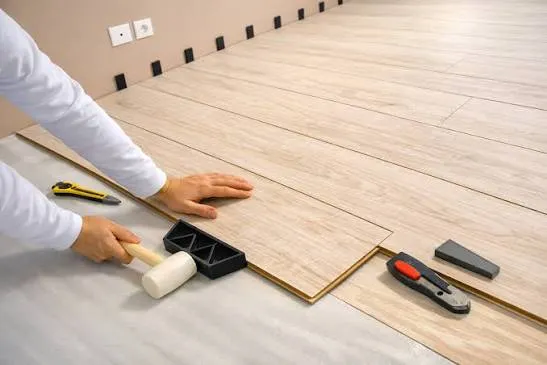
Fragment 1/3
When renovating rooms with high humidity, many plan to buy waterproof laminate in Minsk, expecting beautiful coverage with tile-like practicality. However, simply having a designation like Water Resistant or Aqua in the name is insufficient. It is important to find out exactly how the manufacturer protects the base and joint connections, how long water contact is permitted, and whether the warranty covers use in the kitchen or bathroom.
How does the waterproof option differ from ordinary?
A classic laminated floor has a wood-fiber base that is sensitive to prolonged water exposure. In special series, more dense moisture-resistant HDF boards, protected joints, and hydroprotective surface treatment are used. For example, the EGGER Aqua+ technology combines a special load-bearing board and protected joint connection, while individual collections are claimed to be resistant to water for up to 72 hours.
Quick-Step uses the HydroSeal coating, which protects not only the surface but also the area around panel joints. Pergo also applies top-layer sealing and edge banding and provides separate warranty conditions for spaces where liquid contact is possible.
Therefore, when comparing, one should look at technical specifications rather than advertising names.
Where such covering is particularly useful
High moisture resistance is relevant where household spills or wet cleaning occur regularly. Such zones include:
- Kitchen
- Foyer
- Corridor near the entrance
- Room next to a balcony or terrace
- Individual living areas
- Bathroom, if the manufacturer explicitly permits such installation.
Some series are indeed allowed for kitchens and bathrooms, but installation conditions may require mandatory sealing of compensation joints and adjacent areas. This is explicitly provided for in Pergo's warranty requirements for wet rooms.
One should not automatically consider any water-resistant covering suitable for a shower zone or a room with drainage under the floor. Manufacturers may exclude saunas, showers, and other areas with constant or intensive water exposure.
Key characteristics to check first
Before purchasing, it is helpful to study the technical passport. Attention should primarily be paid to several parameters:
- The declared water resistance duration
- The type of load-bearing board
- Protection of the joint connection
- Warranty conditions for wet rooms
- Operating class
- Board thickness
- Compatibility with warm flooring
If the manufacturer claims specific 24, 48 or 72 hours of durability, one must read under what conditions this result was obtained. For example, EGERG indicates 72-hour protection for several Aqua+ series thanks to the combination of special base and lock.
How to choose load class
Water resistance does not replace wear resistance. A floor can well withstand random spills but be insufficiently designed for heavy foot traffic.
For apartments, class 32 or 33 is more commonly considered. The first suits most living rooms, while the second provides greater margin for entryways, kitchens and other frequently used areas. Both options appear in water-resistant series; for example, the technical specifications of Aqua+ provide an operating class of 32 and compliance with EN 13329.
Match the choice of thickness with actual load, rather than striving for maximum values in all rooms.
Thickness matters
Thickness affects board stiffness, walking feel and floor height requirements. Panels around 8-
A large, wide board is better showcased in a spacious interior, while a calmer pattern is convenient for compact rooms.
Don't forget about preparing the base.
Even a water-resistant collection cannot compensate for poor installation. The base must be level, dry, and sturdy. Before installation, you must follow the manufacturer's requirements regarding height differences, underlayment, and expansion gaps.
If the flooring is being installed in an area with increased humidity, the following may additionally be required:
- Vapor barrier
- Perimeter sealing
- Special sealing cord
- Waterproof sealant near walls and doorways
These requirements are directly included in the instructions of individual manufacturers to preserve the warranty for use in wet rooms.