Menu
Which winter tires are chosen in Belarus? Rating by orders for 2026
GUIDE
Which winter tires are chosen in Belarus? Rating by orders for 2026
Winter tires are already in seasonal demand. We looked at which models are most often purchased in the Onlíner Catalog, which sizes are currently the most popular, and what to pay attention to before buying. At the same time, we figured out the tread patterns, studs, age of the tires, and the requirements of the Belarusian traffic rules. In particular, whether it is possible to drive on all-season tires in winter - and if so, on which ones exactly.
Which tires do Belarusians buy most often
The most purchased winter tires in 2026
The most purchased sizes of winter tires
What to pay attention to when choosing tires
What kind of tread pattern is there
Scandinavian and European type of tires - what is the difference
Studs: is there a point in Belarus
Tire production date: what is important to know
What are the requirements for winter tires in Belarus
Is it possible to drive on all-season tires in Belarus in winter
When to switch to winter tires
This guide has already been published on Onlíner. In the fall of 2026, we updated it - added a fresh rating of popular winter tires and up-to-date statistics of purchases in the Catalog.
The most purchased winter tires in 2026
Let's start with the sales statistics in the Onlíner Catalog. Here are the models that are most often chosen this season:
Belshina Artmotion Snow HP Bel-517 225/65R17 106H
Belshina Artmotion Snow Bel-317 205/55R16 91T
Belshina Artmotion Snow HP Bel-494 225/60R18 100H
Belshina Artmotion Snow Bel-277 205/60R16 92H
Cordiant Winter Drive 2 SUV 215/55R18 99T
Belshina Artmotion Snow Bel-337 195/65R15 91T
Belshina Artmotion Snow Bel-287 185/65R15 88T
Ikon Character Snow 2 SUV 225/55R18 102R XL
Belshina Artmotion Snow Bel-297 205/65R15 94T
Hankook Winter i*cept iZ3 W636 205/55R16 94H
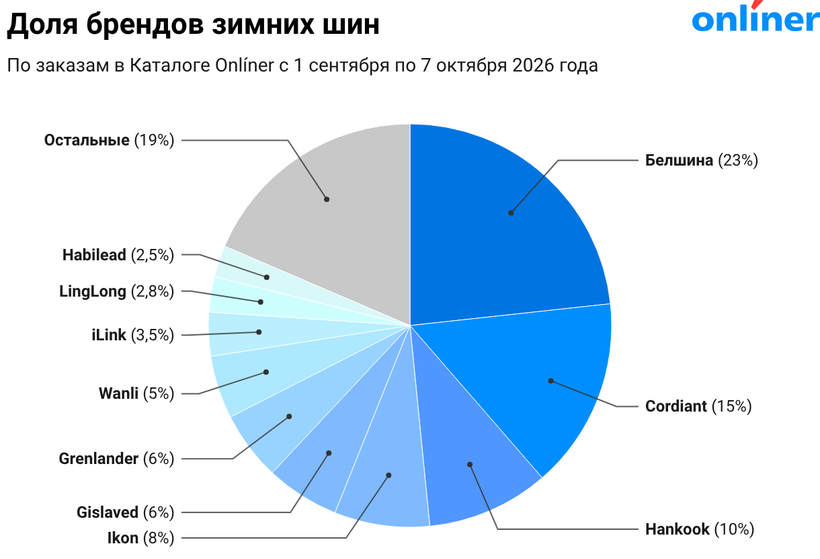
According to the statistics of the Onlíner Catalog, Belshina has retained its first place and increased its share from 14.9% to 23.3%. Now, almost every fourth order for winter tires is for this brand. Cordiant follows next, which was fifth last year and has now risen to second place. Its share has grown from 9% to 15.3%. Hankook has risen to third place, which was ninth last year. Its share has increased from 4.1% to 9.8%. Ikon has made an even more noticeable gain, moving from 19th place to fourth, and its share has grown from 0.7% to 7.6%. Both manufacturers have received more orders than during the same period last year.
Several of last year's favorites have seen their positions weaken. Gislaved has dropped from third place to fifth: its share has decreased from 10.5% to 5.9%. Grenlander has moved from second place to sixth, losing more than half of its share — from 12.7% to 5.5%. iLink's indicator has fallen from 8% to 3.5%. The most drastic change is for Goodride: instead of fourth place, it now occupies twentieth, and its share of orders has decreased from 9.8% to 0.5%.
Top 10 brands
Belshina Cordiant Hankook Ikon Gislaved Grenlander Wanli iLink LingLong Habilead
Most popular winter tire sizes
The most popular size remains 205/55 R16, accounting for 8.6% of winter tire orders in the Onlíner Catalog. However, there are changes further down the list. Compared to the same period last year, the 215/55 R18 size has risen from fourth place to second, while the 185/65 R15 size has retained its third place. Last year's "silver medalist," the 195/65 R15, is now in sixth place: its share has decreased from 7.8% to 4.9%.
In general, buyers are more often choosing tires with a larger diameter. Sizes R18 and above now account for 41.4% of orders, compared to 34% last year. If orders are combined by wheel diameter, R18 has become the leader, pushing R16 into second place. In particular, the share of 225/60 R18 has grown from 3.7% to 5.2%, and the share of 225/55 R18 has increased from 2.7% to 4.9%.
205/55 R16 215/55 R18 185/65 R15 225/60 R18 205/60 R16
Below are the best-selling tires for the three most popular sizes.
Rating
205/55 R16 215/55 R18 185/65 R15
Belshina Artmotion Snow Bel-317 91T Cordiant Winter Drive 2 SUV 99T Belshina Artmotion Snow Bel-287 88T Hankook Winter icept iZ3 W636 94H Gislaved ArcticControl 99T Belshina Artmotion Snow Premium PW-104 92H Cordiant Winter Drive 2 94T LingLong GreenMax Winter Ice I-15 SUV 99S Hankook Winter icept iZ3 W636 92T Gislaved ArcticControl 205/55R16 94T Hankook Winter I*cept X RW10 215/55R18 95T Cordiant Winter Drive 185/65R15 92T Wanli SW312 205/55R16 91T Wanli SW312 215/55R18 99S XL Cordiant Winter Drive 2 185/65R15 92T
What to pay attention to when choosing winter tires? Let's break down the basic questions: what types of tires are there by tread pattern, how do Scandinavian and European models differ, how important is the year of manufacture, and what requirements does the traffic police have for winter tires? By the way, pay attention to the markings — perhaps your tire does not meet the current rules, and you didn't even suspect it.
What types of tread patterns are there
There are three options: directional symmetric, non-directional symmetric, and asymmetric. Let's briefly explain how they differ and which one is suitable for whom.
Directed Symmetric
This tread pattern can be easily recognized by its V-shaped or arrow-like design. It effectively drains water and slush from under the wheel, reducing the risk of aquaplaning and helping the vehicle stay on course on wet or loose roads. These tires are particularly well-suited for highways and winters with frequent thaws. The downside is that they can only be installed strictly in the direction indicated by the arrow on the sidewall, otherwise, all the advantages are lost.
The most straightforward and "carefree" option is the nondirected symmetric tread pattern. The design is the same across the entire surface, so these tires can be installed in any direction and swapped freely, which extends their lifespan. They are cheaper, work more quietly, and are suitable for those who primarily drive in the city, without high speeds and snowy adventures.
Asymmetric
The inner part of the tire is responsible for traction and water drainage, while the outer part is responsible for stability during turns. This results in a compromise: comfort, handling, and safety all in one package. Such tires are more commonly found in mid-range and premium brands. The main thing is not to mix up the sides during installation: the "outside" label should face outward.
What to Choose?
If you often drive on highways or on slushy roads, directed tires are the best choice. For calm city driving and economy, ordinary nondirected symmetric tires are suitable. And if you want both reliable traction and good handling during turns, asymmetric tires will be the optimal choice.
Scandinavian and European Tire Types - What's the Difference
Winter tires are classified not only by their tread pattern but also by the type of winter conditions they were designed for. The two most common approaches are Scandinavian and European. The difference lies in the softness of the rubber, the structure of the tread, and how the tire behaves on snow, ice, and wet asphalt.
Scandinavian Type
These tires are designed for real winter conditions with deep snow and ice. They have soft rubber and large lugs that literally "bite" into the snow and grip the ice. On snowy roads, they show excellent traction and a short braking distance, but on dry asphalt or during thaws, the soft rubber wears out faster and may slip.
European Type
European winter tires are designed for milder winters with rare snow and frequent thaws. The rubber is slightly harder, the tread is often asymmetric or directional, and it effectively drains water and slush. On dry or wet asphalt, they behave stably, wear less, and handling is more predictable. However, on deep snow, they lose to Scandinavian tires in terms of traction.
What to choose for Belarus
The type of tire needed depends on where and how you drive. If the roads are often covered with snow and ice, and you frequently drive out of town to remote areas, Scandinavian tires would be suitable. But for ordinary urban and highway conditions, "Euro winter" tires are often sufficient.
Studs: is there a point in Belarus
According to expert estimates, studded tires are not particularly popular. They are purchased either by those who are not confident in their skills on ice, or, on the contrary, by confident drivers who need to maintain control in extreme conditions. The best conditions for studs are short periods of black ice and snow on the road, especially in the city at intersections and pedestrian crossings. On such days, they really help maintain control over the vehicle.
However, studs have their drawbacks. They are noisy, wear out faster on clean asphalt, and require careful "running-in" - the first 500 km it's better to drive calmly, avoiding sharp braking and skidding. There are restrictions on their use: studded tires are not allowed in some European countries (for example, Poland), some parking lots in Minsk restrict entry (studs damage the coating), and they are not accepted at technical inspections (they can damage the brake stands).
Tire production date: what's important to know
When buying tires, a question often arises: is this old tire? And yes - the production date is indeed important. But not everything is as dramatic as many people think.
Rubber loses some of its properties over time - elasticity, traction, and the ability to smooth out irregularities. Experts and manufacturers emphasize that aging depends not only on the release date but also on storage conditions, operation, and climate.
For example, Michelin notes that tires that have been stored correctly and not mounted can remain virtually "like new" for up to three years. Moreover, under proper storage conditions, most tires retain their properties for up to five years. Continental provides similar recommendations: an unused tire up to five years old can be sold as new and safely installed on a vehicle - if local regulations permit it.
How to determine the year of manufacture? Look for the DOT marking on the sidewall of the tire - the last four digits show the production date. The first two digits indicate the week, and the last two digits indicate the year. For example, 1922 means the 19th week of 2022.
What does this mean when buying? If you have tires that are 2-3 years old and have been stored correctly, you can safely take them. But if these are tires with a production date 5-7 years ago, it's worth either asking for a discount or looking for a newer option. And be sure to inspect the sidewalls before installation: are there any cracks, has the rubber become hard and dull? Such signs indicate aging, even if the tread seems to be in order.
What are the requirements for winter tires in Belarus
The traffic police draw attention to the fact that winter tires are considered to be those that have a double marking on the sidewall: a mountain peak sign with three peaks and a snowflake inside, and one of the following options: "M+S", "M&S" or "M S". Even if the tire has other designations such as "All Season" or "Road + Winter (R+W)", it will be considered a winter tire only if it has these two signs. At the same time, the tread depth in winter should be at least 4 mm.
For violating the rules, administrative liability is provided: the first time - a warning or a fine of up to 45 rubles, repeated within a year - from 90 to 225 rubles (the amounts are valid on the day of publication of the article). If driving on summer or worn-out tires leads to an accident, the fine will be significantly higher, and possible deprivation of driver's license.
Can you drive on all-season tires in Belarus in the winter?
Yes, all-season tires can be used, but there are nuances. The main thing is to look at the marking: the tire should have a mountain peak sign with three peaks and a snowflake inside, and one of the designations: "M+S", "M&S" or "M S". There is no complete ban on all-season tires, but the rules have become stricter after the update of the traffic rules on September 1, 2025.
Previously, for winter operation, tires with the marking "M+S", "All Seasons" and similar ones were allowed. Now the requirements have been clarified: in winter, only tires with a combination of signs that officially confirm their suitability for winter operation are permitted. The "All Seasons" marking as a separate technical category has been excluded, but manufacturers often use it as a commercial name for the model - this does not mean a complete ban.
It is worth remembering: using all-season tires in difficult winter conditions is unsafe. The statistics of accidents and the practice of the traffic police show that the risk increases especially when combining winter tires in the front and all-season tires in the back. The head of the main department of the State Traffic Inspectorate, Viktor Rotchenkov, noted: such a combination often leads to skidding and accidents, especially on slippery roads.
In other words, all-season tires may formally comply with the traffic rules, but for safety, it is better to assess the real weather conditions and understand that on ice and snow, their effectiveness is inferior to real winter tires.
When to switch to winter tires
In Belarus, winter tires are officially mandatory from December 1 to March 1: on all wheels of the vehicle, with the same tread pattern on one axis. The exception is trucks over 3.5 tons and buses over 5 tons.
Experts recommend orienting not only to the calendar but also to the temperature. As research and manufacturer recommendations show, summer tires lose their effectiveness when the average daily temperature consistently drops below +7 °C. In such conditions, tires hold the road worse, the braking distance increases, and the risk of accidents grows.
That is, if the cold and frost come earlier than December, it is reasonable to change the wheels in advance. If the temperature remains above the mark, you can wait for the official deadline, but it is important not to delay the replacement for too long - road safety is more important.