Menu
When Car Manufacturers Go Off the Rails: 10 Strange Cars from Well-Known Brands
TOP-10
When Car Manufacturers Go Off the Beaten Path: 10 Strange Cars from Well-Known Brands
Authors: Denis Logunovich, Ivan Krishkevich. Photos: manufacturers
We are used to thinking in stereotypes. In the world of cars, this is especially noticeable: Ferrari is a sports car, Scania is a bus or a truck, and Rolls-Royce is a luxurious sedan (if it can be distinguished from Bentley). However, the history of car manufacturers sometimes takes companies into such uncharted territory that even their own marketers are surprised by these twists. Onlíner has compiled a list of the ten most unexpected models. For example, did you know that the Zaporizhzhia Automobile Plant was developing a prototype of a taxi similar to the London cab? Or have you heard about the Ferrari station wagon? No, we're not talking about the FF model. In general, take a look and be amazed!
The models we will be discussing include:
Aston Martin station wagon DAF coupe 5-door Ferrari station wagon Lada family minivan 4-seat Lamborghini hatchback Porsche 911 sedan Rolls-Royce station wagon "Volga" coupe A competitor to the London cab in the form of a "Zaporozhets" Stylish LuAZ
This article has been previously published on Onlíner. We have updated and expanded it – the list of models has become even more accurate and relevant.
Aston Martin Station Wagon
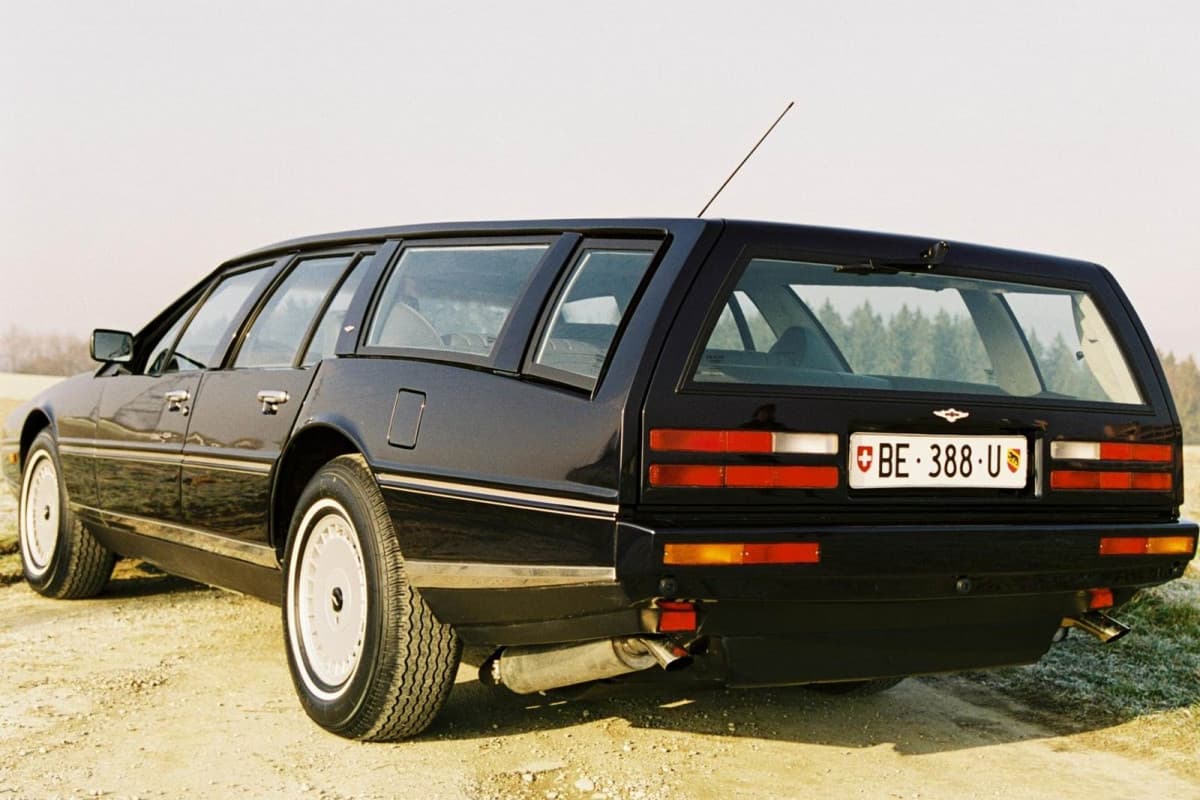
We all perceive the British manufacturer Aston Martin as a company that creates cool sports cars with their unique character, distinguishing them from Italian competitors. Experienced car enthusiasts remember that the British also release Aston Martin sedans – the exclusive Lagonda and the less expensive Rapide. And yet, station wagons have been present in the company's model range for over half a century! Of course, these are exclusive models, sometimes even prototypes, but they exist.
In the winter of 2000, for example, the Swiss company Roos Engineering Ltd, in collaboration with the British, developed a luxurious station wagon based on the aforementioned Lagonda sedan. As is customary in the world of expensive station wagons, it was called Shooting Brake. The car was built on the basis of the 1987 model and equipped with a 309-horsepower gasoline V8 with a 4-speed automatic transmission. This "shed" could accelerate from 0 to 100 km/h in 7.8 seconds. By modern standards, it's slow, but at the time, there weren't many fast cars with this type of body. Roos Engineering's list of works also included the Vantage V600 Shooting Brake station wagon, developed in 1999.
DAF Coupe
The company DAF is, of course, associated by everyone with tractor units. Some people may also recall the DAF buses that have left the market. However, if you delve into the history of this Dutch manufacturer, you will discover an interesting fact: in the second half of the last century, the company actively produced passenger cars. Just take a look at this stylish DAF 66 Marathon 1300 coupe, which was produced in the mid-1970s. And this is not a concept – nearly 25,000 units of such cars were produced.
This was by no means the first (or last) experience of DAF in the segment of passenger cars. In the 1960s, the company produced 2-door coupes almost as many as trucks and buses. There were also station wagons and sedans. In general, the brand has a very rich history. However, today DAF is exclusively engaged in the production of commercial equipment and tractor units.
When it comes to Ferrari station wagons, the first thing that comes to mind is the all-wheel-drive sports car FF, which was later renamed GTC4 Lusso. Many people were skeptical about this model, and at the slightest opportunity, they accused the company from Maranello of betraying its own traditions, saying that "Ferrari is not what it used to be, they never used to produce such nonsense." But they did! There were similar "shooting brakes" like the FF, and even 5-door full-fledged station wagons.
In 1996, the Italian atelier Pininfarina presented the Ferrari 456 GT Venice Estate model to the world. If social media had existed back then, the hashtag #FerrarisDeath would have probably topped the charts. Nevertheless, six people in the world were willing to buy such a car for an enormous amount of money. And the Italians produced exactly six units of this model. All of them are still intact and can be found in museums and collections. And they could have been used to transport cucumbers and potatoes! It seems that the rich do not know how to use station wagons for their intended purpose.
The family minivan Lada
But do you know that even before Largus, Lada had a 7-seat minivan? Those who read the issues of "AvtoReview" and "Behind the Wheel" at the end of the last century should remember the model with the symbolic name "Nadezhda". The full name is VAZ-2120 "Nadezhda". The car was produced for a relatively long time - from 1998 to 2006. But only 8 thousand copies were produced. Less than the Lamborghini Gallardo. Almost all "Nadezhdas" are still on the roads (mostly in Russia), and the car can be considered exclusive. Not everyone has seen the 2120 in person.
The "Nadezhda" became the first Russian minivan. The car inherited the platform from the "Niva" with minor modifications. The same chassis was used in the 5-door Lada 2131. Despite the small production volume, the model received a lot of various special versions, including taxis, pickups, vans, and even a rear-wheel drive version with a bridge from the "Izh Oda". The engines are VAZ units with a volume of 1.7 and 1.8 liters. The low popularity of the model is due to the high cost and not the most successful design.
4-seat hatchback Lamborghini
Now that we've covered Aston Martin and Ferrari, it's a sin not to recall Lamborghini. No, we won't touch on the tractors that the manufacturer was engaged in at the dawn of its history. By the way, the company Lamborghini Trattori, founded by Ferruccio Lamborghini, still operates today. In today's material, we decided to include a lesser-known model - the Marco Polo hatchback. And although it's just a prototype, it's one of the most unusual projects that the Lamborghini logo has been attached to.
The car's designer is none other than Giorgetto Giugiaro. The concept was developed at ItalDesign. Lamborghini's passenger cars have never been designed with an emphasis on practicality. But the developers of the Marco Polo were aiming for comfort. Here, we have improved sound insulation, a comfortable 4-seat salon, and two doors that function like a "seagull wing", allowing you to open them from both the front and rear seats. There were no plans to mass-produce this model, which resembles an Audi "barrel" from the back.
Porsche 911 sedan
There is the 911, and then there are the other Porsche models. This is how true fans of the German sports car manufacturer think. They believe that all these "Cayennes" and "Panameras" are just marketing products to increase sales. And that's true to some extent (otherwise, Porsche would have closed down a long time ago). But do these fans remember that the 911 has become a sedan more than once? In 1967, American millionaire and fan of expensive cars William Dick decided to surprise his wife for Christmas. He ordered from the Troutman firm a rather unusual 4-door car - based on the Porsche.
The design of the car was developed in Italy, and it was built jointly by the guys from Troutman and Porsche. The creators of this unusual model simply took a 911, cut it in half, lengthened and strengthened the base, and welded everything together, adding the missing parts. By the way, the second pair of doors is slightly "trimmed" doors from the serial 911. The rear seats in the Porsche were made to order. That's how the "announcement" of the Panamera turned out. And there was also an interesting sedan, the 989, in 1988. In general, even before the Cayenne, Porsche had some not-so-typical models. The C88 is worth mentioning.
Rolls-Royce Wagon
In the 19th century, in the United Kingdom, vehicles for hunters were called "shooting brakes." At that time, there was no familiar classification of cars, so any car that could accommodate hunters, guns, and prey received the prefix Shooting Brake. Later, this term came to mean stylish, expensive wagons or (already closer to our time) 3-door wagons created on the basis of coupes. And even a manufacturer like Rolls-Royce has a couple of wagons in its portfolio. Some of them were named Shooting Brake in the old-fashioned way - a car for millionaire hunters.
The first experience of creating a familiar wagon for the British manufacturer of luxury cars was back in 1978. Then, at the request of a very wealthy client, the company released the Rolls-Royce Silver Shadow II Estate Car. Two years later, the manufacturer introduced the second-generation Silver Shadow, which already had the Shooting Brake prefix in its name. Later, there were ideas to create a "shed" based on the Phantom, but they only limited themselves to a VIP hearse.
Volga Coupe
In Soviet times, few people did not dream of a "Volga". A big comfortable sedan, one could say, of a representative class. In addition to the "four-doors", the "Volga" also had a popular body type, the universal. In 2005, history threw into the "nest" of the Russian manufacturer a car with two doors. The company's management seriously intended to establish the production of a coupe based on the 3110. For the Moscow "Motoshow" exhibition, GAZ built a prototype of the model, which was already ready to go into production.
The coupe had a shortened base by 20 cm compared to the sedan and an enlarged driver's door. Under the hood was a turbo engine ZMZ-4064, which developed quite decent 190 horsepower. People liked the car, it was effective and unusual. But the price of $12,000 quickly scared off all those who wanted to buy a 2-door "Volga". The project was decided to be closed.
A competitor to the London cab in the form of a "Zaporozhets"
In the late 1970s, the management of the Zaporozhsky Automobile Plant announced a corporate competition for the best car for passenger transportation. According to the idea, such a car was supposed to become the national taxi of the USSR, something like the famous London cabs. The competition was won by an interesting project based on the "Tavria" (with an engine from it).
The car had an overall length of 3.5 meters and a separate driver's cabin located above the left front wheel. The engine was located on the right, and in the back, there was a spacious passenger compartment of the salon, isolated from the driver. But the project remained just a project, not finding financing for implementation.
Stylish LuAZ
The LuAZ brand brings to mind not the most stylish off-road vehicles, but with huge off-road potential. The car sold quite well and was popular among hunters (apparently, among those who did not have money for a British "shooting brake"). But in the 1980s, the LuAZ-969M had already become somewhat outdated, and the plant began working on an update of this model. Thus, the LuAZ-1301 appeared. Also not a beauty, but at least designers worked on it.
The car was built on the well-established LuAZ-969 M platform, but with a new body. The interior was designed in the style of the passenger Tavria. Of course, the prototype did not make it to series production. In 1994, an attempt was made to revive the project, but it also came to nothing. It was not until 2003 that LuAZ released a small batch of 1301, which was somehow distributed to dealers.