Menu
Transport Quest: Why Residents of Smolevichi Can't Get to Work and School
Movement is life. But often it depends on someone else's schedule. And the distance to work, school, pharmacy, or bank is measured not in kilometers but in minutes spent waiting for transport. In large cities, this isn't a problem: if a bus is late, there's the metro, minibuses, or as a last resort, a taxi. It's a bit more complicated in district centers, and for residents of remote areas, it's a real trouble. Many suburban routes have been reduced to just two trips a day, or even just one a week. Carriers say it's no longer cost-effective or practical. There are simply too few passengers in small villages. But they also want to travel in comfort.
Those who go to work rise with the first rays of the sun. And if the journey is long, you have to wake up even before dawn. In Smolevichi, which is forty kilometers from Minsk, everything is so close and yet so far at the same time.
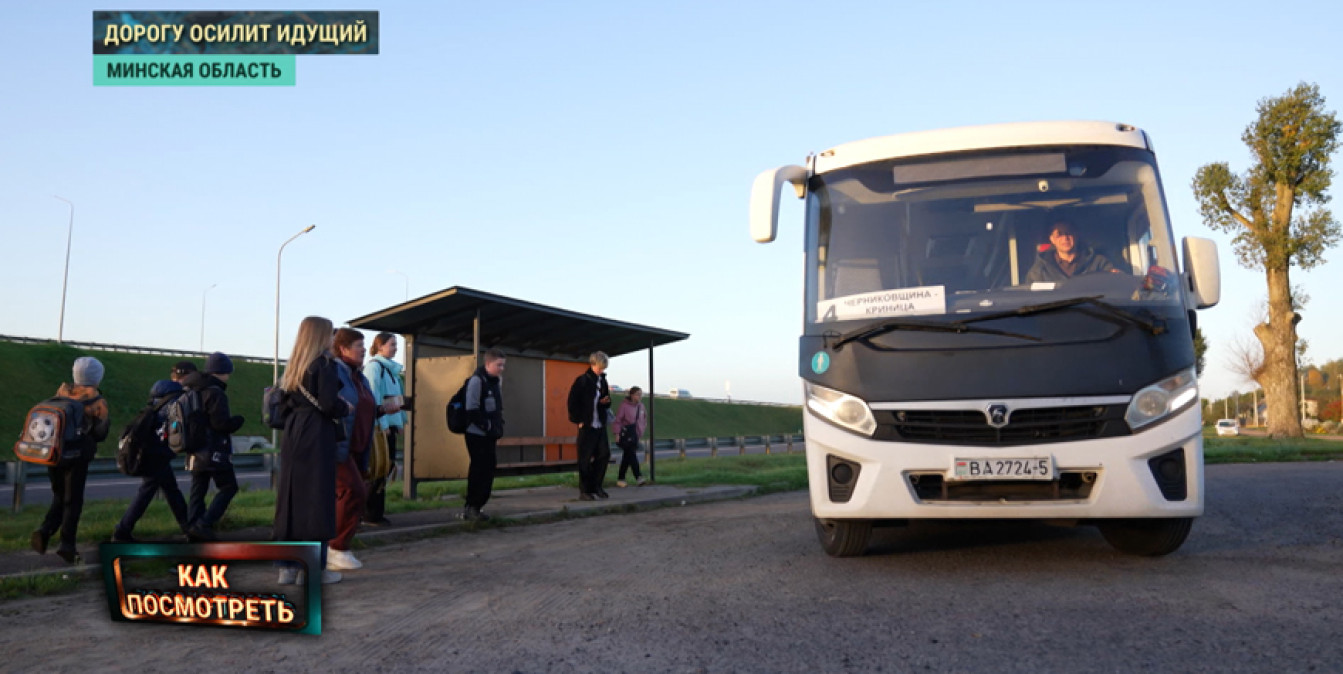
The first bus is at 7:50, the next one an hour later. On weekends it's harder: only two trips a day. The minibuses (the ones connecting to Minsk) pass nearby, but there's a catch. Their maximum is the bus station. Only three buses operate in the district, and just one of them makes a stop in Krinitsa. The carriage is loaded.
We board, payment is by cash or card. Of course, kids ride free. They filled almost the entire salon. But not for long—school is just a couple of stops away.
Darya Nechadim: "The schoolchildren got off, and the salon immediately emptied. Only one or two adults got on at each stop, heading to work in the morning. Still, the salon wasn't even half full."
Fast, without traffic jams—here are the advantages of a small town. The Krinitsa district was a village twenty years ago, and now it's a full-fledged part of Smolevichi. Although the transportation question makes you doubt this "full-fledgedness."
Darya Nechadim: "Our bus had barely pulled away when another city bus arrived. Not even... I don't know, five minutes. Maybe two. For some reason, he didn't think to stop... 'Smolevichi – Dekhan'. 8:13, according to the schedule. Well, he didn't pick me up! He didn't stop."
Probably deciding I wasn't very interesting. Although besides our film crew, there was also a man at the stop. Some people, it seems, have already stopped counting on public transport—they prefer to go on their own.
The journey to work is like a quest—emotions are overflowing. They vent them on social media. Yes, it's piled up. Not everything can be solved instantly: transport officials note a shortage of drivers. Nevertheless, there is a solution.
Sergey Yatsynovich, director of the enterprise "Minoblpassazhirtrans": "Krinitsa. We have already worked on the morning trip, and literally within a few weeks we are launching this route. All inquiries are received, and all of them are examined in detail."
On weekends they plan to add another bus to Smolevichi. And the morning run to Krinitsa on weekdays will appear in a couple of weeks, but in test mode. It is necessary to assess whether transport is really in demand at this time. This is where there is
Ekaterina Stankevich, chair of the Association of Professional Passenger Transporters, said that transporting just one or two people there, given that pricing will be regulated and will actually cost only a few kopecks... In other words, the carrier's cost component – whether state or private – doesn't matter. If you organize the transport logistics so that vehicles stop here, stop there – dissatisfaction begins among passengers for whom the trip becomes longer.
It is not ruled out that extending the route will cause tension among passengers who will have to travel around the world. But when choosing between two evils, they pick the lesser one? There's something to think about. In solving any issue, it's important to move forward together, hand in hand. This is how those for whom walking is currently the only option have been doing it for years.
Through thorns to knowledge? Lomonosov endured no less for the sake of science. Although times, of course, are no longer the same. Movement is better than staying put. But it is still more reasonable when it is justified and poses no risk to lives.