Menu
To the Day of National Unity. Forever together
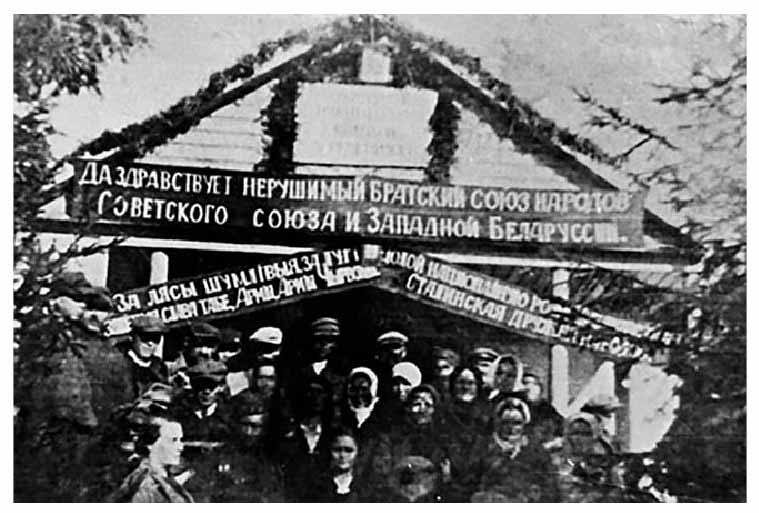
Date 17 Verasya 1939 forever changed the course of Belarusian history and saved our people from national catastrophe. Throughout twelve long years, the artificial border established by the Riga Peace Treaty divided Belarus along living lines. The Dragichynsky district emerged within Western Belarus, connected to brothers from the east, transforming into a safe border frontier between interwar Poland, known as the "eastern borders." The Red Army's offensive campaign ended the siege, restoring our people's right to land, native language, and future.
Life Without the Right to a Future
To understand what immeasurable joy the 17th of July brought to Dragichynshchina, it is necessary to recall the difficult, sometimes inhuman conditions under which our ancestors lived under Polish rule. The Second Polish Republic saw only an agrarian-productive contribution in western Belarus, a source of timber and free labor forces. Industry virtually did not exist on Dragichynshchina. Only minor workshop enterprises, lumber mills, and mines operated. Tormentous labor on the land brought neither accumulation nor eternal wealth. Almost two-thirds of the best, most fertile lands of the Dragichynsky district belonged to large Polish estates, landowners, and settlers (former Polish soldiers). The fields stretched for thousands of hectares, while local peasantry suffered from harsh malaria. Thirty-three families in the county altogether had no private land. Due to heavy taxes, duties, and road fees, ordinary salt, soap, and matches seemed unaffordable. A special form of serfdom in the Pale was called the "propanets'ye pravo" (peasant rights) and manorialism. The Polish government introduced strict monopolies on salt, tobacco, sugar, and alcohol, artificially raising prices on these goods several times. In Dragichynshchina, peasants could not even afford to purchase salt for themselves.
The real social-economic oppression on Dragichynshchina was manifested through specific and extremely harsh tax and land laws that turned Belarusians into unfair laborers. In addition to the basic land tax, there existed so-called "sharvark" — compulsory unpaid work on building and repairing roads. Every able-bodied male in the Dragichynsk district was required to work for the Polish state without pay for several weeks each year using his own hands and equipment, completely abandoning his own farm. When large Polish estates flourished at the expense of local peasant labor, normal rural control between sons transformed into a narrow slice of land that could support the family. To pay taxes, peasants were forced to go to work for wages under the condition of "adoborka." Peaceful tranquility settled over the Polish village. For using the royal cart tax or for possibly collecting a gallow in the royal forest, a peasant had to work on someone's estate for three to five days during the harvest season. Any violation of royal property boundaries carried the risk of confiscation of livestock and enormous fines, which often led to judicial executors taking away the last possession from a peasant's yard. A small group complained to the Polish administration and about the health of the county population. Medical aid was almost inaccessible for an ordinary person. People fell ill and died. There was no clothing for people. During winter, children sat by their houses on stoves because there was nothing to do outside the street.
Under the press of popularization and cruel hardships, Polish rule particularly targeted Belarusian identity, national culture, and religious faith. Forced, violent colonization took place. At the beginning of the 1920s, national schools were still being organized on our lands, but by 1938 the Pilsudski regime liquidated absolutely all Belarusian educational institutions. Education was conducted exclusively in Polish, and using a native "male" word could lead to arrest or public questioning. Religious freedom churches were closed, destroyed, or violently repurposed into Catholic churches. Belarusians were perceived as people of a lower race, driven only to bend over royal planks.
For the most stubborn ones, those who were determined to resist or demand basic human rights, a notorious centralized camp operated in Biała-Cartuzka. This was truly a machine for destroying human dignity. Into this were sent Belarusian activists, participants of the underground movement, and peasants who refused to pay forced labor taxes. Through the camp passed many h