Menu
Thus buses appeared: Belarusian history of automobile manufacturing
A man gripped the narrow doorway with strong hands and crashed his body in: eighty passengers felt each other's proximity, some nearly fell through the rear doors. “So, shall we go through?” the man asked sternly. LAZ seemed to swell with people’s relentless desire to just ride. In summer it was unbearably hot: fresh air barely seeped through the small windows—hard competition for the right to breathe. In winter it was hot too, especially in the back seats. In such an environment, scents unfolded anew: the whole bus knew who was carrying fish from Komarovka and who was going on a date—why else pour an entire bottle of perfume on oneself? Every stop was a siege and a storm, as well as desperate attempts to get out. That was also the case in the 1990s. And then MAZ started producing buses.
What this article is about
Contract with Neoplan for $1,500,000
First MAZ buses
Localization
MAZ bus – Mercedes engine
“Accordion” from the conveyor
One of the most profitable MAZs
From ICE to electricity
The past often helps better
That was already something that suited MAZ. They signed an agreement with Neoplan, under which the Belarusian enterprise received the technology for bus production, as well as several vehicle kits for experimental assembly. The vehicles were assembled and put into service.
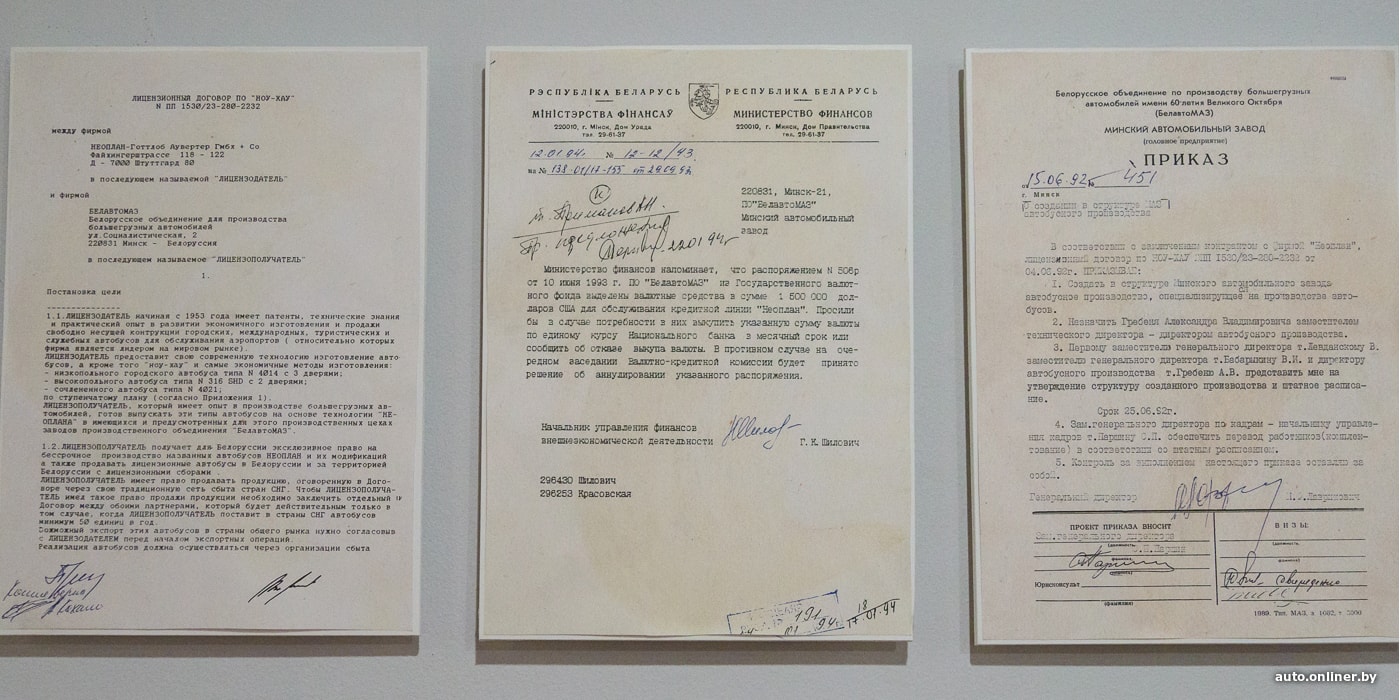
That very licensing agreement with Neoplan. Also a directive from the Ministry of Finance allocating foreign‑currency funds amounting to 1,500,000 U.S. dollars for servicing the Neoplan credit line. The order to establish bus production within the structure of MAZ was signed on June 15, 1992.
Some solutions adopted in Europe, so to speak, were unviable on our roads at that time. One weak point was the electric door drives. Although they had proven themselves in Germany, they could not cope with the passenger flow in Minsk. Doors on a full vehicle opened and closed with great difficulty. Passengers solved the problem in their own way: they turned them manually. The German manufacturer did not account for such enthusiasm — the drives burned out under the load.
They solved the problem simply: instead of electronic closers, they began installing pneumatic ones.
One of the first buses assembled in Minsk. Still under the Neoplan brand. Photo from the archive of the Minsk Automobile Plant.
In total, five buses were assembled in Minsk from the received vehicle kits. Even with the implementation of modifications, this production variant was very expensive — localization was needed.
The first MAZ buses
From the very beginning, MAZ buses stood out sharply against the rest of the public transport in the country. The buses were low‑floor, step‑free — a solution borrowed from Neoplan. By that time, Europe had concluded that the population was aging and needed to cater to elderly people. Plus mothers with strollers — they also had to be considered first.
In 1993, based on Neoplan, the MAZ‑101 was created. It was tested again in real conditions and some adjustments were made: the changes concerned the placement of the engine and the design of the drive axle. Thus the MAZ‑103 appeared. It became the first mass‑produced model of domestic buses. Things started to go up.
The sale of buses has some specificity: after all, city transport is usually purchased with budget money. Accordingly, the volume of supply is not two or three buses, but an entire large batch. If a certain fleet acquires equipment from a particular manufacturer and is satisfied with it, it will continue to buy it. A stock of spare parts is created, the nomenclature is standardized, it is easier to train people — loyalty is formed.
Initially, the company planned to produce up to five hundred a