Menu
This is not Photoshop. In this city, a cottage settlement of 1572 identical villas has been built
For a long time, a surreal satellite image with hundreds of absolutely identical sandy-beige roofs has been circulating on the internet. Reddit users, after discussing it, collectively concluded that it was just an ordinary photoshopped image created for hype. However, Google Maps soon disproved the skeptics, confirming the existence of the Dubai cottage community Nad Al Sheba Villas, developed by the major Emirati developer Nakheel. In this flawless matrix in the middle of the desert, there are 1,572 houses, and while urbanists lament the victory of soulless copy-paste over common sense, local residents feel quite comfortable. The project, which seems like an illustration of a perfectionist's dream (or perhaps a nightmare), was created to address specific tasks: to quickly satisfy the market's hunger by providing hundreds of ready-made and relatively affordable villas by local standards, without the tedious multi-year wait for completion. Let's take a closer look at what life is like inside this conveyor belt paradise and why Middle Eastern development sometimes resembles an industrial printer.
Neighbors of the racetrack
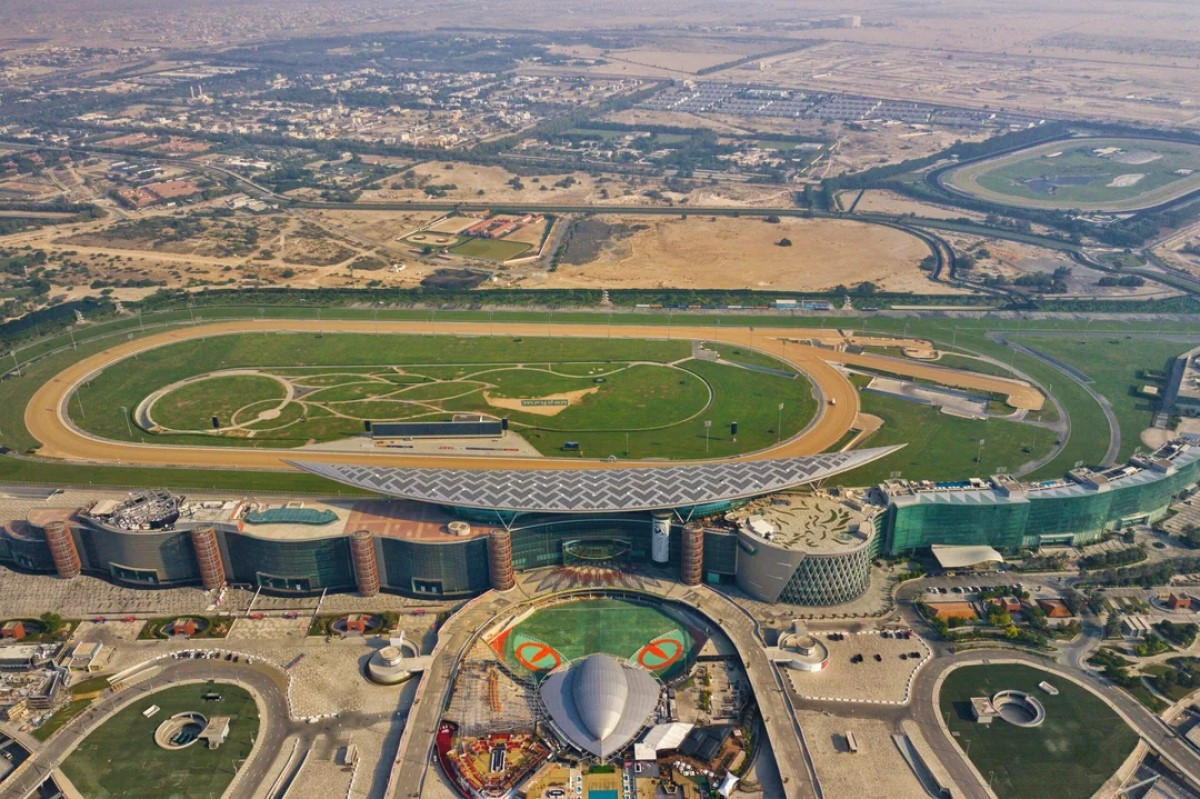
The Nad Al Sheba community is located away from the usual postcard-like glamour of Dubai's beaches, Dubai Mall, and Burj Khalifa. The area is adjacent to the busy Sheikh Mohammed bin Zayed Road, which allows you to drive to the downtown area of the metropolis in just ten minutes. For a long time, this location was associated exclusively with elite equestrian sports. Since 1986, a famous racing complex has been operating here, where the multi-million dollar Dubai World Cup is held annually. The racetrack has been modernized and renamed Meydan over time, but the historic name has firmly stuck to the area.
The main feature of this place is its "closedness" to foreigners.
Developers openly call the location one of the most conservative and traditional areas, where only the indigenous population of the UAE prefers to settle. The new generation of wealthy Emiratis stubbornly holds on to their roots, trying to buy housing closer to their numerous relatives. The infrastructure has quickly been adapted to meet their requests. Prestigious schools, including the British campus of Rugby School, have opened in Nad Al Sheba. Against the backdrop of neighboring premium constructions from Meraas, which attract buyers with landscape designs, our orderly geometric village looks like the most disciplined and strict "resident" of the area. Such a large-scale project could only be handled by a player who has experience in changing Dubai's geography.
Generals of the sand quarries
In translation from Arabic, Nakheel means simply "palms". This modest "botanical" name conceals an important architect of Dubai's urban wonder. It was these people who created the legendary Palm Jumeirah island and the ambitious The World archipelago, transforming a humble 70 kilometers of Dubai's natural coastline into over 300. However, in 2009, the large-scale land reclamation project resulted in a devastating debt crisis: losses were counted in billions of dollars, and the company, along with its parent structure, nearly dragged the entire emirate into financial ruin. The Dubai government had to rescue the developer, injecting enormous funds, taking Nakheel under direct control, and completely dissolving its board of directors.
However, memory is short in Middle Eastern business, and appetites are boundless.
Today, no one remembers the past debts, and Nakheel is once again executing billion-dollar contracts. Literally, in the spring of 2026, the company allocated almost a billion dollars to build over 500 new villas on the revived mega-island of Palm Jebel Ali, and to cement its unsinkable status, the developer was finally integrated into the state superstructure Dubai Holding. Such giants in the construction industry are called master developers. This means that they do not simply build standard residential complexes, but actually redraw the country's map, sometimes creating entire cities from scratch. The Nad Al Sheba Villas project became an opportunity for them to show that they can build in the desert as well. However, the company's trademark gigantomania has not disappeared.
Initially, the project was conceived as more modest. The developer planned to build "only" about a thousand houses exclusively for rent. However, as the project progressed, appetites grew, and by 2016, the village had expanded to 1,572 villas. Nakheel allocated $650 million for this construction project, driving an entire army of builders into the desert. According to the authors' plan, the result should have been an elite residential complex. In practice, however, the mass simultaneous pouring of concrete according to uniform templates turned the complex into a giant architectural constructor.
All the houses in the village were divided into two types of facades: Mediterranean and Moroccan.
The variability is minimal. Buyers were offered houses with four or five bedrooms, but the internal layout was planned with truly eastern grandeur. Each bedroom has its own bathroom, the living area includes a mandatory garden, a closed garage for two cars, and a room for servants with an autonomous entrance from the street, so that the domestic staff intersects with the owners as little as possible. The area of such standard "boxes" starts from 350 square meters, and they are placed on small plots of land with an area of around five hundred square meters. Squeezing a huge house onto a modest plot of land, leaving neighbors the opportunity to peek into your windows, is the signature style of local developers.
Life inside this concrete perimeter is organized according to the principle of self-sufficient autonomy.
The village is completely closed to outsiders, and a five-kilometer jogging and cycling path runs along the fences. For those who are too lazy to leave the neighborhood, Nakheel built a local mall, Nad Al Sheba Mall, which opened its doors in the spring of 2025. Instead of the initially promised two hundred stores, it managed to attract just over a hundred retail outlets, restaurants, and a mandatory supermarket. The main feature of the public space is a sports cluster on the roof with a pool and fashionable courts for padel tennis. The calculation is that the local family should spend money without leaving their native reservation.
Only for their own
At first, Nakheel tried to rent out the clone villas, setting a price of $32,000 per year. Later, the strategy was adjusted, and the houses were put up for sale, but with a strict Middle Eastern filter. The geometric utopia was legally formalized as a freehold zone, a format of absolute, lifelong ownership of both land and house, but in this case, it was only available to citizens of the UAE and the Gulf states. An ordinary foreign expat, no matter how much money they had, could not buy anything here. At the start of sales in 2019, about $870,000 was asked for each of the first hundred villas, but in the midst of the 2020 pandemic, the developer panicked and lowered the price to $640,000. The cheap, by local standards, and already finished houses caused a frenzy among Emiratis. People were massively buying their first homes or moving out of their parents' homes. In less than a year, the total amount of transactions exceeded $500 million.
Today, there is nothing to catch on the primary market, because the developer has completely sold out the village. All transactions have moved to the secondary market, where prices have doubled over the past six years. In 2026, a typical house is already being sold for around $1.4-1.5 million. Rental rates have repeated this jump, rising to $60-82,000 per year. This economy is most clearly highlighted by a comparison with neighbors. In the nearby complex of Nad Al Sheba Gardens from Meraas, where foreigners are allowed to buy real estate, and architects have tried to move away from total uniformity, a villa with four bedrooms is already being sold for more than $3 million. Against this background, Nakheel's mass-produced houses have become a kind of Middle Eastern analogue of a sturdy "comfort class" without excessive architectural ambitions, but instead, they are their own, understandable, and stably becoming more expensive.
Yes or no?
Discussions about whether this type of format is suitable for a comfortable life usually quickly reach a dead end. On the one hand, the everyday pragmatism of a closed secure perimeter, prestigious schools nearby, and a homogeneous social environment where neighbors do not bring surprises is understandable. On the other hand, there are the classic urban planning pitfalls. In the well-known study Dubai Detox by the University of Maryland, this type of development is openly criticized for its absolute dependence on cars and colossal energy consumption. The mandatory double garage at each facade of Nad Al Sheba Villas only confirms this position. Without a car, a person here instantly becomes a hostage of endless concrete fences.
In internet discussions, defenders of the Dubai format parry with a standard argument. At summer temperatures of forty-five degrees in the shade, pedestrian routes and parks still turn into a scorching oven, so a air-conditioned SUV is a basic element of survival. Critics object that the extreme climate has become a convenient excuse for developers who mindlessly copied the American single-story suburb with its endless dead ends and labyrinths.
Both sides are probably right. If you look at that same satellite image again, the endless rows of identical roofs seem like a system failure or a bug in computer graphics, but as soon as you descend to the ground, this visual nightmare becomes a reality in the spirit of the now-trendy liminal spaces.
[images omitted]