Menu
"This is a 'Belarusian Atlantis'. What remains of the Old Believers' world in Vetka."
Special Project
"This is like a 'Belarusian Atlantis'". What remains of the Old Believer world in Vetka
Author: Natalia Nekrashevich. Photo: Alexander Ruzhechka
Today, Vetka is a small district center in the Gomel region, with a population of around 8,000 people. Almost three centuries ago, the town and its surroundings were home to around 40,000 inhabitants. Here, people traded in salt and spices, women wore silk sarafans and kokoshniks adorned with pearls, and local books and icons were distributed throughout the Old Believer world. This world was created by people who did not accept the church reforms in the Moscow Tsardom and wanted to preserve their former faith and way of life. They were forcibly resettled twice, but the town was reborn again. In a new issue of "Unknown Belarus" with the support of belbet, we will travel to Vetka to find out what it was like several centuries ago and what remains of that amazing culture.
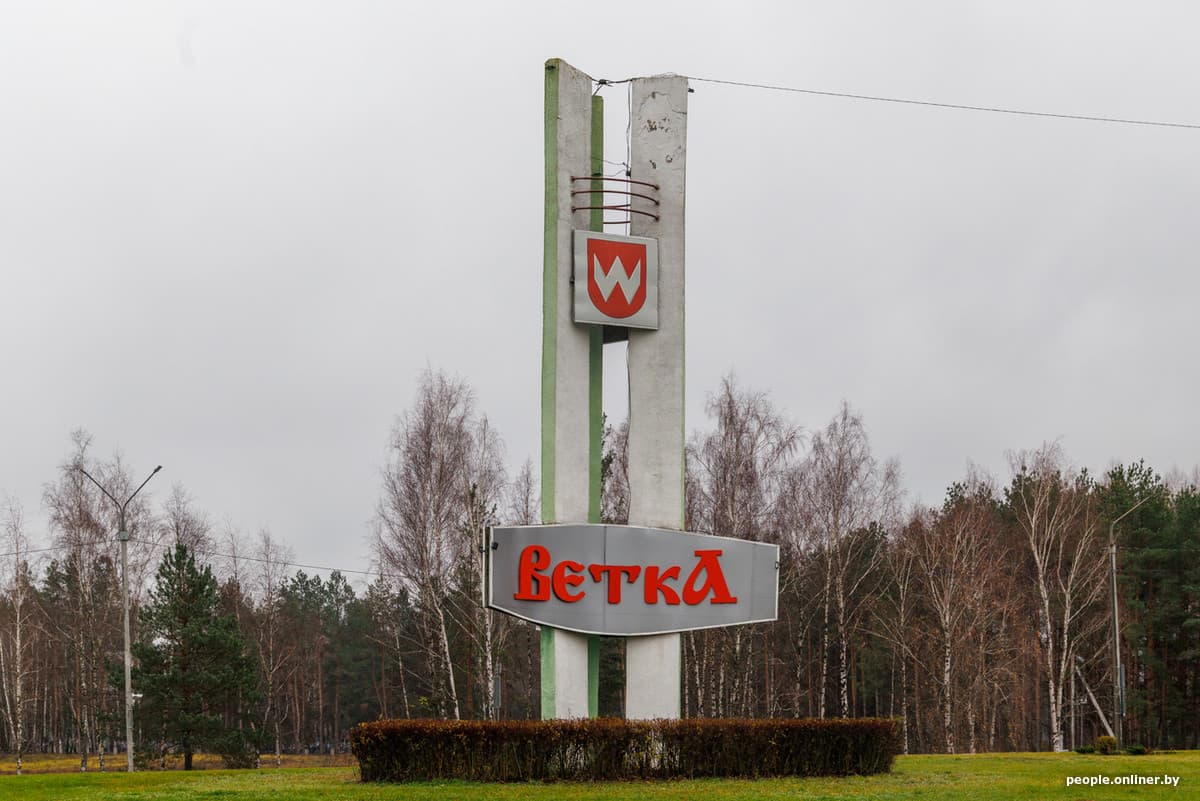
We arrive in Vetka on one of the overcast November days.
The fact that this town was once one of the main spiritual and cultural centers of Old Believers is only hinted at by the carved window frames on the wooden houses. Otherwise, the town is like any other: a bus station, a "large" "Evroopt" store, small shops.
On the central square of the town, called Red Square, just like in Moscow, we meet our guide - a tour guide, local historian, and ethnographer named Pyotr.
From here, we head to Gromyko Street. On both sides, there are wooden houses with carved window frames and high gates. Most of these buildings, according to our guide, date back to the late 19th century.
Pyotr shows us old forged gates and an unusual lock mechanism: a long metal bolt passed through the wall of the house, and it was locked from the inside.
Look: house, gate, house, gate. There is no large gap here through which one could enter the yard directly from the garden. The entire street becomes a single fortress. You walk as if through a medieval city.
To get into the house of an Old Believer, you could usually only do so through the yard, not directly from the street. And this was connected, among other things, with religious customs.
But before telling you about them, let's figure out who the Old Believers are and why they began to migrate to the territory of the Polish-Lithuanian Commonwealth several centuries ago.
The city built by refugees
In 1653, Patriarch Nikon began a church reform that not all believers accepted. Among the well-known opponents of forced changes were Archpriest Avvakum, who after exile and long imprisonment was burned in a hut, and Boyarynya Morozova. She, along with her sister, was imprisoned in an earth prison in Borovsk, where both died of starvation.
Well, the other Old Believers thought: if they didn't spare the first people of the state, if they treated them like that, then what will happen to us, simple believers? And they split into two streams. Some (mainly the priestless) went to Siberia to pray peacefully. And the others - merchants with capital - went to the border with the Polish-Lithuanian Commonwealth, to Starodubye. They came, lived there for a bit, and then in 1685, Tsarevna Sophia issued her 12 decrees, which toughened the attitude towards the Old Believers: torture, prisons, and even the death penalty. Then they realized that it wouldn't be possible to live in peace, crossed the border between the Moscow Kingdom and the Polish-Lithuanian Commonwealth, and asked for asylum from the local lord, Chalecki - he rented the island of Vetka to the settlers, - Petr explains.
And still, why did the Old Believers decide to seek refuge specifically in Vetka?
On the territory of the Polish-Lithuanian Commonwealth, the Statute of the Grand Duchy of Lithuania of 1588 was in effect, which enshrined religious tolerance. The Old Believers came here and felt that they were under the protection of the law: they could open churches and practice their faith. Here, Orthodox, Catholics, and Uniates lived peacefully. And the Old Believers were not considered sectarians, as was the case in the Russian Empire, where they were outside the law. The law on religious tolerance was adopted there only in 1905. Until then, Old Believers were considered not just a different faith, but a prohibited religion.
In official documents, the Old Believers were long referred to as schismatics.
— They are still sometimes called Old Faith believers, but I have always had a question about this term. How can faith be old or new? It either exists or it doesn't. Therefore, I think it's more correct to say "Old Believers". After all, the church schism primarily affected the rituals: for example, the direction of the cross procession, the number of prosphora, the depiction of the cross, — the ethnographer reasons.
The main square of Vetka was named Red by the settlers — in honor of the one in Moscow, in order to maintain a connection with their native lands in their new location. Besides, in the ancient Russian language, the word "red" meant "beautiful", "main", or "best".
The origin of the name "Vetka" itself is not so straightforward. According to the most common explanation, it is connected with geography: the settlement emerged on an island near the Sozh River, which was formed by a small tributary — a "branch" of the river. There are other versions as well. For example, according to one of the folk legends, the first settlers let a branch float on the water and decided to establish a settlement where it would wash up on the shore.
Over time, Vetka and the surrounding villages turned into a large trade, spiritual, and cultural center of Old Believers.
They traded in salt, wore pearls, and taught girls to read and write
By 1735, more than a dozen Old Believer villages had grown up around Vetka. In the settlement itself and its surroundings, about 40,000 people lived. Many were engaged in trade and crafts, and the town became a major center from which books and icons were distributed to various lands.
The villages differed from ordinary villages in the status of their inhabitants. If serfs of the nobles lived there, then the Old Believers belonged to no one and rented the land on which they lived. These were free people.
The main goods traded here were spices, fabrics, and salt. The latter, by the way, was a particularly valuable commodity at that time.
— It seems to us now: what's so special about salt? But at that time, if you traded in salt, you traded in gold. There was a good trade route: the Sozh River, the Dnieper River — the Black Sea.
The villages were also notable for the fact that the Old Believers did not just trade in ordinary goods, but also wore pearls and taught girls to read and write.
Icons and books also played a significant role in trade. As academic Nikol'skii wrote, Vetka supplied them to the entire Old Believer world: from here they were distributed to various communities and lands. Icon painting was not only a part of spiritual life but also a profitable craft.
One icon could cost 25-30 rubles. Icons were painted using gold and mineral paints, including turquoise.
The prosperity of the Vetka Old Believers was also reflected in their attire. Their costume preserved the traditional Russian style: women wore sarafans and kokoshniks. However, there were also expensive imported fabrics. Ethnographer Ivan Abramov, who visited Vetka in 1907, wrote that many women's trunks stored silk sarafans - aziatki. This was a special type of sarafan made from fabric imported from St. Petersburg. Kokoshniks were decorated with pearls.
Why were the Old Believers loved? Because they were teetotalers, non-smokers, and hardworking, decent, and educated. They had a principle: prayer and work. In labor, you are pleasing to God, explains Petr.
When the Old Believers were forbidden from opening their own schools, they hired educated women - keleynitsy - to teach their children. They gathered small groups and from autumn to spring taught the children to read, write, count, and sing church hymns. Girls were also taught handicrafts.
There was no such thing as a woman only being able to cook shchi and give birth to children. The Old Believers believed that everyone should be educated. And in general, despite all the difficulties and persecution, they were big optimists.
The world behind closed gates
Why did the Old Believers build their houses in such a way that you could only enter them through the courtyard, and not directly from the street? Petr explains this, among other things, by religious customs.
If a person came from the street, no one knew if they were an Old Believer or a person of a different faith. And in the house, there were icons. Therefore, first, it was necessary to understand who had come, and in case of necessity - to close the icons and fumigate the premises.
The ethnographer notes that in the architecture of the Vetka Old Believers' houses, you could see carved columns, shells, and decorative curls.
— People traveled a lot, traded, and adopted architectural techniques. But marble was expensive, it had to be brought from afar, so they used wood. Besides, Vetka was burned down twice during raids. What's the point of building stone walls if troops could come again and destroy everything? Wooden houses were easier and faster to rebuild.
Another feature of old Vetka houses is the four-sloped, or hipped, roofs. Petr associates them with the places from which the Old Believers migrated: such a structure better withstands strong winds.
— The carved decorations of neighboring houses are similar in style, but do not repeat each other. They were made by professional craftsmen who worked in artels. So, different but stylistically similar details appeared on the street.
We ask Petr if there is an Old Believer cemetery somewhere nearby. After all, ritual traditions, monuments, and burials can tell a lot about the culture of a particular community.
— There are two cemeteries in Vetka: a regular one and the so-called "Moskal" one. The latter was initially a place of burial for Russian Old Believers — migrants from the Moscow Kingdom.
Of course, we need to go there. The first thing that catches our guide's attention is the eight-pointed crosses. For Old Believers, this form is important: an upper and lower crossbeam are added to the main crossbar, with the inscription "Jesus of Nazareth, King of the Jews" on the upper one. But what surprises us most is not even their shape, but their arrangement. Most of the crosses and monuments on this cemetery stand not at the head, but at the feet of the deceased.
— Old Believers believe that when the sun rises, they should pray, facing east. Therefore, the cross is placed at the feet: it turns out to be in front of the person's face.
This custom is also connected with a folk interpretation: as if after the resurrection, it would be more convenient for a person to rise, holding onto the cross.
Another notable detail is the stones that are placed on the graves. They symbolize the stone from the Lord's tomb, which was rolled away after the resurrection of Christ.
On the Old Believer cemetery, forged fences and various monuments have been preserved. Among them are merchant ones, for example, the grave of Vetkovsky merchant Timofey Drygintsev.
What's also noteworthy is that on old monuments, only the date of death and the person's age are indicated. On later ones, you can also find the day and year of birth.
Some headstones are made of concrete, decorated with flowers and curls, and the influence of modernism, which was fashionable at the time, is noticeable in them.
Many crosses have white rushniks, and at first, it seems to us that they are also part of the local tradition.
No, the Old Believers did not weave rushniks. They didn't even cover icons with them - everything was with gold, pearls. This is a later mixture, a more modern tradition, folk Christianity. In Soviet times, everyone started doing it this way: one person tied it, a neighbor saw it and also tied it. That's how everything gradually mixed together.
They wanted to preserve the old, but created something new
But let's return to Vetka icon painting. What's its peculiarity?
Vetka icons are distinguished by their attention to volume, perspective, and everyday details. Petr acquired one such icon from a private collector. It belongs to the Vetka-Starodub region - that's what this tradition is called in scientific circles.
Here we have a classical direct perspective: the house with the largest windows is in the foreground, the next one is already farther away. This reveals the depth of the entire street, and you get almost a real European street that you can imagine walking along. And here, the story of the righteous Joachim and Anne, the parents of the Virgin, is depicted. But what's interesting is not just the plot itself, but how many everyday details the icon painter added: a servant brings Anne food, there are knives, forks, and dishes nearby, the doors are open, you can see fancy fabrics, flowers, and decorated windows. The neighbors came to visit the mistress, and the servant is even checking the water with her hand.
Vetka loved such details. It turns out to be almost an ethnographic sketch - not just a story about a biblical event, but a depiction of a completely recognizable everyday life.
As the ethnographer explains, it is precisely such details that create the impression that we are not looking at an abstract story, but at a fully real life. The icon helps us imagine how interiors looked, what dishes were used, how people dressed and received guests. For people of that time these details were recognizable, and today they help us picture the everyday life of a bygone era.

To see more authentic works and examine other features of Vetkovskaya iconography, we head to the Vetkovsky Museum of…