Menu
The price of every record is round-the-clock work for results: Yury Gorlov on achievements in the agro-industrial complex
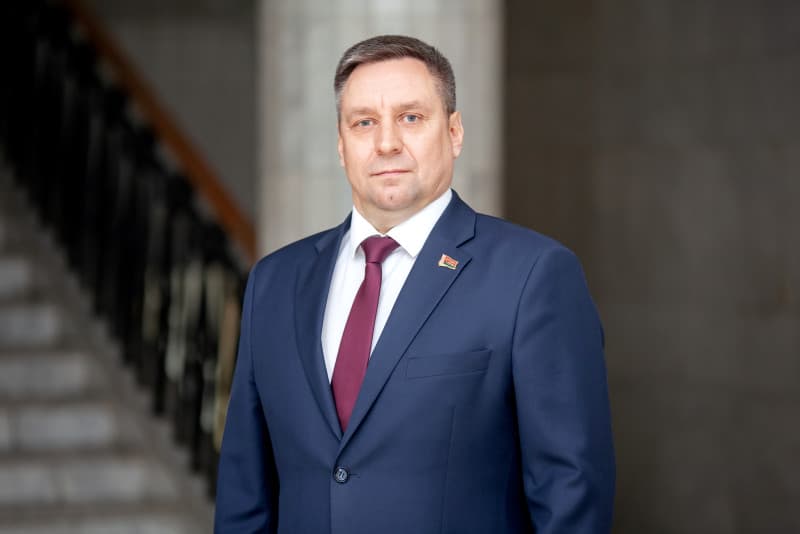
Autumn is traditionally the time to sum up the results of the harvest season. The harvesting of grain and rapeseed is in its final stage, and the gathering of fruits and vegetables is ongoing. On the eve of our professional holiday—Agricultural and Processing Industry Workers Day in the Republic of Belarus—we spoke with Yuri Nikolayevich Gorlov, Minister of Agriculture and Food, about how the land responds to labor, why fewer machinery units mean greater efficiency, and whether we will have enough bread.
— Yuri Nikolayevich, this year's result is over 11 million tons of grain and oilseeds in bunker weight, but what lies behind this and other achievements?
— The harvest has turned out quite productive; we have not lowered the bar set last year. As of November 13, 11,449,000 tons of grain—including rapeseed and corn—and more than 5 million tons of sugar beets have been harvested from the fields. It is no exaggeration to say that we are seeing growth across all crops and agricultural production items. Of course, all of this was achieved thanks to the intensive and coordinated labor of our farmers. After all, behind every record lies round-the-clock, not always visible work toward a common goal. Each region and district has summed up its results at the "Dozhinki" harvest festivals, confirming their successes. But this does not mean that everyone has relaxed and is resting on their laurels. Work in agriculture never stops. Everything we see in the charts and reports is the result of competent planning, strict adherence to technology, and, certainly, the dedication of the people on the ground—from the machine operator, field agronomist, or milking operator to the regional head. Behind these achievements are the timely preparation of machinery, high-quality seeds, well-thought-out plant protection, and, of course, state support.
And besides the harvest, we have much to be proud of this year. Our work speaks for itself through the numbers: Belarus maintains absolute leadership in the post-Soviet space and in Eastern Europe in terms of food independence. The percentage of self-sufficiency is extremely high: milk and dairy products stand at almost 300%, a colossal figure; meat is at 139%; eggs at 132%; potatoes are at 102%, with nearly the same figure for vegetables. On average, a single Belarusian consumes 104 kilograms of meat, 255 kilograms of milk and dairy products, 89 kilograms of fruit and berries, 183 kilograms of vegetables, 159 kilograms of potatoes, and 290 eggs per year. Today, our dairy and meat products are in demand in every corner of the world and sought after on foreign markets, which means that we must utilize our unrealized potential and increase the production volumes of livestock products.
This year is also largely landmark for Belarusian animal husbandry. Over the first 10 months of this year, high growth rates were maintained in milk production at 102.9 percent, in the rearing of livestock and poultry (in live weight) at 104.8, including cattle at 102.3, poultry at 105.7, and pigs at 107.6 percent. The productivity of the dairy herd increased by 246 kilograms compared to January–October of this year, reaching 5,742 kilograms. Growth was secured in the average daily weight gain for the rearing and fattening of cattle by 44 grams (reaching 710 grams), and pigs by 24 grams (706 grams).
The success of domestic livestock farmers is directly linked to the fulfillment of the Head of State's requirements regarding the improvement and development of the industry through the construction of new and the reconstruction of existing livestock facilities, the enhancement of genetics, feeding and housing technologies for farm animals, and the introduction of innovations.
— In recent years, we have faced climatic anomalies that are becoming the rule rather than the exception. It is traditionally believed that farming remains a hostage to the weather, and any whim of nature can negate months of labor. Are we succeeding in overcoming this dependence?
— It cannot be said that weather anomalies have a major impact on our results today. On the contrary, we must skillfully use technologies if we want to achieve high yields. Today, Belarusian agrarians are adapting to any conditions while fulfilling their assigned tasks, thanks in part to land reclamation. More than 37% of agricultural land in the country is reclaimed, and on such land we can minimize the impact of weather conditions on crop cultivation. It is precisely on these lands that the bulk of the feed base is cultivated, and the reconstruction of reclamation systems yields a 1.3- to 3-fold increase in productivity. Here is a simple figure: for every conventional ruble invested in land reclamation, we receive 3.5 rubles of profit in the form of produced goods.
— The modern younger generation mostly grows up in urban environments and sometimes loses connection with the land, as well as an understanding of the value of creative physical labor. In your opinion, how can we instill in the youth that very "personal responsibility" for their native land?
— Belarus is, first of all, an agrarian country, and we have a historically shaped special attitude toward the land as a living heritage. Today, an attentive, caring attitude toward one's land is a multifaceted indicator reflecting a high level of labor culture. We are obligated to teach this to our younger generation as well, so that they can see the results with their own eyes and understand that high yields and order do not appear out of nowhere—behind all of this stands a human being.
Therefore, we place high hopes on students of agrarian universities who are studying in the era of artificial intelligence and breakthrough progress in science and technology. The solution to the most ambitious tasks in the agro-industrial complex today depends on the training of qualified specialists who possess new knowledge and advanced technologies, which they will subsequently apply successfully in practice. But a diploma alone is not enough. The transfer of experience is also extremely vital—from mentor to student, from the older generation to the younger. Labor dynasties remain strong in our industry, where a son or daughter continues the work of their parents.