Menu
The owner of a large residential complex declared war on its residents and regretted it. Everything ended with a loss of billions.
In January 2009, the residents of Stuyvesant Town, a gigantic residential complex in Manhattan, filed a loud collective lawsuit for $40 million against their landlord, the Tishman Speyer consortium. The new owners, who had purchased the complex at the peak of the market for a record $5.4 billion, decided to transform this historic stronghold of the middle class into elite housing. The main (and unexpected) obstacle was the tenants of apartments with stabilized rent, whose rates had been protected by law for many years. To evict the "beneficiaries," the developers hired an army of lawyers and private detectives who were looking for any pretext to terminate the "social" contracts and transfer such housing to the "market" fund. But New York residents know how to defend themselves, and behind the residents' association stood experienced lawyers and deputies. Already in October, the Appellate Court of the state recognized the scheme as illegal, and in January 2010, Tishman Speyer was forced to hand over the complex to creditors. The attempt to break the city's rules cost the investors one of the most notorious defaults in the history of American real estate.
The Gas Quarter
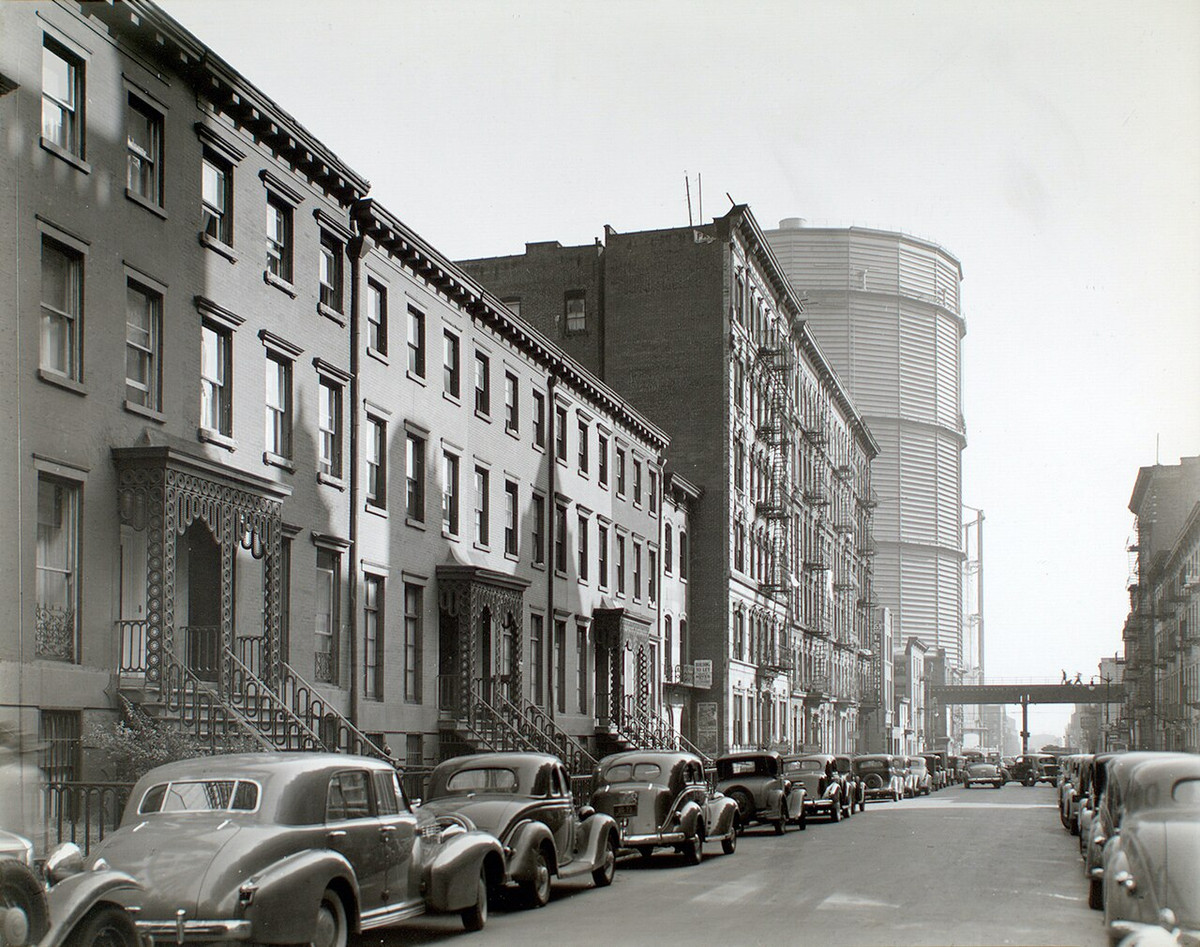
By the end of the 19th century, the eastern edge of Manhattan near 23rd Street resembled a branch of hell on earth. In 1842, the first gas holder - a huge circular reservoir for storing illuminating gas - was built here. Soon, the Consolidated Gas company built several more such steel monsters along the shoreline, turning the area into an industrial hole, nicknamed the "Gas Quarter." No one in their right mind wanted to live here. The reservoirs constantly leaked, filling the air with a suffocating sulfuric stench, and in 1898, one of them even exploded, burying local workers under the rubble. Due to the unbearable conditions, the land here became devalued, turning the district into a magnet for poor immigrants: Irish, Germans, Jews, and Armenians.
However, the Gas House Gang, a band that kept the entire neighborhood in fear and committed up to 30 daring robberies per night, felt perfectly at home in these surroundings.
The nightmare ended only by the 1930s, when the tanks were dismantled and the new coastal highway, FDR Drive, finally connected the isolated slums to the rest of the city. In the midst of World War II, urban planners set their sights on the vacated space. The legendary mayor of New York, Fiorello La Guardia, and urbanist Robert Moses began looking for a way to resettle veterans who were due to return from the front lines, and proposed that private capital take on the "renewal" of the Gas House district. The insurance giant MetLife responded to the call. The city cleared the site, exempted the developer from taxes for a quarter of a century, and applied the right of eminent domain, effectively evicting three thousand poor families for the sake of a large construction project. In return, MetLife undertook to keep rental prices in the new Stuyvesant Town below market rates.
When the generous tax breaks expired in 1974, the complex automatically fell under New York's rent regulation system. A special city council gained the right to dictate to landlords what tiny percentage they were allowed to raise the rent when renewing a contract. For a typical Manhattan landlord, such concern for one's neighbors seemed like sophisticated mockery. By the beginning of the 2000s, the difference between the low bills of the complex's old-timers and the real market value of housing in Manhattan had turned into a chasm. This situation prompted investors in 2006 to believe that they could cheat the system and make a good profit.
A city for the select few
The great migration within the metropolis came at a great cost to New York. To clear the territory for the future construction project of the century, the city authorities had to put 11,000 people out on the street. In 1945, The New York Times openly called this exodus the largest deportation in the city's history. The developer MetLife, for the sake of appearances, even created a special department to help the displaced, but its employees usually just shrugged their shoulders when approached by former residents of the Gas House district. The prices in the new residential complex turned out to be twice as high as the former slums, so only a handful were able to return to their apartments.
Stuyvesant Town was conceived from day one as an oasis for the affluent middle class, built at the expense of the city's poor.
However, social inequality paled in comparison to the racial scandal. MetLife's head, Frederick Ecker, openly stated that "whites and blacks cannot live under the same roof," which is why only people with the "right" skin color were allowed into Stuyvesant Town. Racial segregation outraged even veterans. White veterans joined forces with black activists and waged a real guerrilla war against MetLife, secretly settling their black friends into their apartments and picketing the developer's headquarters on Madison Avenue around the clock. It was not until 1952, under pressure from the courts and protests, that the corporation surrendered and allowed the first three black families into the neighborhood. However, the capitulation turned out to be on paper only. By activating a hidden sabotage mode through fake "waiting lists," the company cut off unwanted individuals for years. As a result, by 1960, the proportion of black residents in the massive complex barely reached 0.2%. The idyll of the model neighborhood was initially maintained, among other things, by a racial filter, which over time was replaced by an economic one.
Barracks-like paradise
From an architectural standpoint, Stuyvesant Town resembled a Soviet microdistrict. Reporter Charles Bagli aptly dubbed it the "urbanistic version of Levittown," a typical American one-story suburban development, only transformed into a vertical format. By New York standards, the complex had a truly royal location: 32 hectares of land on the first line of the East River, literally a stone's throw from the fashionable neighborhoods of Greenwich Village and Gramercy. On this premium site, 110 absolutely identical Spartan houses made of red brick were built. Inside this isolated super-block, there were quiet green courtyards without cars, playgrounds, and a large central park called the Oval with a lawn. However, this comfort came at the cost of freedom. MetLife's management governed the enclave using military discipline. Lawns were fenced with posts and heavy chains, and fierce guards (the district's own "police" still exist today) strictly suppressed any attempts by residents to step on the perfect grass. Pets were completely banned. Cats and dogs were only officially allowed into the neighborhood in the 21st century.
Despite the administration's barracks-like behavior, Stuyvesant Town became a unique melting pot.
For decades, ordinary workers, clerks, firefighters, nurses, police officers, and the city's elite, including judges, writers, and politicians, coexisted here. This is where the future speaker of the New York City Council, Dan Garodnick, grew up, whose family lived in one apartment for 40 years. People put down roots and stayed here for generations because the enclave lived by its own economic rules. By 2006, three out of four apartments remained "stabilized". Their tenants paid a fixed $1,200 per month for spacious three-room apartments, which on the open Manhattan market were already easily rented out for $4,000. For the residents of the complex, this was a social guarantee of stability, but for predatory investors, who were already looking over the fence, these subsidized square meters looked like mountains of gold that just needed to be taken.
The evening of the record deal
On October 16, 2006, in an office on the seventh floor of the Rockefeller Center, 37-year-old Rob Speyer, the heir to the Tishman Speyer construction empire, nervously paced around the negotiating room. By this point, his team, together with the investment fund BlackRock Realty, had spent ten weeks trying to determine their bid at the city's main auction of the decade. At stake was Stuyvesant Town. A similar situation applied to about a dozen of their competitors. A call from the broker came around five in the evening: "You won". Speyer triumphantly raised his fist and rushed to hug his partners. By morning, a non-refundable deposit of $400 million had already been transferred to MetLife's accounts.
The winners outbid their closest competitor by $50 million.
The most telling aspect of this megadeal, which had a total value of $6.3 billion, was the origin of the capital. The Tishman Speyer consortium paid a paltry $56 million out of its own pocket, less than one percent of the total amount. The rest was paid by outside players, ranging from commercial banks and the sovereign fund of Singapore to pension funds and even the Church of England. The deal's authors were not taking any risks, planning to live comfortably on the management commission for the colossal residential complex. After winning the auction, Rob Speyer immediately got in touch with Deputy Garodnik, who became the head of the local activists, and assured him: "We will preserve the spirit and charm of the district, there will be no drastic changes." Garodnik politely listened to the top manager, hung up the phone, and, according to him, immediately realized that his district had been sentenced to a large-scale cleanup. In the mid-1940s, MetLife had evicted poor people from these neighborhoods to build a paradise for the middle class. Ironically, 60 years later, the new owners came to throw out the middle class in favor of a new elite and white-collar workers.
The logic of Tishman Speyer's business plan seemed flawless. In New York, the housing legislation had just been relaxed, introducing the so-called "luxury decontrol." If the regulated rent of a social apartment exceeded the threshold of $2,000 per month, state regulation of the rent ceased, and the square meters permanently went to the free market. It was only necessary to find a legal way to forcibly increase the stabilized rent rate, and such a loophole existed. According to city laws, the repair of a vacated apartment allowed for a permanent increase in the monthly payment by one-fortieth of the cost of the work. Therefore, as soon as an apartment became empty for one reason or another (for example, due to the death of the previous owner), Tishman Speyer demonstratively invested $30-40,000 in it, installing granite countertops and stainless steel kitchen appliances. The estimate was artificially inflated, the rent legally broke through the coveted ceiling, and voila - the housing went from subsidized to market-based.
In addition, the new owners launched an aggressive rebranding of the residential complex.
It acquired fashionable logos and a bold slogan, promising young people a life "closer to the party-going Greenwich Village than to the dull Greenwich in Connecticut". The dormitory rules of MetLife were abolished. Sunbathing was allowed on the sacred lawns of the Oval, dogs were allowed into homes, and new residents were given a month of free living when signing a contract. Stuyvesant Town began to fill with students and young financiers from Wall Street. While old-timers grumbled in disgust at girls in swimsuits lying in the park, and young people filling the gym that replaced the former supermarket, new residents began to divide spacious apartments with temporary partitions to share the rent among four people.
The war for every apartment
Another weapon in the arsenal of the new owners in their war to free up valuable square meters was the hunt for so-called "primary residence". According to the law, New York's subsidized rent is only available to those who actually spend most of the year in the apartment. Tishman Speyer's lawyers began sending out so-called "Golub notices", legal warning letters named after a 1985 court precedent. According to the rules, the developer has a narrow window of 90 to 150 days before the end of the contract to express their suspicions, otherwise the procedure would have to be postponed for years. Such a letter did not automatically evict a person, but launched an exhausting court process, where the resident had to justify every departure and prove that Stuyvesant Town was their only home. Pensioners spent thousands of dollars on lawyers, fending off accusations of having "secret dachas". The company's management stubbornly claimed that it was acting strictly according to the law and only cleaning up the complex from scammers, but the native inhabitants perfectly understood that under the guise of fighting for justice, there was a deliberate plan to squeeze out social old-timers.
By 2009, the situation had reached a boiling point.
Managers conducted a total raid on apartments, searching for illegal student partitions, which people perceived as a treacherous invasion of private life. The tension reached a point where any actions by the administration provoked outrage among the locals. The multimillion-dollar renovation program was ridiculed, and free youth rock concerts on the Oval resulted in hundreds of complaints about unbearable noise. The complex's residents, in their own words, "felt like game that was being hunted." As journalist Charles Bagli recalled, tenants opposed any action by Tishman Speyer, including the mundane planting of trees. The leaders of the developer and BlackRock had experience managing luxury business centers and naively believed that real estate laws were the same everywhere. But they made a mistake. New York's regulated housing turned out to be a special kind of beast: if you don't understand its customs, traditions, and local politics, it will start hunting you.
The main problem for the ambitious project was a lawsuit filed by nine ordinary residents of the complex. As early as January 2007, just a couple of months after the record-breaking auction where Tishman Speyer won, they hired a lawyer and turned to the court. The city's tax program J-51 became the hook. According to its rules, the municipality provides developers with tax benefits in exchange for a commitment to keep rates in check. It turned out that MetLife, and subsequently Tishman Speyer, had calmly received over $25 million in such subsidies, but at the same time continued to withdraw apartments from the regulated market. The developer's lawyers argued that the restrictions only applied to buildings initially constructed as social housing.
The residents, in turn, noted that it was impossible to simultaneously use city budget support and cancel rent regulation.
The first round stayed in favor of the developer: in August 2007 the trial court dismissed the claim.
However, the tenants pushed on, and in March 2009 an intermediate court sided with the residents.
The final point was set by the New York State Court of Appeals on October 22 of that year.
The judges confirmed that taking tax incentives and simultaneously inflating prices to market levels is unlawful.
For Rob Speer's business model this means...