Menu
The Chinese are advancing on the European market. Sales statistics are impressive.
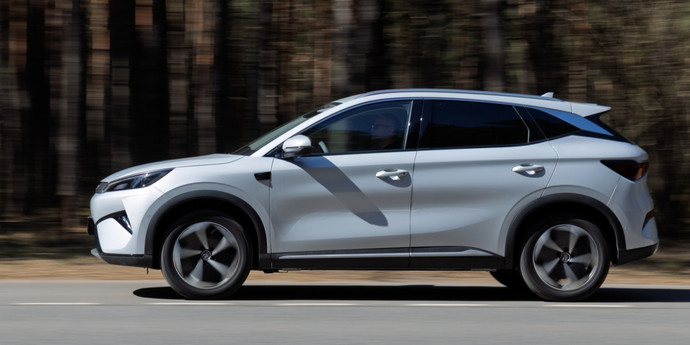
"Chinese automakers are not just coming to Europe, they are already there," declares Motor1.com, commenting on data published by the European Automobile Manufacturers' Association (ACEA). The occasion is provided by the results shown by BYD, which is already "breathing down Ford's neck." And other manufacturers from China are not far behind either.
According to data for the first 8 months of the current year, BYD sales grew by 144.1%, reaching a record high for the brand of 234,099 vehicles. And this is already not far from Ford's declining results — 244,938 units (–14.4%).
"BYD is only 10,839 vehicles behind Ford, and if this trend continues, we would not be too surprised if the two companies swap places in the ranking before the end of the year. BYD's market share in Europe is now 2.5%, compared to 1.1% in the period from January to August 2025. However, this should not come as a big surprise. BYD is doing the exact opposite of what Ford is doing in Europe: rapidly expanding its model lineup," the portal writes.
And indeed, in recent years the American company has removed models such as the Fiesta, Focus, and Mondeo from the European market, even though they were the brand's sales locomotives for decades. The remaining Puma and Kuga are already noticeably outdated and, moreover, do not cover all market segments. Ford will still get new compact models, but using Renault technology.
Not far behind BYD is the SAIC concern (which owns the MG brand): as of August, 230,290 vehicles were registered (+19.7%). Geely's results are even higher: 289,128 units (+11.6%), but it is important to note that these figures include all brands that are part of the Geely Group, including Volvo, Polestar, Lotus, and others.
Chery (including the Jaecoo, Jetour, and Omoda brands) has 207,871 registrations to its name, but here the sales growth rate of 279.7% draws attention.
"If you do the math, Geely, BYD, SAIC, and Chery now hold 10.4% of the European market. That's right: every tenth car registered in Europe has Chinese origins," the publication summarizes.
True, it is worth clarifying that by Europe, ACEA means all 27 EU member states, Iceland, Liechtenstein, Norway, Switzerland, and the United Kingdom. This is not the entire continent, but all the major markets, so the figures reflect the overall trend fairly accurately.