Menu
The agricultural sector of the future: what is changing for farmers - new criteria for benefits, stabilization funds, and the transfer of products free of charge
Today, perhaps, no one doubts that farm households have become an integral part of the country's food security. The state is interested in their development and provides constant assistance in this direction through the means of the republican budget in accordance with the State Program "APK of the Future". To stimulate the activities of farm households, serious benefits and preferences are provided: reduced tax rates for agricultural producers, three-year tax holidays, simplified accounting and reporting.
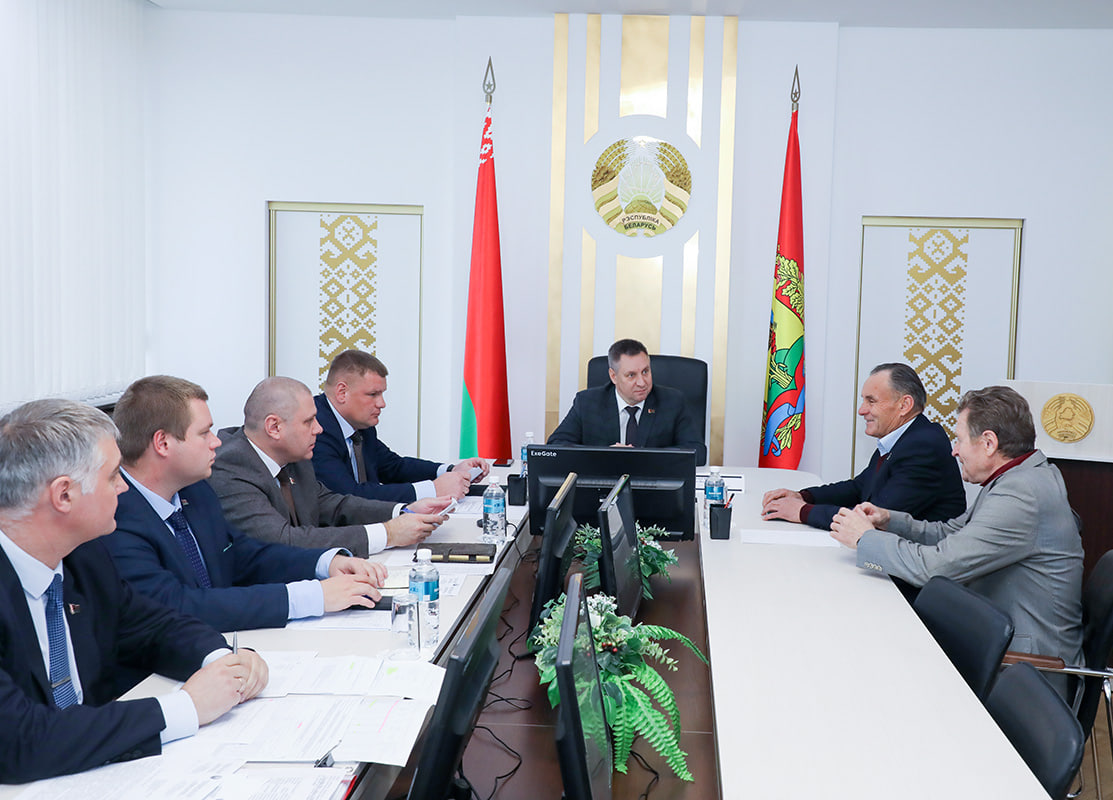
Yuri Gorlov, during a meeting with farmers, detailed the proposals for improving the system of resource distribution in the agricultural sector and emphasized that priority is given to those households that efficiently process the land, demonstrate high agricultural culture, produce high-quality products, and timely pay for the resources received, and actually create jobs in rural areas. It is precisely such households, Yuri Gorlov believes, that should be in the focus of state management bodies and receive targeted state support with a clear definition of areas of responsibility.
A vivid and convincing example for others in this regard, without any exaggeration, is the farm "Pralesak" of the Mogilev district, which is headed by Yuri Korshunov. In addition, Yuri Fedorovich heads the public association "Union of Farmers of the Mogilev Region", which protects the interests of farmers in the region, raises issues of interaction with product processors, and develops agribusiness. In essence, this is a link between the authorities and farmers.
As is known, the official starting point for the formation of farming is considered to be 1991, when the Supreme Council of the BSSR adopted the Law "On Peasant (Farm) Economy". Yuri Korshunov was among the first in the region to decide to become a free farmer. Today, he recalls that during the formation of farming, the norms for providing land for peasant farming were often limited by local executive committees and legislation to 50 hectares, then it was possible to take 100 hectares, and today the KFH "Pralesak" already has around 2,000 hectares.
— At present, my farm, — tells Yuri Fedorovich, — is one of the largest in the region. It consists of up to 56 employees, we have a park of energy-intensive equipment. We are engaged in the cultivation of agricultural crops. We also focus on the effective work of the livestock industry, keeping 39 heads of dairy cattle. To feed them well and get the proper return, we initially prepare a solid feed base, trying to achieve high returns from each hectare of processed land.
The fact that this is indeed the case is eloquently testified by the results of the last harvest. The average yield of grain and leguminous crops in the farm was 65.2 centners per hectare. 239.5 kg of grain was produced per 1 ballo-hectare of sown area. This is the best indicator in the region, which allowed the KFH "Pralесak" to take first place in the regional competition for achieving the best indicators in harvesting grain and leguminous crops in 2026 among agricultural and other organizations.
— The secret to success in achieving high results is simple, — believes Yuri Korshunov. — It is essential to love your work! Be persistent in achieving your goals! The land does not like idlers.
The state gave us the land, essentially, for free. The rent money is not that significant. Look: we work on domestic equipment, our enterprises produce high-quality products, we produce import-substituting goods. This means we are independent. We should be proud of this. I think: the state helps us, so why shouldn't I take a reciprocal step?
And if we talk in general, regarding state support for farmers, first of all, I want there to be no division of the agricultural business into private and state-owned. Both agricultural enterprises and farm households should receive equal support, since we work in equal conditions. We produce food, and export markets should also be equal, since our common task is to ensure food security. As was noted during the meeting in Gorki, all the proposals voiced by farmers during the open dialogue will be taken into account when further refining the mechanisms of state support for agrarians.
As Yuri Gorlov assured the meeting participants, active work is already underway in this direction. The Council of Ministers, together with other interested agencies, has been tasked with ensuring the comprehensive processing and updating of the Law "On Peasant (Farm) Economy" and other legislative acts, including the development of a mechanism for the liquidation of farm enterprises that do not engage in agricultural production and processing, as well as storage. In the opinion of specialists, it is also advisable to review the criteria for applying preferential taxation to farm enterprises - for example, by establishing a higher share of revenue from agricultural production, or by limiting the application of preferential taxation only to such revenue.
It is necessary to work out the issue of participation of large farm enterprises in social projects and take measures to ensure the unconditional fulfillment of farm enterprises' requirements of the Land Code in terms of preserving soil fertility.
The head of the country's agricultural sector also noted that the government is preparing a draft law that will determine how farmers will work in the future. It will affect both fundamental issues - the organization of the economy, its liquidation - and private ones. For example, the participation of farmers in the creation of stabilization funds. Among the rights of farmers, some very interesting ones may appear, such as the possibility of transferring agricultural products to organizations and individuals free of charge.
In addition, starting from 2027, it is planned to increase the share of the consolidated budget for the purchase of mineral fertilizers by 6%. Control over the use of budget funds and the application of mineral fertilizers will be entrusted to the regional executive committees.
In the future, farm enterprises may become the main producers of vegetables, potatoes, fruits, and berries. In animal husbandry, farmers can make a contribution to the breeding and cultivation of meat and dairy cattle, small animals (sheep, goats, rabbits) and beekeeping. In short, there is a vast amount of work ahead.
And for those who think: "I would like to become a farmer," the state will provide education and create all the conditions for fruitful work on the land. The main thing is to have the desire and a sincere willingness to work with full dedication, both for one's own benefit and, undoubtedly, for the prosperity of one's Motherland. As people say, the road will be mastered by those who walk it!