Menu
Simple engines and "frightening" variators. What to expect from used Nissan crossovers
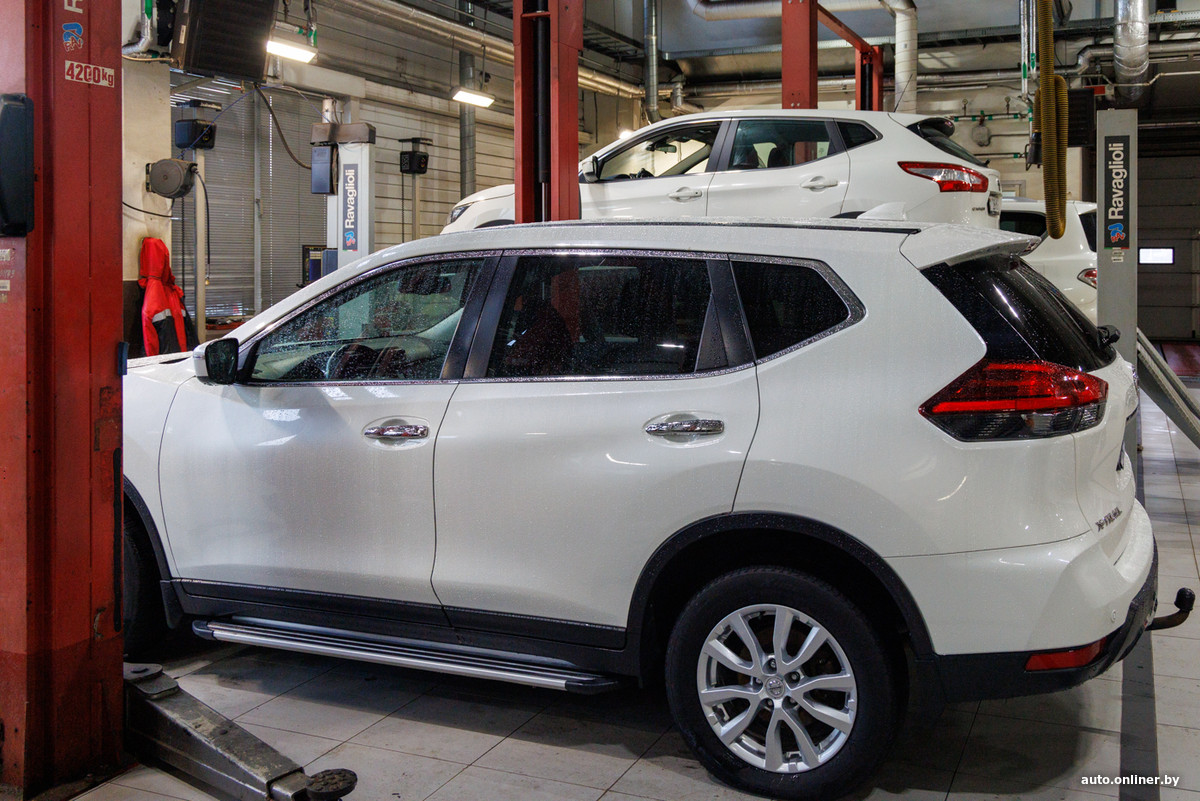
At one time, Nissan crossovers were quite popular in the new car market. Starting with the first generation of the British-assembled Qashqai (2014-2016), which was one of the pioneers of the modern C-SUV segment. But today, we will talk about the second generation of this model (2013-2024), the production of which was also established at the Nissan plant in St. Petersburg. It was from there that the Belarusian dealer received the larger X-Trail T32 crossovers (2013-2025). We should not forget about the first-generation Juke (2010-2019), which was also produced in the UK.
Body and more
On the one hand, some Nissan owners sometimes complain about the loss of their car's appearance: after several years, the plastic may fade and become dull, and the gentle paintwork is not very resistant to minor mechanical damage, which is why scratches appear quite quickly.
But at the same time, there are usually no serious problems with corrosion. Even the oldest examples of the models in question may not have external signs of rust, and everything will look quite decent from the bottom. However, it should be taken into account that the plastic trim covering the arches and sills can hide areas damaged by corrosion - often it forms in such places.
Especially for our visit, all three models mentioned above were brought to the repair zone. It's interesting to see how they look from the bottom.
The master of the repair shop "Drive Motors", Kirill Medvedko, while inspecting the cars on the lift, pays attention to the condition of the heat shields: over the years, they deteriorate at the attachment points, so they start to rattle and hang loose. However, this disease is characteristic of many cars. Over time, it is also necessary to deal with the exhaust system mounting - welding the flanges and mounts.
The Qashqai has a well-developed rear beam. But this element has a large margin of safety, and there is still a lot of metal under the rust. The other two cars look much better, despite the fact that the X-Trail is a 2019 model, and the Juke is a 2016 model. This applies to the body itself. Even the Qashqai has rather local areas of corrosion, and the other two cars confirm that the models in question hold up quite well even with age, but anti-corrosion treatment would still be beneficial.
Installing a protective mesh on the bumper also makes sense, as it will better preserve the air conditioner condenser. However, on cars with a variator, a transmission cooling system radiator is installed at the front. But what is more vulnerable is not the radiator itself, but the steel pipe that supplies it - not from mechanical damage, but from the aggressive environment. It is this pipe that often needs to be replaced on many cars, says a service representative.
Engines
Most likely, the Juke will have a 1.6-liter gasoline-powered HR16DE engine with a power output of 94-117 horsepower, depending on the version. The chain drive in cars that do not skimp on oil and are not subjected to aggressive driving can last for more than 250,000 kilometers. Will it be necessary to adjust the thermal clearances of the valves before this mileage, since hydraulic compensators are not provided for in the design? The manufacturer recommends performing this operation every 90,000 kilometers, but in practice, mechanics encounter the need for such a procedure much less often.
Sometimes you can come across reviews about increased oil consumption, but, as service workers say, this more often happens to those who like to stretch out maintenance intervals or save on the quality of materials used. When replacing spark plugs, it is necessary to remove the intake manifold.
Four-wheel drive Jukes were equipped with a 1.6-liter turbocharged engine with direct injection and turbocharging HR16DDT (190-214 horsepower). After the earliest versions got rid of childhood diseases such as problems with the crankcase ventilation system, the overall reliability of the engine is considered to be decent. But the "charged" version itself provokes a corresponding driving style, which affects the overall technical condition of the engine, the resource of the same chain, and the turbine.
Later versions of the Juke, as well as the Qashqai II, received a 1.2-liter turbocharged engine NR12DDT (115 horsepower). A service station worker calls this unit capricious:
— In fact, it has problems with premature chain stretching, especially if the oil is not changed on time or if there are frequent short trips: in the engine warm-up mode, the engine "enriches", fuel gets into the oil, diluting it, and this affects the resource of the chain, among other things.
According to the source, there were cases where replacement was required at a mileage of around 40,000 km - this was discovered through typical errors indicating phase distribution failures and a characteristic sound.
— There is no specific regulation for the replacement intervals of the timing drive, says Kirill. Some people drive with such an engine and do not know any problems, while others encounter them. He also recalls problems related to the fuel system - the injectors and the fuel pump. This led to low pressure in the system. There were also cases of "oil consumption" due to wear of the cylinder-piston group.
The atmospheric engine 2.0 MR20DD (144 hp) can be found on the Qashqai and X-Trail. It also has a chain and no hydraulic compensators, but, according to service personnel, usually, there is no need to deal with the gas distribution mechanism until 150-200 thousand km.
— It's a good, reliable engine, there are no questions about the fuel or oil system. The only thing that may require attention at some point is the drive belt of the auxiliary units. You will understand that it is worn out by the characteristic squeak, Kirill clarifies.
What about the fact that the spark plugs on this engine need to be replaced carefully? They say that with too strong "over-tightening", you can damage the spark plug wells of the aluminum cylinder head. But our consultant today claims that they have not encountered such cases in the service, especially since the spark plugs are tightened using a torque wrench.
The X-Trail also had a 2.5-liter atmospheric engine QR20DE (171 hp) installed, which in terms of reliability is generally comparable to its 2.0-liter counterpart, but gives the car slightly better dynamics.
The maintenance interval is 15,000 km or once a year, the brake fluid is changed every two years or every 30,000 km, and new spark plugs are installed at the same mileage. Every 90,000 km, it is recommended to replace the coolant.
Diesel versions can also be found on the Belarusian market. For example, Juke and Qashqai with a 1.5 dCi engine are not rare here. We discussed the design features and nuances of this unit in a separate article, and here we will remind you of the main points. After numerous modernizations, the K9K engine is considered resourceful and reliable, and also inexpensive to maintain. Yes, the lack of hydraulic compensators will sooner or later require setting the thermal clearances of the valves, but the belt-driven timing drive is a cheap solution with a predictable resource. If the car came from Europe, where maintenance intervals were 30,000 km, it's worth making sure that the bushings do not need to be replaced. It won't hurt to check the spring of the oil pump's pressure relief valve and the oil filter valve, as these parts could have been the cause of oil starvation at some point.
The 1.6 dCi (R9M) engine can be found on Qashqai and X-Trail. It is also considered quite reliable, however, the chain-driven timing drive is not eternal, and on some cars, it needs to be replaced before reaching 200,000 km.
"We don't cut out or reprogram the particulate filters. The owners of such cars burn out the filters themselves during operation and don't complain to us," says Kirill.
Transmissions
The five-speed manual transmission usually doesn't give any reason for complaints, but the six-speed transmission starts to crunch when shifting into second or third gear with age - usually the cause is "worn-out" synchronizers. Oil change is recommended at a mileage of 90,000 km.
In the case of automatic transmissions, various models of Jatco variators are used on the models in question. For example, the JF015E is used on front-wheel drive Juke, and the JF011E is used on all-wheel drive models. The X-Trail uses the JF016E, and the Qashqai, in addition to the 15th and 16th models, can also be equipped with the Jatco JF017E. The reputation of these units is contradictory, as is the case with most variators. But our interlocutor claims that in terms of reliability, they look decent.
"The weakest transmission is on the Juke: on average, five out of a hundred cars are sent for repair due to it. Qashqai and X-Trail do not have this problem. If you maintain it correctly, use high-quality oil, the variator shows itself to be quite good," notes Kirill, adding that the maintenance interval for variators is 90,000 km.
As for problems, in addition to the already mentioned need to replace the tube, there are nuances related to the hydroblock, wear of the cones, and so on. In the case of serious malfunctions, the box is sent for repair to a specialized service.
In general, to extend the life of the variator, in addition to timely oil changes, it is recommended to avoid increased loads - aggressive driving, wheel spin, and towing trailers. In winter, it is advisable to exclude any loads on an unheated box.
The automatically connected all-wheel drive usually does not cause problems, although over time it may require replacing the crosspiece of the cardan shaft.
Suspension, steering, and brakes
The front suspension is McPherson, and the rear is a multi-link suspension. This scheme is used on all X-Trail and Qashqai, as well as all-wheel drive Juke (on front-wheel drive versions, a simpler semi-dependent suspension is used at the rear).
The dealer's representative draws attention to some differences in English cars - the front subframe without silent blocks and a slightly different design of the levers compared to cars of Russian production. Ball joints are pressed in and cannot be replaced individually. Fortunately, original parts last a long time.
The rear suspension is durable, but over time, the adjusting bolts of the toe-in become rusty and have to be cut off and replaced with new ones.
One of the weak points of Qashqai and X-Trail is the hub bearings, which last approximately 30,000 km. Sometimes we replace them all at once, especially in the spring, notes Kirill. The rear silent blocks of the front levers also do not last long in all models - usually, they require replacement every 2-4 years. In the case of Juke, it is sometimes cheaper to replace the lever assembly.
The specialist says that over time, the stabilizer bushings begin to rattle. How long they last depends on the driving style. At the initial stage, when they just start to creak, lubrication helps, and then they need to be replaced.
The steering system does not have any particular complaints. There have been cases of replacing both the tie rods and the steering racks themselves, but this has not been a widespread issue. There is also a well-known feature that is not exactly a problem, but rather a peculiarity: when the steering wheel is turned quickly, an unpleasant creaking sound appears. To eliminate this, it is enough to lubricate the rubber seal of the steering shaft.
Over time, the brake caliper guides start to stick, so it is recommended to clean and maintain them at least once a year.
In general, according to the interviewee, with timely and proper maintenance, all three crossovers demonstrate a high level of reliability and good repairability. And this applies not only to the chassis, but to the entire vehicle as a whole, from the body to the main components. However, this does not cancel out the need for a thorough inspection before purchasing a desired vehicle.