"We shipped it to the warehouse today, and tomorrow everything is gone." How exporters should work in the new reality
Author: Olga Lenskaya. Photo: Onliner archive
Add to Google's primary sources
Today you loaded goods into warehouses, and tomorrow those goods are gone. So is the money for them. Now Belarusian exporters are calling insurers en masse, but "unfortunately, not all risks can be predicted," as noted by one of the speakers at a conference organized by the Belarusian Chamber of Commerce and Industry (BelCCI) to discuss practical aspects of modern foreign economic activity. On the sidelines of the event, experts discussed working conditions in a rapidly changing environment. We recorded the most important points — for those who are already exporting or just planning to.
The event brought together heads of foreign economic services, logistics specialists, financiers, and everyone somehow connected with exports. The topic was practical aspects of foreign economic activity amid modern challenges. And there turned out to be many challenges: sanctions, export bans, problems with confirming the origin of goods, risks in supplying to marketplaces, the departure of Western brands, and the growing Chinese presence.
One of the most pressing issues raised at the conference was export risk insurance. Against the backdrop of events surrounding marketplaces, Belarusian exporters have en masse encountered a situation where the goods exist, but the money for them does not. Experts also discussed new instruments — the institution of authorized exporters, electronic certificates replacing certificates for resale of goods from third countries, as well as the possibilities of protecting brands through customs registers. Below is the most important from the speakers' presentations.
"The ideal we strive for"
Kirill Pavlyuchenkov
Head of the Department of Rules of Origin, Customs Cooperation Conditions and Preferential Trade of the Trade Policy Department of the EEC.
Kirill Pavlyuchenkov spoke in detail about the specifics of trade agreements with certain countries and focused attention on the development of a new mechanism — the institution of authorized exporters, which will give companies the opportunity to independently declare the origin of goods without contacting a certifying body. According to the expert, this scheme is successfully applied in the European Union, Australia, New Zealand, and many other states.
"This is a fairly interesting document that is used in many Western countries. It is designed to save time and money, and to promote the simplification and acceleration of operations and increase the volume of export shipments under the free trade agreement," the speaker explained.
However, obtaining the status of an authorized exporter is not easy. A company must employ a specialist who is well-versed in the rules of origin of goods and can reliably determine the origin of products. The training of such specialists will be conducted on the basis of the BelCCI. After receiving the authorization, the company is added to a register maintained by the State Customs Committee. Partners, when clearing customs, see that the exporter has the right to determine origin independently and receive preferences without providing a certificate.
The speaker also noted that the EAEU is currently developing an electronic system for certification and verification of the origin of goods, which will make it possible to carry out certification exclusively in electronic format.

Slide from the presentation by Kirill Pavlyuchenkov
The exporter will pass the details of the certificate to its counterparty, and customs authorities will be able to verify them through integrated information systems. The process will become fully automated and digitized.
"No waiting for a certificate will be required — neither an original on paper nor copies or scans. The customs authority will immediately understand that it has reliable, up-to-date information in front of it.
This is the ideal of the origin verification procedure that we are striving for."
They initially planned to launch such a system with Vietnam, but the process dragged on. Now, according to Kirill Pavlyuchenkov, work is underway with China and Serbia. At the national level, some agreements within the CIS already operate with electronic systems.
"Prohibitions are multiplying"
Pavel Pavlyukevich
Deputy Head of the Main Directorate — Head of the Department of Prohibitions and Restrictions of the Main Directorate of Tariff and Non-Tariff Regulation of the State Customs Committee.
An expert recalled that Belarus has a ban on the export of a wide range of industrial goods: machine tools, industrial equipment, machinery, electrical products, engines, generators, cables, communications equipment, computers, electronics, audio and video equipment, vehicles, buses, trucks and passenger cars, as well as components:
"The ban was introduced by a resolution of the Council of Ministers in order to protect the domestic market. It has been in effect since September 22, 2020 and applies to the export of goods outside the customs territory of the EAEU to states that are not members of the Union."
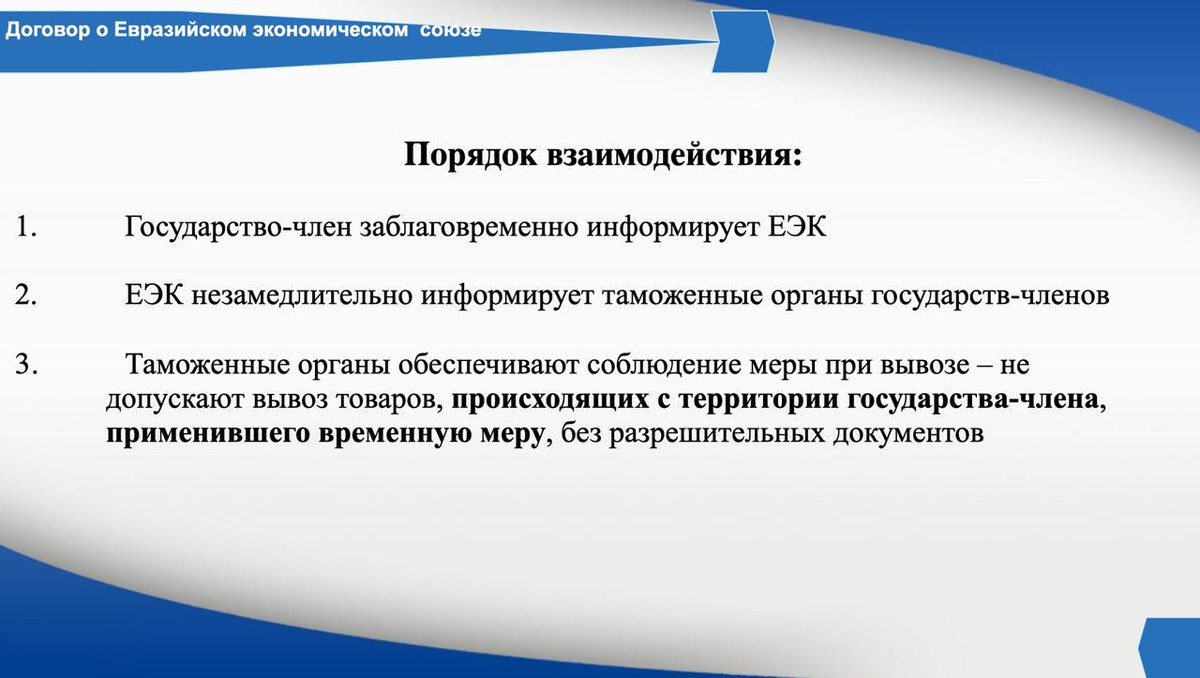
Pavel Pavlyukevich emphasized that despite the desire of EAEU countries to apply uniform regulatory measures, in practice countries often introduce unilateral restrictions. In 2025, 87 restrictions on the import and export of goods were introduced unilaterally.

Slide from Pavel Pavlyukevich's presentation
Belarus, in turn, also introduced restrictions on the export of industrial goods, as well as vegetable products: white cabbage, apples, beets, carrots, cereals (wheat, rye, barley, oats, corn) and some others.
At the same time, if some country introduces a ban, it is obliged to notify the Eurasian Economic Commission. The Commission cannot overturn such a decision, but it records it.
Slide from Pavel Pavlyukevich's presentation
To monitor compliance with regulatory measures, special rules are already being developed that will help determine the origin of exported goods. They will apply to all goods for which bans, quantitative restrictions, or a permit-based export procedure have been introduced.
Pavel Pavlyukevich also recalled changes in threshold amounts: from July 1, 2026, the threshold value of goods for which confirmation of origin is required will be reduced from 10,000 to 5,000 euros. And from January 1, 2029 — to 1,000 euros. This means that confirmation of origin will be required for virtually every shipment.
"Want to reduce the duty? Here's how to do it"
Yuri Gorelik
Head of the Department of International Cooperation and Exhibition Activities of BelCCI.
Yuri Горелик explained to the conference audience how customs and tariff regulation works within the EAEU and how businesses can influence duty rates. He reminded them that the rates of the EAEU's Common Customs Tariff apply only to goods from third countries. Within the Union itself, no duties are levied.
A product code under the TN VED determines not only the duty rate but also all the required permits, licenses, and statistics. The first six digits of the code are universal for 98% of global trade and are determined by the WTO. The remaining digits are decided by the country or the Union.
"If you want to raise the rate, you first need to check Russia's commitments to the WTO. If there is already a WTO-bound rate, you cannot raise it above that. If, however, there is technical room, you need to prepare an economic justification: show that your output can saturate the market and that the price is competitive. Lowering the rate, on the other hand, can be done without looking back at the WTO — even down to zero. But it's important to understand here: if you lower the rate in the interest of one enterprise, others may suffer. That's why the decision is made based on a balance of interests."

Slide from Yuri Горелик's presentation
The expert described the procedure in detail: the enterprise prepares an application, coordinates it with the relevant ministry, and then the package is sent to the EEC, where it is reviewed at meetings of the specialized committees.

Slide from Yuri Горелик's presentation
Previously, the process was lengthy, but after 2022, according to the speaker, many procedures have accelerated.
"You can be left without both the goods and the money"
Alexey Makayev
Head of the Export Risk Insurance Department at BRUPEIS "Beleximgarant."
Alexey Makayev told the audience about the insurance instruments that help exporters when force majeure occurs.
"It's no secret that we have exporters who loaded goods into the warehouses of well-known marketplaces. They are promised some compensation, but let's look at the facts. For now, the reality is that you can end up without the goods and without the money."
According to the expert, after attacks on the warehouses of Russia's largest marketplaces, the number of insurance inquiries has surged. "After it happened, everyone wants to get insured," he said. In his view, not all risks can be predicted. He explained how the scheme for insuring export contracts works, presenting a detailed diagram on a slide.

Slide from Alexey Makayev's presentation
Alexey Makayev also answered a question that exporters often ask: "Why can't you insure my risks at 100%? I'm ready to pay." His answer sounded logical:
"If an exporter is not willing to bear even 10% of the responsibility for his own choice, then perhaps he's simply not ready for serious foreign economic activity. Insurance covers the main part of the risk, but a small share remains on the conscience of the entrepreneur himself." And in the speaker's opinion, this is the right approach.
"There are almost no Western brands left in the registry"
Mikhail Khodosevich
Associated Partner at the law firm Arzinger.
Mikhail Khodosevich told the audience about customs registries of intellectual property objects — a tool that helps protect brands from counterfeiting and "gray" imports. At the same time, the speaker noted:
"The customs registry is not a guarantee of legal protection for your brand. Before using the registry, you need to make sure that your brand is registered as a trademark in the specific territory. Without this, there's no way."
The expert pointed out that the structure of rights holders in the registry has changed dramatically over the past four years. Previously, there were many Western, Japanese, and South Korean brands.
Now there are practically no Western brands left. Their place has been taken by Chinese companies — currently they account for 50—60% of the registry.
"The problem for Belarusian entrepreneurs is that Chinese companies are not very amenable to agreement in this regard. If you want to ship goods without the approval of the official Chinese manufacturer, the Chinese are reluctant to make such concessions and far from always allow such shipments."
Mikhail Khodosevich also mentioned that Belarus and Russia have a law on parallel imports that allows bringing in goods without the rights holder's permission, but this doesn't work for all categories and requires special caution.
"Simply cutting a product into pieces is not enough"
Nikolai Zhukovsky
Head of the Certification and Expert Activities Department of the organizer of the conference of the Belarusian Chamber of Commerce and Industry.
Nikolai Zhukovsky explained how to obtain certificates of origin and why basic processing of goods does not grant the right to Belarusian origin. The expert began with the fact that the world has many rules for confirming origin — within the CIS, with third countries, national legislations, and so on:
"Most agreements have their own specifics, which both experts and exporters find difficult to understand. Therefore, before concluding a contract, if you want to obtain a confirmation certificate, carefully study the agreement with the second country. For example, under CIS rules, the criteria for sufficient processing include, for instance, a change in the product code at the four-digit level or a share of material costs not exceeding 50%. Cutting, packaging, and mixing are simple operations, and in our country they are not considered sufficient processing.
If you simply cut a product into pieces, packaged it, and want to pass it off as a Belarusian product — we cannot issue a certificate."
Nikolai Zhukovsky reflected in detail the specifics of confirming the country of origin of goods in his presentation:


In conclusion
At the conference, speakers were unanimous: we need to be prepared for the fact that the rules of the game will change rapidly. Those who master the new mechanisms and learn how to hedge risks will gain an advantage. The rest will have to play catch-up.
Do you enjoy reading Onlíner? Add our news to your Google "Primary sources"
Got something to share? Message our Telegram bot. It's anonymous and fast