Menu
Shabby, but charming
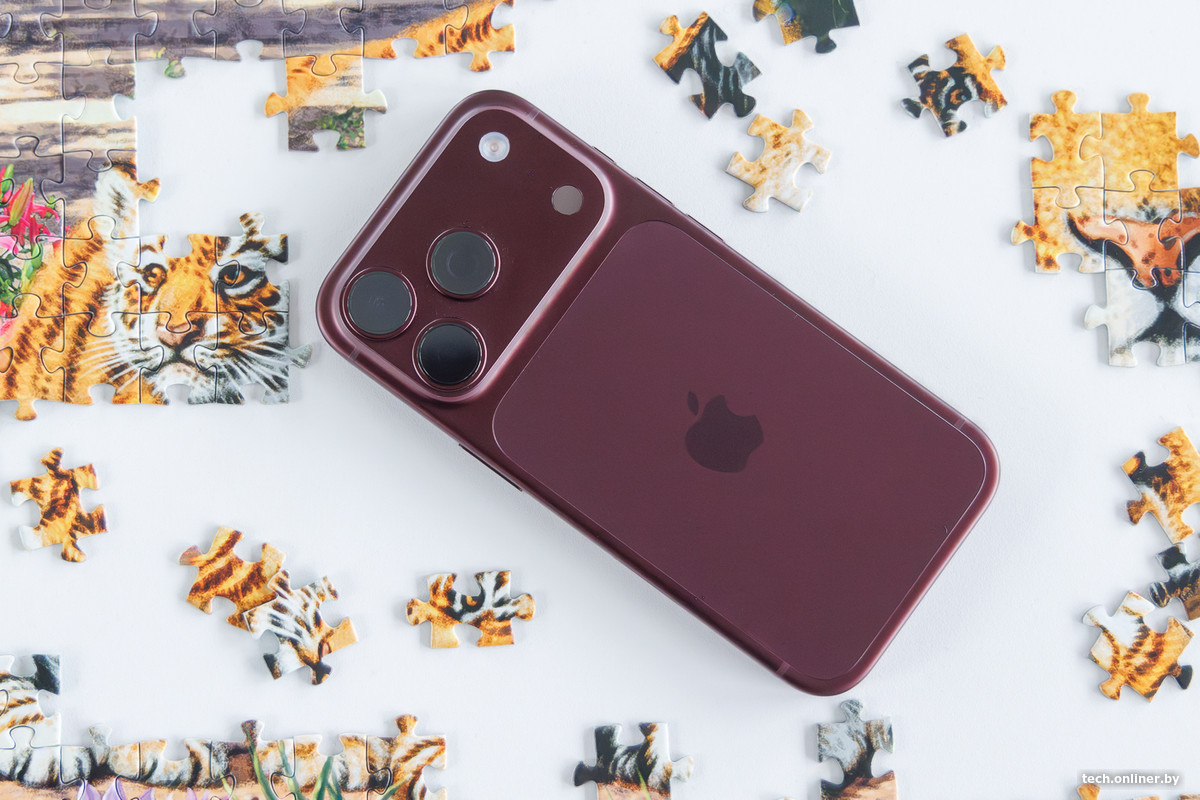
On September 9, Apple presented the latest generation of its smartphones. Paradoxically, the most "budget-friendly" gadget at the moment is the iPhone 18 Pro — the release of the real "base" model is still pending. We were able to get our hands on the new device and test it in all aspects: we're telling you how successful this device turned out to be and whether it's worth upgrading to it from the iPhone 17 Pro.
Notable, but charming
This iPhone is available in four colors: silver, black, blue, and burgundy. It's the latter option, which seems the most interesting in this release, that we got our hands on.
As with the iPhone 17 Pro, the main material for the body is aluminum. It's complemented by a glass insert located on the back cover. This element of the body eagerly collects fingerprints, so we advise aesthetes to get a case, or at least a microfiber cloth.
The display boasts a Ceramic Shield 2 coating: according to Apple, the resistance to scratches is three times higher than that of the iPhone 16 Pro. Judging by the data from blogger JerryRigEverything, the screen stoically resists scratches, but the device's body copes with them worse, and the colored aluminum can quickly become scratched.
In terms of controls, there are no differences from the previous year's model. On the left, there's the familiar Action Button and volume control buttons, on the right, there's the screen lock and Camera Control. The version we got our hands on didn't have a physical SIM card slot, so there's an additional antenna insert on top, necessary for the correct operation of eSIM.
The device weighs 211 grams, the body thickness is 8.75 millimeters, and the screen diagonal is 6.3 inches. The iPhone 18 Pro is protected according to the IP68 standard and feels great in the hand, as there are no problems with balance.
And there's good news for those who didn't want to spend money on new cases: cases from the iPhone 17 Pro should fit the new device, since the physical dimensions in terms of height, thickness, and width of the smartphone remain the same. Why Cupertino decided to be generous is a mystery.
An excellent screen with a "slimmed-down" Dynamic Island
Owners of the new "proshka" can expect the already familiar OLED with ProMotion support, dynamic screen refresh rate of up to 120 Hz, peak brightness of 3000 nits, oleophobic and anti-reflective coating. Symmetrical thin frames, vibrant colors, and no distortion when rotating - the iPhone 18 Pro display can be safely called exemplary. It would be more surprising if Apple had done something wrong in this regard and the new screen was inferior to last year's release.
In terms of the display, the key update is perceived as Dynamic Island, which has decreased by 25%. This was made possible by moving the infrared camera under the screen: now it is located in the top left corner and can only be noticed on a white background, and even then with some effort.
The space freed up by Apple is proposed to be filled with three dynamic Live Activity notifications at once: for example, the music being played, the training indicator, and the timer can be displayed. Subjectively, this update cannot be called groundbreaking, but it is another step towards an iPhone with a pristine clean screen. Perhaps this is exactly what will happen with the anniversary version of the smartphone.
Decent autonomy and increased performance
The iPhone 18 Pro boasts a 4056 mAh battery: an increase of +1.7% compared to the previous generation. At the same time, the situation is more optimistic for the 18 Pro Max, where the battery capacity has increased by 11.7%.
Apple claims that the device can be charged to 50% in about 15 minutes. And this corresponds to reality - with this arrangement, it is indeed difficult to stay with a completely discharged smartphone. Note that in mixed usage mode, which included games, music listening, video watching, and web surfing, the gadget can last a little over 16 hours.
At the same time, autonomy is not the key advantage of the iPhone 18 Pro: instead, Apple puts performance at the forefront. It's all about the A20 Pro processor, which the company calls the "most powerful and efficient chip for iPhone". A dual-block 16-core neural processor is used here, allegedly guaranteeing a 50% increase in memory bandwidth, and all this is equipped with a new generation vapor chamber, the area of which has increased threefold. It is claimed that in combination, these updates make the iPhone 18 Pro 40% faster in terms of graphics performance than the iPhone 17 Pro.
What does all this mean for a user who is not going to remove the back cover of their smartphone to examine the processor from all sides, and does not plan to run the device through a series of AnTuTu tests? At the very least, you can count on agility and smooth operation without overheating, even if you like to jump from Genshin Impact sessions to 4K video recording and back.
By the way, what about video recording?
The cameras have become another feature of the iPhone 18 Pro. The key hardware change is the variable aperture in the main camera, with which users can manually switch between f/1.48, f/1.8, f/2.8, and f/4.0 and control the amount of light that enters the matrix.
Both the main camera and the ultra-wide-angle camera and telephoto lens are 48 megapixels. The focal length of the "main" camera is 24 millimeters, the "wide" camera with a 120-degree field of view and hybrid focusing sensors is 13 millimeters, and the telephoto lens with four-fold optical zoom is 100 millimeters. The front camera has 18 megapixels and allows you to take horizontal shots, even if you hold the device vertically.
Controlling all this has become easier thanks to full-fledged manual shooting settings located in the standard camera app. In addition to focus, white balance, and exposure adjustment, you can add a histogram, as well as focus tracking - the latter makes life easier when shooting moving objects.
Globally, the iPhone 18 Pro is primarily worthy of praise for the aforementioned manual settings, exemplary zoom, and night shooting — even with a lack of light, the frames remain clean, without excessive noise. However, the variable aperture is largely perceived as a specialized tool that the vast majority of users simply will not use.
In total, should we upgrade or not?
If you already have an iPhone 17 Pro, there is no urgent need to purchase the new Cupertino device — unless, of course, you are a fan of burgundy.
This time, Apple focused on work "under the hood," and for many, the improved processor, expanded camera settings, and slightly reduced Dynamic Island may seem like minor details. This is largely because last year's Pro model still takes good pictures, launches videos, and plays content just as well. Here, form often prevails over content, and the updates inside the 18 Pro seem like minor details compared to what users will get from the same iPhone Duo.
At the same time, if you are using an iPhone 15 Pro or later, the iPhone 18 Pro may become your potential match. Simply because it will be an improvement in all parameters - from enhanced autonomy and increased performance to updates in terms of body design, cameras, and AI capabilities.
In summary, in a vacuum, the iPhone 18 Pro is good in itself. But the answer to the question of whether to take it or not will directly depend on what you already have in your pocket.
We thank the i-Store store for providing the smartphone for review.
Bittrex24 Vibrocode: from idea to application - in just a few minutes
Previously, to automate non-standard processes, it was necessary to find a developer, prepare a detailed technical specification, and wait weeks for the result. With Bittrex24 Vibrocode, it is enough to describe the task in ordinary words - AI will write the code, connect the portal data, and launch the ready-made solution - from a special report to a CRM assistant.
Where to start? Open Bittrex24 Cowork/Code - an AI employee with application creation mode. It will guide you from idea to working tool.
Vibrocode is available on any paid Bittrex24 tariff. Within the platform, there is its own balance - vibes.
Here is a detailed guide that collects everything you need for a confident start: vibrocode scenarios, portal connection formats, and key platform concepts. Take a look at it to use Vibrocode to the maximum.