Menu
Secrets of the 'Fortress on Water': archaeologists unearthed a unique medieval bridge in Krevo Castle
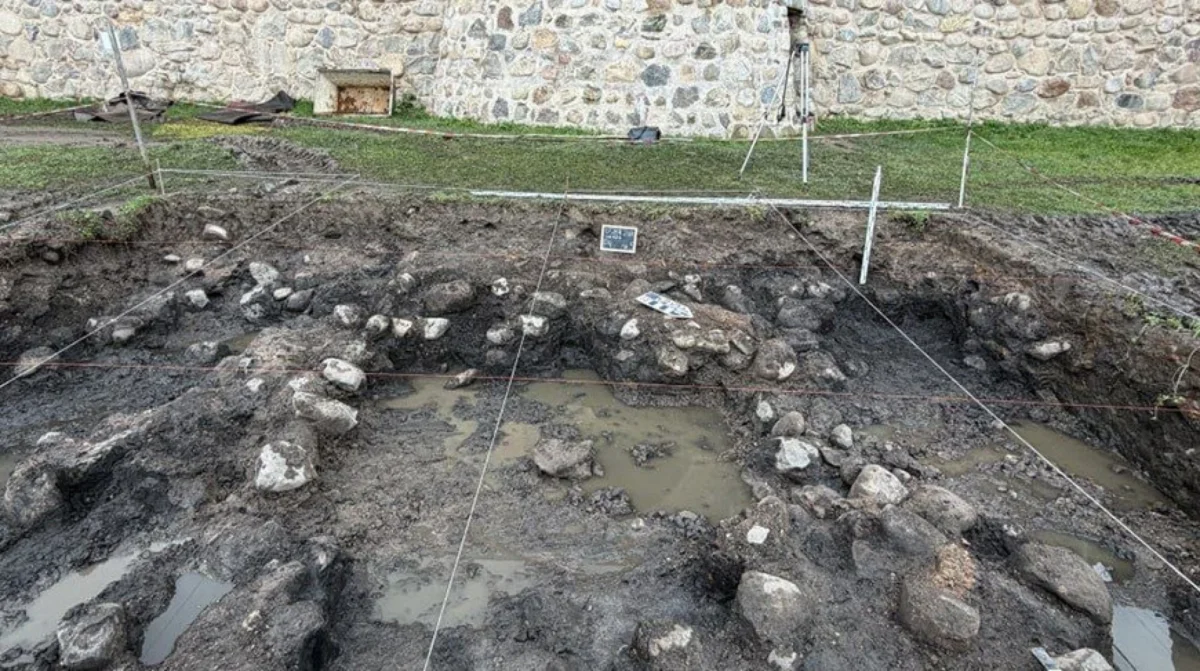
Large-scale excavations at the legendary Kreva Castle have brought scientists a sensational discovery. An expedition from the Institute of History of the National Academy of Sciences of Belarus, led by leading researcher Oleg Dernovich, has uncovered the preserved foundations of an ancient bridge in the inner courtyard (detinets).
The find completely changes conventional understanding of the internal infrastructure and defensive strategy of one of Belarus's oldest stone citadels.
Medieval Engineering Masterpiece
Archaeologists conducted a detailed study of two lines of parallel stone masonry that once served as reliable supports for massive wooden structures. This ancient bridge performed a strategic function: it ran directly from the Small Gate (Malaya Brama), crossed the castle pond, and led to an artificial earthen mound right inside the fortress courtyard.
While cleaning the ancient masonry, researchers uncovered a number of important details:
- Niches for vertical piles: special grooves in the stone that firmly secured the wooden support beams.
- Unknown structures: remains of foundations of small buildings located directly beneath the bridge and in its immediate vicinity. Scientists have yet to determine their exact purpose.
Life Surrounded by Water
The discovered structure vividly confirms the historical concept of Kreva Castle as a "fortress on water." The citadel was erected on marshy terrain, and during its construction an artificially flooded zone was deliberately created.
The castle's defenders had to live for years surrounded by water. The bridge that was found was not merely a convenient thoroughfare but an extremely complex element of fortification. It played a dual role: it ensured the safety of the gate during an assault while simultaneously functioning as part of an effective water-regulation system (controlling the water level in the castle pond).
Return from Oblivion: The Bridge Will Be Restored
The important archaeological discovery came just in time: a new phase of extensive investigation has begun at the site in collaboration with specialists from Belrestavratsiya OJSC.
The current restoration project for Kreva Castle officially provides for the complete recreation of two historical bridges on its grounds. Now, thanks to the discovery of the authentic stone foundations, one of these bridges will be reconstructed with maximum historical accuracy in its original location.