Menu
Rivals Nokia 3310 in durability? Review of the Honor X9e Pro smartphone with a cunning chip
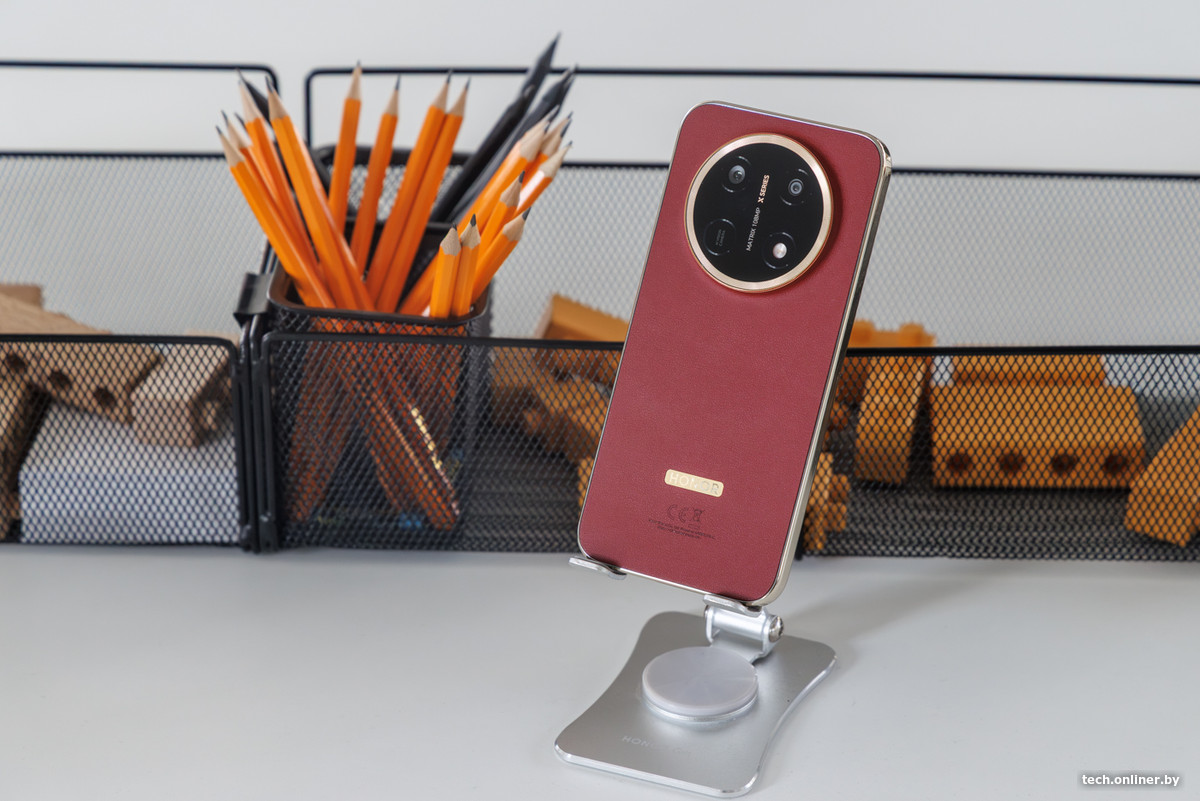
The company Honor presented the smartphone Honor X9e Pro at the end of September. The novelty immediately attracted attention with its very capacious battery, even by today's standards, at 11,000 mAh, which was once the prerogative of power banks. Looking ahead, it can be said that this is very convenient - after a couple of days of active testing, the smartphone had to be charged only towards the end, although benchmarks were run and games were played.
Design and Ergonomics
The Honor X9e Pro will be available in Belarus in three out of four color options: graphite, purple, and terracotta, which was the one we reviewed, while the golden option was left out. It looks rich, as the saturated color of the back panel is combined with a "golden" rim of the main camera, edges, and the Honor inscription at the bottom. On the one hand, there is a feeling of premium quality, on the other hand, this approach to design is usually found in mid-range devices rather than flagships. In any case, it's not a boring rectangle.
Apparently, the material is so-called eco-leather, which by texture resembles natural leather. The tactile sensations are ambiguous: if you run your fingertips over the material, you get a rustling sound that evokes the image of dense paper. However, the cover is never cold and, as practice has shown, not hot either, it remained only slightly warm even after heavily loading the system with tests.
The photo module is traditionally raised above the body, and the material of the back panel partially extends to the camera, so dust and dirt will not accumulate at the base. The golden "bezel" around the lenses also has a nice texture that plays with the light.
The edging is made of plastic with a polished gold finish, but the color is more subdued, and at a certain angle, it looks like light chrome. Thanks to the material, there are no noticeable inserts for the operation of wireless modules along the perimeter.
On the right side, there are classic volume rocker and power button, they have a large travel and a noticeable tactile response, although the volume button could be longer and more raised above the side, but this is a matter of habit. On the top side, there is an additional speaker and microphone, on the left side, there is nothing, on the bottom side, there is a slot for SIM cards, microphone, Type-C, and the grill of the main speaker.
The screen is flat, so the frames around it are noticeable, they can be attributed to the category of thin and not striking.
The Honor X9e Pro fits comfortably in the hand, with a well-balanced weight distribution, nothing slips, and it's hard to accidentally drop it, as the device doesn't cut into the palm. The smartphone's dimensions are 162.2 × 77 × 8.1 mm, and it weighs 203 grams.
The distinctive feature of the line remains its "protectiveness". This is not a classic "brick" with plastic bumpers and a massive body, but rather the characteristics of the materials and internal design (in particular, the screen mounting) provide the smartphone with resistance to damage from falls from a height of up to three meters and other "tortures". However, again, we did not try to test its durability. The description also states that the smartphone meets the IP69 standard and can withstand immersion in water at a depth of 10 meters, not 1.5 meters, as usual.
It probably won't compete with the original Nokia 3310 in terms of durability, but still.
Performance, battery life, and screen
The smartphone is equipped with a Snapdragon 6 Gen 5, a 4-nm chip oriented towards the mid-range segment. One of its distinctive features is the algorithms that allow for increased "visible" performance: applications launch faster, there are fewer freezes, and the interface works more smoothly - this was stated by Qualcomm in its announcement in May 2026, which promised to rid affordable Android smartphones of "lags". The device runs on MagicOS 10 based on Android 17.
The amount of RAM is 6 or 8 GB, depending on the configuration. It seems that the influence of the crisis is noticeable here, as 6 GB of RAM already looks like a minimum that you wouldn't expect to see even in a mid-range device - you want more. Although what to do with these 8 GB? The usual fast RAM is helped by an additional 16 GB of slower "virtual" RAM from the storage, which, in turn, has a capacity of 256 GB in the junior and 512 GB in the senior version of the Honor X9e Pro. Apparently, from old stocks - a storage device with a capacity of half a terabyte. But to keep the price in check, the version with 12 GB of RAM (available not in all regions) is only supplied with a 256 GB storage device.
The version of the UFS storage device could not be precisely determined. Some sources claim it is 3.1, however, the speed shown by the permanent memory in synthetic tests when writing data does not reach the indicators of UFS 3.1.
If we evaluate it "by feel", the storage device is definitely not the fastest, but there is also no agonizing feeling of waiting when installing large applications.
The benchmark results are as follows, the smartphone was switched to "performance" mode after setup:
One interesting aspect is the behavior of the system in the throttling test. Usually, the benchmark starts with a high frequency, which then decreases due to heating, but here we see the opposite situation: the core frequency increased and remained close to the maximum. At the same time, the heating, as mentioned above, remained very low (for the created conditions). Well, either this is another plus in the piggy bank of autonomy time and system optimization, as well as cooling, or the Honor X9e Pro is excellently optimized to work with such a benchmark. However, there was also no noticeable heating when recording video in 4K format, and the same applies to games, so it seems that it is indeed the combination of optimization and system cooling.
In general, there were no problems with games, the Snapdragon 6 Gen 5, apparently, works as Qualcomm planned.
The battery capacity is 11,000 mAh, which is really a lot, especially considering the compact body for the diagonal and adequate weight. Fast charging at 80 watts is also available. Apparently, it is quite difficult to drain the battery: with system setup, software installation, games, and tests with photos, it was possible to "remove" about 50% of the charge. That is, the phone can easily last a couple of days, if you are not a hardcore gamer - and it will do so easily. In standby mode without disconnecting from communication networks, it will live for at least a couple of weeks, or even a month.
The display on the Honor X9e Pro is a 6.8-inch AMOLED with support for 120 Hz and a resolution of 1280×2788 pixels. The frames are of average width for its class, uniform around the perimeter - not the thinnest, but not eye-catching either. Plus, there's a traditional set of features designed to protect your eyesight, the ability to adjust the screen temperature and refresh rate, and the resolution can be changed to "smart" - it adjusts to the content (if disabled, the image is apparently always at its passport values). There were no questions about brightness or contrast. The scanner is built into the screen, and there's also face unlock.
Camera
The main camera is 108 MP (f/1.7, PDAF, OIS), the ultra-wide-angle camera is 5 MP (f/2.2), and video recording is up to 4K at 30 fps. There's a separate macro mode, but it traditionally works best with the lightest zoom.
Regardless of the zoom factor, it's not recommended to use zoom and "wide" in night shooting: on the smartphone screen, it looks great, but on a large screen, artifacts from the noise reduction and AI activity start to appear, and the quality noticeably decreases.
Night shooting is better done in night mode. However, there are nuances: the camera tries to capture as much light as possible, and the photos look overly bright, which can be corrected by adjusting the brightness directly during shooting (but you need to remember this, since on a small screen, everything looks great anyway). If you shoot in automatic mode, the photos turn out too dark.
Twilight:
The most challenging conditions for the Honor X9e Pro camera are twilight, and then the photos slightly lose saturation, or almost complete absence of external light sources (which is normal for the automatic mode of any smartphone camera).
Nighttime:
It's worth noting that when shooting at night, the camera's ability to capture light and produce a good image is compromised, and the photos may not turn out as expected. However, this can be improved by using the night mode and adjusting the brightness settings. Overall, the camera on the Honor X9e Pro performs well in various lighting conditions, but may require some adjustments to produce the best results.
Night mode
Almost complete absence of lighting:
Without zoom
Night zoom more than x3
Night zoom x3
Zoom:
Macro:
Daytime:
Note: The text appears to be a series of photo captions, with some descriptive phrases in Russian. The translation aims to preserve the original meaning and context, while providing a natural and fluent English translation.
Overall, the camera tends to boost saturation and contrast, resulting in vibrant photos when shooting in bright light: not very natural, but beautiful.
The AI functions remain in place, which is more of a demonstration of capabilities, as they are not used frequently on a permanent basis.
Conclusions
The Honor X9e Pro, first and foremost, wins over with its capacious and truly long-lasting battery. There were almost no questions about performance: once again, it becomes clear that synthetic benchmarks do not reflect the real state of affairs. As for the word "almost", this is likely a question for the slow storage: for some time after the first turn-on, the phone demonstrated stuttering, which then disappeared (apparently, the number of background processes decreased). At the same time, the phone remained always cool, which is directly good - in games and other resource-intensive tasks.
The body has an interesting color and is tactilely unusual - for someone, this can become a reason to choose it or, on the contrary, an argument against, however, this is still not an average design (rather a return to past trends). Yes, the "golden" edging and camera rim also look harmonious with the burgundy color, but still, it's a matter of taste. The camera is characteristic of its class: it shoots excellent photos in good lighting and starts to malfunction in twilight or with insufficient light.
As for prices, the Honor X9e Pro is offered for 1600 rubles for the 6/256 GB modification at the start of sales, for the version with 8 GB of RAM and 256 GB of built-in storage - 1700 rubles, and the top-end 8/512 configuration will cost 1900 rubles.
Alternative
In this price range, it is worth paying attention to the Xiaomi Redmi Note 17 Pro Max 5G. This smartphone is equipped with the same chip, it has a similar screen diagonal, a camera with a resolution of 50 megapixels, and a battery capacity of 10,000 mAh, with 8 GB of RAM. The Samsung Galaxy S26 FE, in turn, features a proprietary Exynos 2500 chip, 128 GB of built-in memory, a slightly smaller 6.7-inch screen with a 120 Hz refresh rate, and a 50-megapixel camera. The Google Pixel 10a is a compact smartphone compared to others, with a 6.3-inch screen, a proprietary Google Tensor G4 chip, 8 GB of RAM, 256 GB of built-in memory, a 48-megapixel camera, and a 5100 mAh battery. The smartphones can be compared via the link.