Menu
Production, investment projects, and modernization. The Chairman of the Oblispolkom Alexey Kushnarenko visited the Borisovsky KHP, its branch, and structural subdivision.
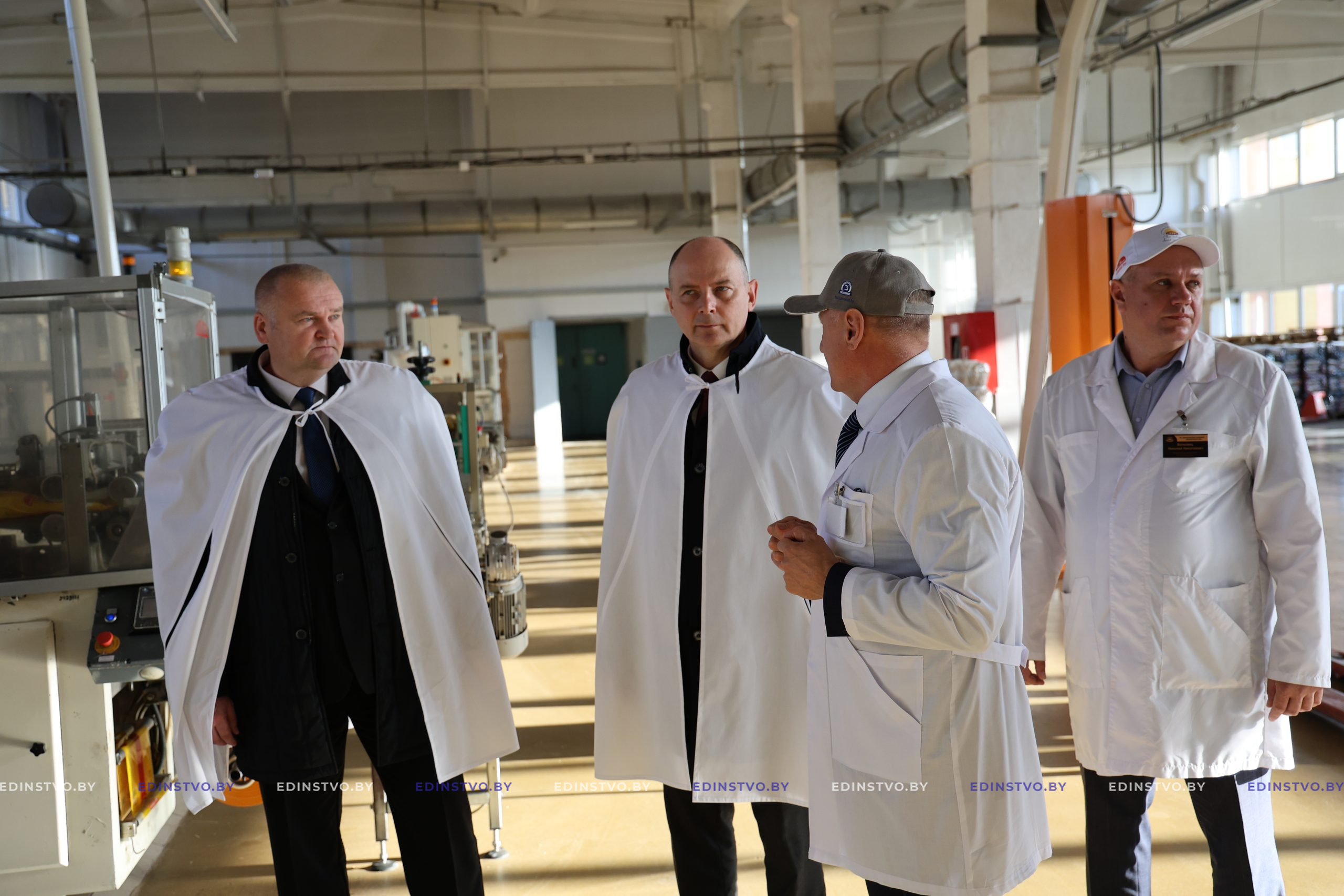
During the visit of the chairman of the oblispolkom Aleksey Kushnarenko to a large agro-industrial enterprise, a detailed picture of the work of Borisovskiy KHP and its branches was presented - from grain processing and pasta production to animal husbandry, meat processing, and related areas.
More than 4,500 people work at the enterprises: 3,183 in industry, and 1,368 in agriculture. The activity is represented by Borisovskiy KHP, the branch "Borisovskiy meat processing plant", the branch "Gorodeyskiy grain reception point", and 4 bread factories (Borisovskiy, Soligorskiy, Molodechnenskiy, and Vileyskiy), 10 pig complexes, the agricultural enterprise "Bolshie Novoselki", as well as a number of branches and divisions, including the Pleshchenitskiy branch, and managed structures - the pig complex "Negnovichi" and the Molodechnenskiy grain products plant, UP "BorisovAgroAlliance".
The structure of product output is diverse: feed products, flour and cereals, meat, meat products and sausages, pork and bread. At the same time, the enterprise provides about 69% of the production of pasta products in the republic.
Particular attention was paid to flour production during the visit. Grain storage is ensured by a network of elevators with a total capacity of 160,000 tons. Daily processing of food grain reaches 300 tons.
Pasta production is organized on four lines: three of them produce short-cut products, and one line produces long pasta (spaghetti, noodles).
During peak periods, the enterprise produced up to 2,800 tons of pasta per month; the current stable volume is around 2,200 tons.
The production of compound feed ensures the release of 400 tons of compound feed per shift, operating around the clock. The production of the entire line of premixes has also been mastered here. Additionally, the direction of extruded dry pet food for dogs and cats is being developed: the line is at the stage of commissioning.
In the livestock segment, systematic work is being carried out to restore and modernize. In crop production, the processed areas are approaching 30 thousand hectares; this year, a harvest of about 100 thousand tons of grain and rapeseed is expected. The yield of rapeseed reaches 42-44 centners per hectare, and grain - over 40 centners per hectare.
The meat processing plant operates on the principle of a complete waste-free cycle: all bone, meat, and other waste is processed into bone meal, feed fat, and blood meal. The volume of bone meal production is 140 tons, which significantly reduces the cost of products. The production of sausage products has grown to 128% of the level of the previous year, almost doubling.
Special attention was paid to infrastructure and environmental projects during the inspection. The company is implementing a project for a boiler house using grain waste (third-class waste): two boilers are planned to be launched in mid-November. At the same time, the canning production is being developed: the current output is 2500 cans of meat canned goods per day in glass containers, and it is planned to increase the capacity by 3-4 times. Among the promising investment projects are the line of burger patties and the production of "Panko" breadcrumbs.
The products are in demand on external markets due to the reputation of the enterprise and strict adherence to GOSTs - in particular, in the production of sausages, recipes according to Soviet standards have been preserved, which are valued by constant partners.
In addition to the main production, non-core but in-demand areas are being developed. The enterprise has a hotel, a restaurant, a dormitory, and a sewing workshop under its management. It is also engaged in providing construction services. These areas not only bring in additional income but also allow for the maintenance of social infrastructure and the provision of employment.
In the course of his working trip, Alexey Kushnarenko assessed the scale and complexity of the production system, where traditional technologies and modern solutions are combined, and also saw the key points of growth, and heard about problematic issues.
The enterprise is not just holding its position in a saturated market, but is also systematically investing in development, while maintaining the principles of naturalness, waste-free production, and social responsibility.
Tatyana SAKOVICH, photo by the author
Post Views: 2