Menu
Preparing the bed for winter garlic – complete guide
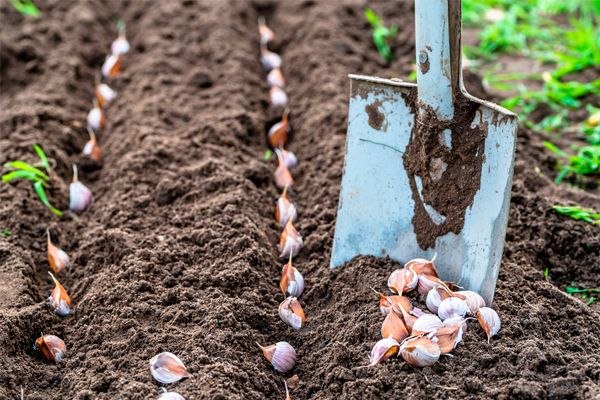
Winter garlic is valued for its ease of cultivation, because autumn planting frees up time in the spring. However, the harvest directly depends on the quality of soil preparation. The bed is prepared in advance, allowing fertilizers to be applied and the soil structure to be improved before the cold weather sets in.
Choosing a location and predecessors
Garlic is demanding of light and moisture, so the area should be level, since stagnant water leads to rotting of the bulbs. The soil should be loose, fertile, and neutral in acidity. If green manures are growing in the bed, they are mowed and incorporated into the soil two weeks before planting. To speed up the decomposition of organic matter, EM preparations are used, after which the bed is covered with black agrofabric.
The best predecessors for garlic are cucumbers, zucchini, early cabbage, legumes, and grain crops. Garlic itself can be returned to its former place after four years. Garlic cannot be planted after onions, since these crops are affected by common diseases and pests.
Organic fertilizers: benefits and limitations
Garlic grows well on loamy and sandy loam soils, while sandy soil leads to a lack of moisture and nutrients, causing the bulbs to grow small. Heavy clay soil retains water and causes rotting, so deoxidized peat, leaf humus, and compost are added to clay soil, while sapropel or lowland peat is added to sandy soil.
Fresh manure and chicken droppings are not applied to winter garlic, as they cause root burns, and excess nitrogen stimulates leaf growth at the expense of bulb formation. Organic matter is best applied to the preceding crop, but if this was not done, 6-8 kg of mature compost or vermicompost is added per square meter.
It is permissible to use fish meal, bone meal, mustard cake, and wood ash, but ash is only suitable for slightly acidic soils and cannot be mixed with phosphorus fertilizers, since this makes phosphorus unavailable to plants.
Mineral fertilizers: potassium and phosphorus
The combined use of organic matter and minerals gives the best result. Nitrogen comes from plant residues, while potassium and phosphorus are applied in the fall, since these elements ensure overwintering and the future harvest. They do not leach from the soil and are fixed in the root zone.
Phosphorus is responsible for the development of the root system and participates in the transport of nutrients. When it is deficient, nitrogen, potassium, and magnesium are absorbed less effectively, and young plants are especially sensitive to phosphorus deficiency. Potassium participates in metabolism, helps absorb nitrogen, increases resistance to diseases and bad weather, accelerates ripening, and improves the keeping quality of the harvest. Potassium removal from the soil is high, so potassium fertilizers are applied annually.
A popular phosphorus fertilizer is superphosphate, which contains monocalcium phosphate, phosphoric acid, magnesium, and sulfur. Simple superphosphate contains up to 26 percent phosphorus, while double superphosphate contains about 50 percent; the application rate for simple superphosphate is 40 g per square meter, while the double rate is halved. On slightly acidic soils, phosphate rock flour is used instead of superphosphate at a rate of 100 g per square meter.
Effective potassium fertilizers are potassium sulfate and potassium magnesia, which are applied at 25-30 g per square meter and worked into the soil to a depth of about 10 cm. These fertilizers contain sulfur, which participates in the synthesis of essential oils and enzymes, increases resistance to temperature fluctuations and diseases, while sulfur deficiency causes garlic to lose its taste and aroma.
Complex autumn fertilizers
For winter garlic, complex fertilizers labeled "Autumn" are applied; they have a prolonged effect, contain increased amounts of potassium and phosphorus, and also include micronutrients. When choosing, study the composition on the packaging and select a complex suitable for your plot.
After applying fertilizers, the bed is loosened with a cultivator or pitchfork, which places the nutrients in the root zone, and digging is done 10-14 days before planting so that the soil settles.
Planting times and protection
Winter garlic is planted a month before sustained cold weather; the optimal time is the second ten days of October. When planting, the rows are dusted with tobacco dust, which protects against soil pests, and when cold weather arrives, the bed is mulched with hay or covered with spruce branches.
Following these rules ensures a good harvest, because autumn soil preparation is the foundation of success, and a careful approach to fertilizers and timing pays off with quality bulbs.