Menu
Perspectives Presented by the Hour
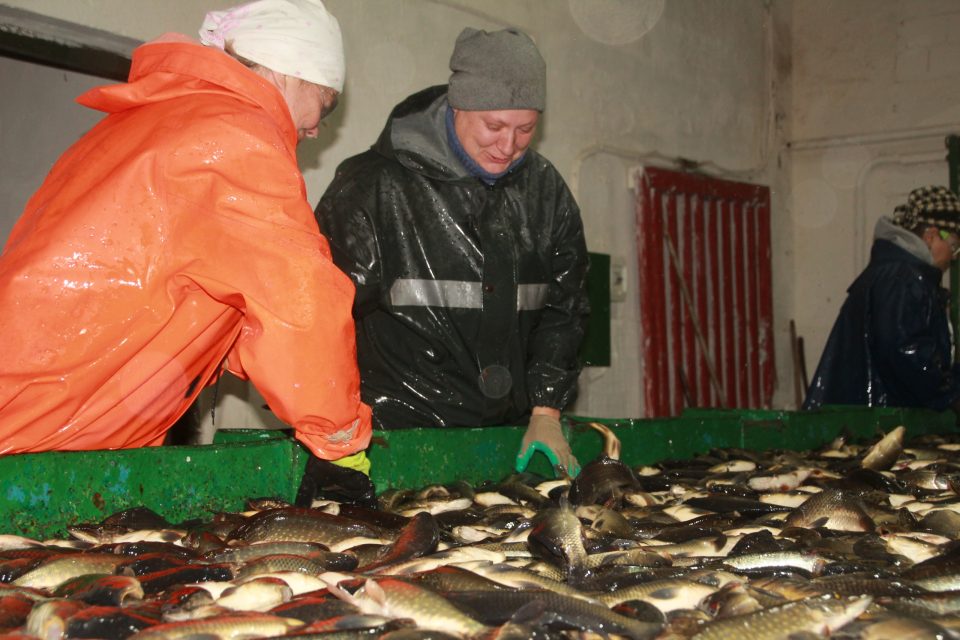
The next stop is the famous "Trémli" pond, located in the town square. The scale of the fishing operation is impressive. It is worth noting that the district leader's visit coincided with the most exciting and responsible moment—the actual fish harvest, allowing the entire production chain to be observed firsthand.
Indeed, in the water, wearing high rubber boots, the fishermen work in a coordinated and confident manner. The heavy net, being pulled step by step to the shore, literally teems with abundant, silvery fish. Carp, pike, and bream glisten in the autumn sun, creating a real fountain of splashes and emotions. This tough male labor requires not only physical strength but also special skill, as every movement here is honed by years of practice. Initially, tens of kilograms of fish end up in special tubs, and from there, after weighing, the gleaming live mass is loaded into special machines and sent further on.
The deputy director of the enterprise spoke about the daily figures of the fish farm. Thus, Mikhail Trusevich noted that in just one work shift, the fishing brigade catches and sends for sorting up to 20 tons of fish.
Mikhail Anatolyevich familiarized the district leader with the technological process of raising the main species of fish—carp, crucian carp, pike, bream, and amur. The conversation covered how feeding is organized, what resources were spent on purchasing feed, and what total weight is expected after the autumn harvest. In terms of numbers, the total area of the ponds currently under cultivation exceeds 1,300 hectares, and the average yield per hectare, according to preliminary calculations, should be about 5 centners.
The chairman of the district executive committee was interested in every detail, as it is precisely the technology of maintenance that determines the cost of the final product, and therefore, the profit of the enterprise.
Pulse of the sorting station