Menu
Opinion on the matter. The world is accumulating economic risks: the IMF warns of a possible shock
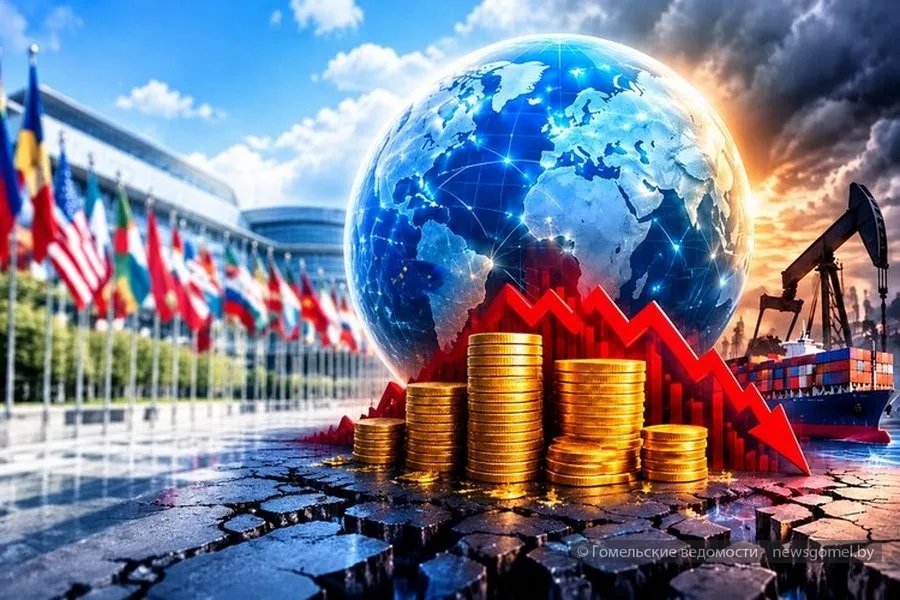
The global economy is currently demonstrating resilience, but behind the relatively favorable overall indicators, serious risks are accumulating. The head of the International Monetary Fund, Kristalina Georgieva, warned about several sources of potential instability.
Inflation is decreasing more slowly than expected, debt servicing is becoming more expensive, and the rapid investment boom around artificial intelligence is forming a new zone of financial risks. According to her, uncertainty is becoming the "new norm".
The first factor is inflation. It would seem that after several years of tight credit policy, price growth should have slowed down confidently. However, the process of disinflation in many countries has stalled. In the IMF's July forecast, global inflation for 2026 was raised to 4.7%. The Fund directly notes that the trend of decreasing inflation observed since the beginning of 2024 has stopped.
This creates an unpleasant dilemma for central banks. To bring prices under control, it is necessary to maintain high interest rates or to tighten monetary policy again. But expensive loans simultaneously slow down construction, consumption, and investment, increasing the cost of servicing already accumulated debts. It turns out to be a vicious circle: the fight against inflation itself makes lending and refinancing debt more expensive.
The problem is especially massive because the global state debt has approached 100% of global GDP. The IMF notes that the debt burden already exceeds post-war maximums and continues to grow. The higher the rates, the larger the portion of budgets that must be directed not to development, infrastructure, or social programs, but to servicing old obligations.
Against this background, a third factor emerges - the investment boom around artificial intelligence. The situation here is particularly contradictory. On the one hand, the construction of data centers, the purchase of equipment, the development of energy infrastructure, and the production of chips indeed stimulate economic activity. The IMF directly acknowledges that the technological cycle currently supports growth, primarily in the US and countries included in the Asian supply chain.
On the other hand, a question arises: to what extent do current financial assessments of AI correspond to its future real return? Enormous projects require colossal capital, and debt financing is playing an increasingly significant role. The IMF separately draws attention to so-called circular financing, when companies invest in each other, simultaneously forming future orders and revenue. Such a structure is capable of driving up asset valuations, but in the event of deteriorating expectations, it can work in the opposite direction.
It is here that the image of an economic "bubble" appears. As long as investors believe in the future super-profit from AI, capital continues to flow into the industry. But if productivity and income turn out to be lower than expected, a revaluation of assets can cause a sharp reduction in investments, a decline in the value of companies, and a tightening of lending conditions. The IMF is already considering such a correction as one of the key risks to global financial stability.
Moreover, the consequences will not be limited to the technology sector. AI requires a huge amount of electricity, cooling systems, data centers, network infrastructure, and other equipment. Therefore, the investment boom is simultaneously increasing demand for raw materials, energy, and capital goods. The IMF notes that in the short term, this construction boom is a positive demand shock, which can also exacerbate inflation.
Adding to this is geopolitics. Current military conflicts and the confrontation between major powers are disrupting trade routes, increasing energy costs, and forcing states to increase defense spending at the expense of their economies. The IMF warns that an increase in military spending can support economic activity in the short term but also create inflationary pressure, worsen budget positions, and crowd out social spending.
Europe is particularly vulnerable in this regard. The confrontation around Russia, the large-scale support of the Kyiv regime by European states and NATO, the sanctions policy, and the increase in defense spending have become part of the new economic reality of the continent. At the same time, European economies have to simultaneously address the issues of expensive energy, industrial competitiveness, budget constraints, and rearmament.
I would say that Georgieva's warnings can be reduced to a simple formula: the global economy is simultaneously facing high inflation, expensive debt, geopolitical upheaval, and overly optimistic expectations from the new technological revolution. Each of these factors individually is manageable. But their combined impact makes the system significantly more vulnerable.
This is why the head of the IMF is calling for caution. AI can indeed become a source of new economic growth - the fund estimates the potential long-term increase in global productivity at 0.1-0.8 percentage points per year. But there is a time gap between today's massive investments and future returns. If expectations prove to be exaggerated, today's growth engine can turn into a future source of bankruptcies.
The global economy is holding up for now. But the IMF's warning sounds extremely clear: the next economic shock may come suddenly and will be particularly painful, since several vulnerabilities - inflation, expensive debt, geopolitical tension, and overheated expectations around AI - are converging at one point. And if at least one of these elements fails, the consequences will not be long in coming.