Menu
On October 29, a trade union legal consultation for citizens was held
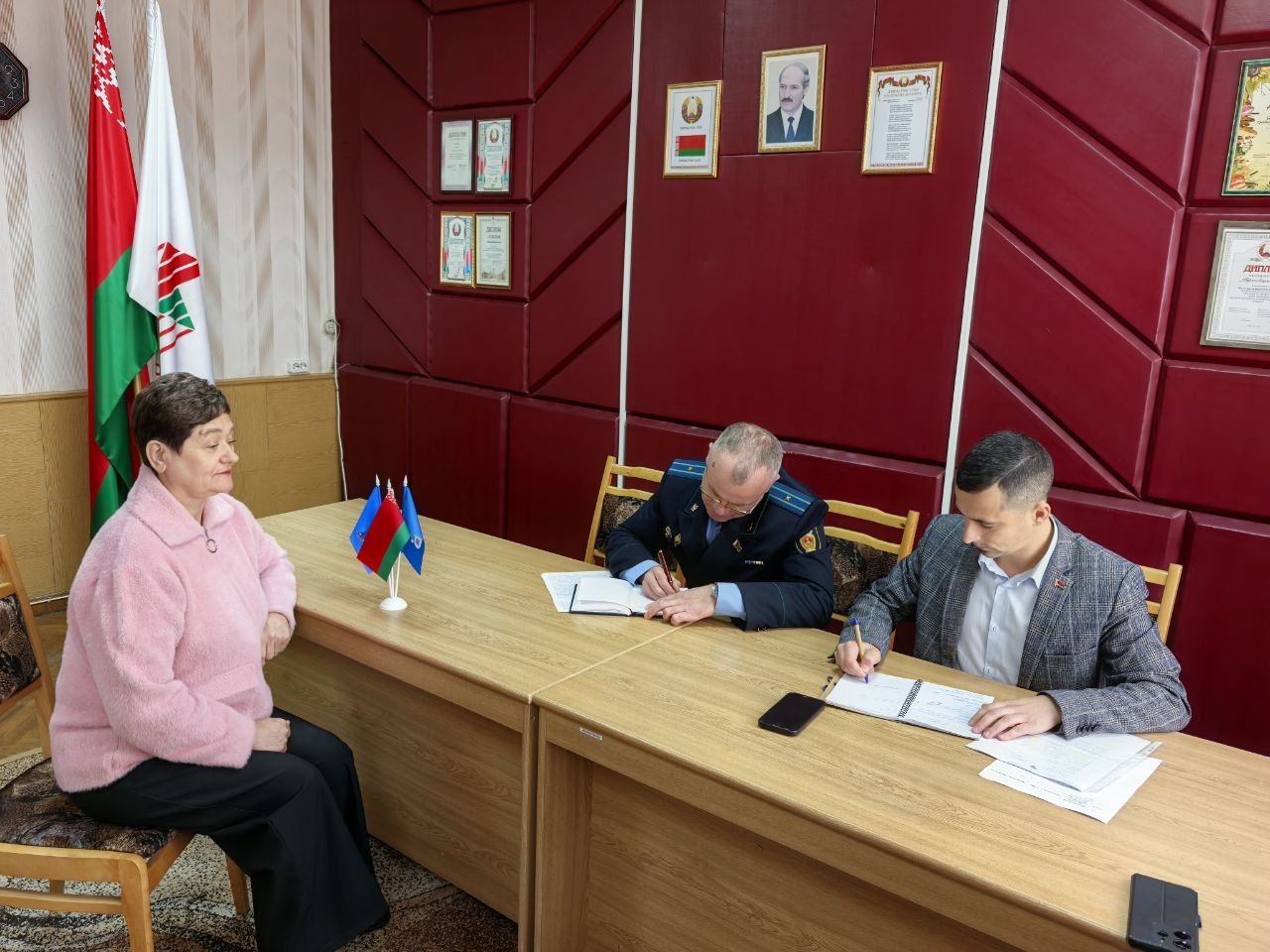
Traditionally, the receptions were held in the format of an open dialogue. Legal advisory platforms operated directly in organizations and enterprises of the Grodno region. Employees received clarifications on issues of labor legislation, pension provision, socio-economic guarantees, and protection of labor rights. Traditionally, the receptions were held in the format of an open dialogue with the participation of labor law inspectors from industry trade unions, representatives of the prosecutor's office, and trade union activists.
Vacation, dismissal, and housing: questions from workers in the Berestovitsky district
In the Berestovitsky branch of the Grodno regional consumer society, a legal reception was held by representatives of the Berestovitsky district organization of the trade union of workers in the agro-industrial complex and labor law inspector of the Grodno regional organization of the Belarusian trade union of workers in trade, consumer cooperation, and entrepreneurship Igor Soroka. The event was also attended by the prosecutor of the Dyatlovsky district Vitaly Yurgo.
Workers were interested in various aspects of labor legislation. In particular, one of the questions concerned the provision of annual labor leave to an employee who has been working in the organization for two months.
As the labor law inspector explained, according to the general rule established by the first part of Article 166 of the Labor Code of the Republic of Belarus, labor leave for the first working year is granted no earlier than six months after starting work with the employer. At the same time, the legislation provides for cases where leave can be granted before the expiration of this period.
Essential working conditions - in the spotlight
In the RUP "Svislochskoe ZhKKh", a legal reception was held by labor law inspector of the Grodno regional organization of the Belkhimprofsoyuz Roman Timoshkov. The meeting was attended by the prosecutor of the Svislochsky district Evgeny Kizilevich and the chairman of the trade union committee of the enterprise Valentina Semakovich.
The labor collective was addressed on the topic of changing essential working conditions. Workers were reminded of the cases in which the employer has the right to change the conditions of the labor contract, what obligations arise for the parties, and within what timeframe the employee must be notified in writing of the upcoming changes.
During the reception, citizens discussed issues of extension and termination of labor relations.
What is important for workers on childcare leave to know
The topic of changing significant working conditions became central during a legal consultation in Volkovysk. Outreach consultations at the regional children's rehabilitation center "Volkovysk" and the district organization of the education and science workers' union were conducted by labor law inspector of the Grodno regional organization of the Belarusian healthcare workers' union, Valentina Tavrel. Together with her, representatives of the Volkovysk district prosecutor's office answered workers' questions.
One of the questions concerned the need to notify a worker on childcare leave about changes to significant working conditions. In particular, the discussion was about the possible introduction of part-time work in the occupied position.
As the specialist explained, labor legislation does not make exceptions for workers on social leave. For the entire period of childcare leave, the employee's workplace and position are preserved. Therefore, if significant working conditions change for the given position, the employer is obliged to notify the worker in writing no later than one month in advance.
If after returning from leave the employee does not agree to continue working under the new conditions, she has the right to resign due to refusal to continue working because of changes to significant working conditions. When introducing part-time work with a duration of less than half the normal working hours, the employee is paid a severance package of at least one average monthly salary.
In addition to this, citizens were interested in the transfer of salary payment deadlines, guarantees for workers during reorganization, and the rights of young specialists. All those who applied received the necessary explanations.
Mostovsky district: labor rights and digital security
A trade union legal consultation and legal awareness day were held at the state institution "Mostovsky district veterinary station". Labor law inspector of the Grodno regional organization of the union "BELPROFMASH", Irina Klimovich, delivered a report to the collective on changes to significant working conditions.
The event was attended by the prosecutor of the Mostovsky district prosecutor's office, Igor Yakimovich, and the inspector for work with trade union organizations of the Grodno regional union association, Svetlana Kryvopust. She spoke about the role of trade unions in protecting the labor and socio-economic rights of workers.
A trade union legal reception was also held at the Mostovsky district organization of the trade union of workers in the agro-industrial complex. Citizens applied with questions about the division of property after the termination of marriage, as well as transfer to another position. In particular, workers were interested in whether it was necessary to conclude a new contract in such a case or whether it was enough to formalize an additional agreement. Clarifications were provided on all appeals.
Voronovo: legal support for young specialists
The employees of the Voronovo enterprise of meliorative systems were reminded of their rights and key aspects of legislation by the labor law inspector of the Grodno regional organization of the Belarusian trade union of construction and industrial construction materials workers, Dmitry Demyanovich, and the deputy prosecutor of the Voronovo district, Veronika Olefirovich.
Every worker should clearly understand that any significant change in their labor process - whether it be a reduction in salary, a review of the payment system or a work schedule - cannot occur spontaneously or simply at the discretion of management, noted Dmitry Arsenyevich. The law requires the employer to have significant economic or organizational reasons for this. You must be warned in writing at least one month in advance. If the new conditions do not suit the employee, they have the full right to refuse. In this case, the employment contract is terminated, but the state guarantees the employee mandatory material support in the form of a severance pay - from two weeks to average monthly earnings, depending on the specific changes.
One of the questions addressed to the trade union lawyer concerned the guarantees of a young specialist who was assigned to an organization in the Voronovo district this year. The worker was interested in whether the employer was obliged to establish a full working day for them.
As Dmitry Demyanovich explained, from December 12, 2024, graduates can no longer be distributed to work with part-time hours. The corresponding rule is enshrined in paragraph 13 of the Regulations on the distribution of graduates, approved by the Resolution of the Council of Ministers of the Republic of Belarus No. 572. At the same time, the legislation provides for separate exceptions established by part two of Article 289 of the Labor Code of the Republic of Belarus.
Another question concerned the confirmation of work experience and earnings when applying for a pension. The worker was interested in how to confirm the fact of payment of insurance contributions if one of the organizations where his father worked was liquidated.
In such a situation, as the trade union lawyer explained, first of all, it is necessary to contact the archive and clarify whether the documents of the liquidated organization were transferred there. Additionally, you can request information through the Social Protection Fund: extracts on the payment of insurance contributions can serve as confirmation. If it is impossible to obtain the necessary documents in any other way, the issue of establishing the length of service or the amount of earnings can be resolved in court.
In the Shchuchin district, a reception was held by the labor law inspector of the Grodno regional organization of the Belarusian trade union of workers in the energy, gas, and fuel industry, Natalya Kuzmich.
A significant part of the questions concerned the regime of working hours, in particular the reduction of working hours on the day preceding a public holiday or a holiday. Workers asked: if the schedule provides for a working day of 8 hours and 15 minutes, and on Fridays - 7 hours, is it necessary to reduce Friday, which has become a pre-holiday day, by another hour? Separately, it was clarified how this rule applies to workers with disabilities of the first and second groups, for whom a reduced working hours are established.
Natalya Kuzmich explained that a shortened working day schedule does not mean establishing part-time work. If Friday is the day immediately preceding a public holiday or a non-working day, its duration is reduced by one hour. Thus, if the usual duration of a working shift on Friday is seven hours, then on a pre-holiday day it should be reduced to six hours.
The same rule applies to workers with a shortened working day, including people with disabilities of the first and second groups. A shortened working day and part-time work are different legal categories. Proportional reduction of a pre-holiday working day is provided only for workers who have been assigned part-time work.
If the pre-holiday working day was not shortened and the employee actually worked an extra hour, such time may be considered as overtime and is subject to payment at an increased rate. An exception is possible in cases where reducing working hours is impossible due to production conditions.
Labor law inspectors of the trade union are always ready to help and advise workers. Our task is not just to quote a provision of the law, but to clearly explain how it applies in a specific situation, emphasized Natalya Kuzmich.
Legal assistance is nearby
Trade union legal receptions in the districts of the region once again demonstrated how wide the range of questions is that workers turn to for consultation. Such meetings help to prevent violations in a timely manner, clarify complex legal norms, and find a legitimate solution to a specific problem. It is important that consultation can be obtained for free and directly in an open dialogue with a trade union lawyer and representatives of the prosecutor's office.
#reception of citizens