Menu
My trade! Find out if it's easy to be a forest master – the journalist from "MP" takes on a new role.
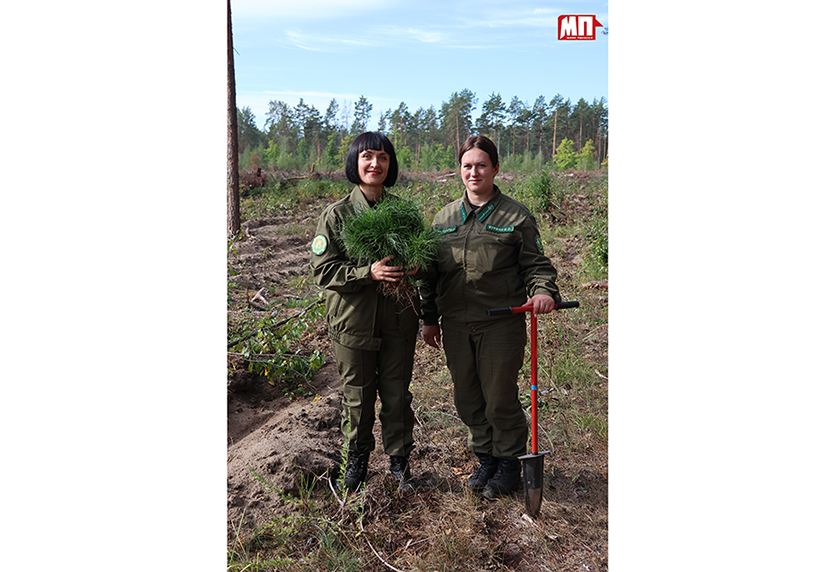
Growing a New Forest – A Task That Is Not Easy
For most of us, a forest is a place of silence, inspiration, mushroom walks, and communion with nature. But for people in green uniforms, it is not just beautiful landscapes, but daily hard labor requiring high discipline, professionalism, and sincere love for one's homeland. Recently, I learned firsthand what makes up a logger's workday.
We arrived at the Komarinsky Experimental-Industrial Forestry Enterprise early. At the threshold, I met Irina Furman – my mentor and colleague for the next few hours.
The workday here starts without coffee. Safety training, checking fire extinguishers, and equipping the patrol vehicle, a fleeting glance at the video monitoring system screens for fire conditions.
"A logger's morning does not begin with coffee," smiles Irina. "Distributing tasks, checking safety compliance, signing the logbook – a strict and unbreakable rule. On top comes fire safety. Therefore, control over the forest area is round-the-clock for us."
Time to head out. Together with driver Vitaly Kraysvetn, we got into the tested forest off-road vehicle – the UAZ 390995, affectionately named by locals "buhanka" (loaf), and set off on the site. It involves determining the boundaries and volumes of timber on plots for future logging.
Together with Irina Furman at the plot point.
"The real extreme in our work is exactly clearing a logging section," Irina explains, as the car carries them over rough terrain.
Forget old paper maps and compasses: in the hands of a modern master lies a tablet with GPS navigation. But marking boundaries, applying markings, and recalculating each tree requires manual effort.
We go to the site. We catch a signal to precisely fix the geotag. Irina demonstrates how to measure tree diameters and apply bright paint marks.
I take a measuring tape, measure the trunk, and enter the data into the ledger. What's interesting is that only simple pencil works here: in rainy weather, a ballpoint pen on paper refuses to write.
Oak, birch, aspen… Commercial wood or firewood? Each tree must be quickly and accurately assessed, its diameter measured, and entered into the correct column using the special points method. In professional forestry terminology, this is called "staking." And the main rule here is absolutely not to step outside the sightline (the line that delineates the logging cut).
- This is it, the most responsible part of our work! – says Irina.
The master shows how it’s done, and then I get to work. I make a deep hole in the soil with a spade, carefully lower the thin pine seedling’s root. Then I make another pressing hole nearby and firmly tamp the soil with my foot.
One confident step – and the little pine gets its place in the sun. Just imagine: in fifty years, a noisy pine forest will rise right here. The feeling, I’ll tell you, is indescribable – in that moment you clearly realize you’re leaving a living trace for centuries to come.
The workday ends where it began – in the forestry office. But it’s too early to rest. On the master’s desk are stacks of folders, maps, records of forest culture transfers, an open 1C program, and the electronic EGAIS system.