Menu
MAZ buses and Ivolga 5.0 trains. Gosstandart and Tver Oblast signed a cooperation roadmap.
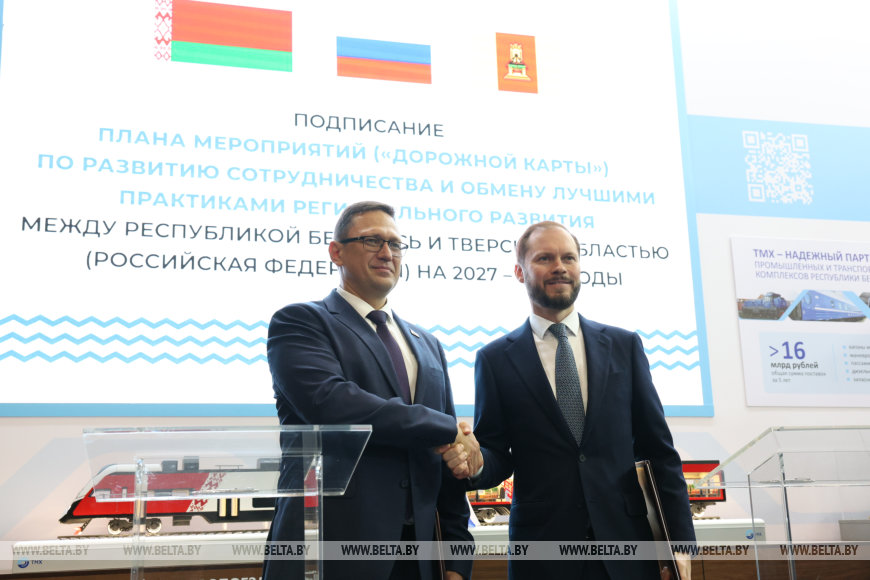
Governor of Russia's Tver Oblast Vitaly Korolev and Chairman of Belarus's State Committee for Standardization Dmitry Basco signed an action plan (roadmap) for developing cooperation and exchanging best practices in regional development between Tver Oblast and Belarus during the INNOPROM. Belarus exhibition, reports BELTA correspondent.
The document envisages working out the issue of opening permanent exhibitions of Tver Oblast in Minsk and Belarus, as well as a multi-brand center of Belarusian industrial manufacturers in Tver, mutual participation of delegations in events of various kinds, developing cooperation in economic sectors to increase the volume of mutual trade turnover and cooperative links.
According to Vitaly Korolev, Tver Oblast has historically maintained close and warm ties with Belarus. Trade turnover currently stands at about $300 million per year, a significant figure — around 40% of Tver Oblast's exports. The signed roadmap is the next step in further industrial integration.
Dmitry Basco noted that this year trade
In the fields of education, youth policy, and culture, it is planned to involve Belarusian youth in the International Military-Historical Search Expedition "Rzhev. Kalinin Front", organize exchange trips for youth of the two countries, exchange information on the most significant cultural events, and involve cultural institutions, creative collectives, cultural sector workers, and representatives of the scientific community in cultural projects and events.
The roadmap also covers such a dynamic sector as tourism. This will help to get to know each other better and expand, including business contacts. Special attention is given to the organization and holding of culture days, and the exchange of case studies on the preservation of cultural heritage and historical memory.
Belarus's cooperation with this Russian region is overseen by the State Standard. In July 2026, in Tver, an agreement was signed between the governments of Belarus and Tver Region on trade-economic, scientific-technical, and socio-cultural cooperation for five years. The agreement covers interaction in the following areas: industry; trade; construction, transport, housing and communal services; agro-industrial complex; information technology, digitalization of the economy; education, science and technology; culture and art; physical culture and sport, health care, tourism; and other areas of mutual interest.
The roadmap for implementing the agreement is aimed at synergizing the potentials of both sides to increase economic and social effect, open new cooperation opportunities, and develop promising directions.