Menu
Learn, Chinese premium! There's something to admire behind the wheel of the Audi Q5L.
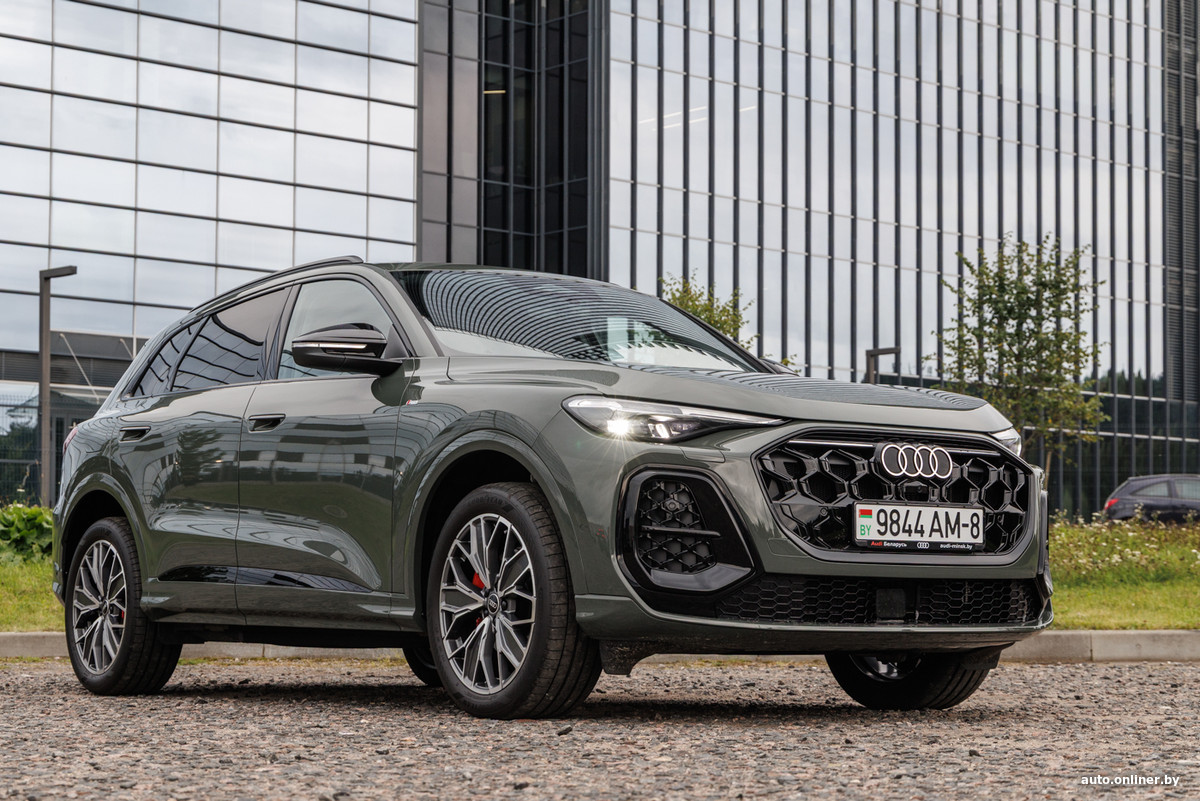
Tired of reading about Chinese electric cars? We hear you. So here’s a gasoline Audi Q5L. Okay, it’s a bit hybrid. And slightly stretched, meaning it’s built in China at the FAW-Audi joint venture. But does that change anything fundamentally? Actually, no. First, German Q5s don’t exist at all; for other markets they’re built in Mexico. Second, despite the 48-volt electric motor, it’s a true gasoline car in character. And third, when it comes to feel, it really is an Audi. And that’s where we’ll focus in more detail.
Everything in favor of rear passengers
Well, yes, they didn’t experiment with the exterior. In the third generation, the Q5 stays true to the brand’s signature style, so the familiar front-end design is in place — with a massive large-mesh radiator grille and no experiments with two-tier headlights.
The Audi Q5L made its debut on the Chinese market at the very beginning of 2026. It differs from the “global” third-generation Q5 by a body stretched 125 mm, bringing the car’s total length to 4842 mm with a wheelbase of 2945 mm. The car is built on the PPC platform (Premium Platform Combustion) with a longitudinally mounted engine.
Under the hood, the Q5L will only have a 2.0-liter turbocharged gasoline engine from the EA888 family, producing 204 or 272 hp, supplemented by a 48-volt starter-generator and paired with a 7-speed S-Tronic robotic gearbox. All-wheel drive is handled by the proprietary quattro ultra transmission.
A Belarusian dealer offers this model in two power variants and one trim level, priced at 88,500 and 97,400 euros at the current exchange rate. The test car is equipped with the 204-horsepower engine.
How can you tell that you’re looking at the Chinese version? Oh, that’s very simple. Walk up to the extended rear doors, grab the original flush handles (on European cars they’re classic, designed for a natural grip), and everything becomes clear.
For rear passengers, the letter L means easier entry (just make sure there’s no car parked next to you, because the “sweep” of the enlarged doors is also considerable), but the main advantage is the abundance of legroom. The distance between the front seats and the rear bench is truly impressive. Even if the driver is tall and the rear passenger decides to slide all the way forward (yes, the bench halves have longitudinal adjustment and even a small range of recline angle).
And the backrest is split into three sections, so any one of them can be folded down, providing good versatility when transporting bulky items. The trunk itself is good, but it lacks a spare tire, because the underfloor space had to accommodate the traction battery of the hybrid system.
Among the drawbacks, one can point to the massive transmission tunnel, traditional for large Audi models. And as for additional convenience features for second-row occupants, there isn't really a great deal. Yes, they also get a panoramic roof overhead and a separate climate-control zone. But there is no seat heating, let alone ventilation or massage—and all of that is available in the first row.
The driver triumphs
Oh, the driver should be delighted with the slightly firm but well-contoured seat. The ideal driving position is found quickly, lateral support is unobtrusively effective, and the cushion adjusts not only for tilt angle but also for length (it's simply baffling why one still has to wait for such "luxury" from Chinese premium brands). The handsome steering wheel, slightly flattened at the top and bottom, fits the hands perfectly.
But there is a fly in the ointment in this ergonomic paradise. All doors have an excellent handle shaped for a natural grip, but in the driver's door, a control panel for the headlights and mirrors is built into the handle. Because of this, you have to grip it with the full width of your palm or hook your fingers into a narrow gap. It's surprising that the Germans allowed this.
Apparently, they threw up their hands, just as they did with the notorious control of everything via touchpads and touchscreens. But credit where credit is due: haptic feedback significantly improves the informativeness of the controls. The absence of a physical climate-control panel isn't particularly burdensome, because in automatic mode the system works flawlessly, requiring no corrections: set it and forget it. And for volume adjustment, there is a physical knob.