Menu
Large-scale reconstruction or ordinary landscaping? Pinsk City Park awaits an update.
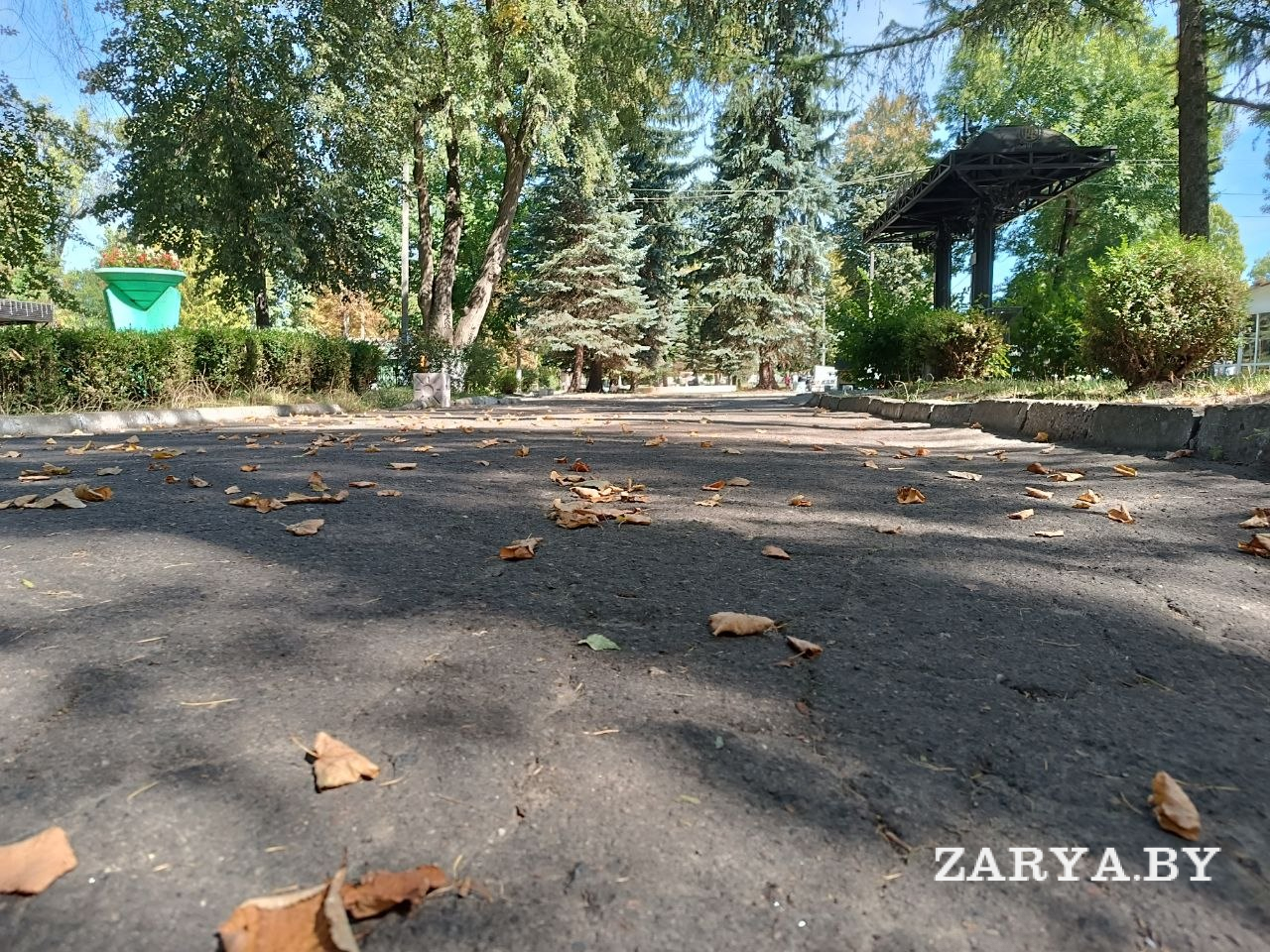
Massive reconstruction or ordinary landscaping? Pinsk city park awaits update
The city park in Pinsk was laid down in the distant 1858 and is considered one of the oldest parks in Belarus. Perhaps the centuries-old giant trees still retain the memory of those times when members of high society strolled here, and in the pre-war period brisk trade was conducted at the Polesie Fair.
During the Soviet era, the city's youth gathered here to dance. Then the park acquired a dance floor, attractions, and sculptures, making it even more attractive for leisure. The legacy of the 'Soviet period' has survived to this day and become part of family stories. There is no doubt that many Pinsk residents, with a touch of light nostalgia, tell their children and grandchildren how they rode as children on these same swing-boats, hung on plaster bears, laid flowers at the Eternal Flame…
A beloved place of rest for city residents and guests over the Pina River, it undoubtedly changed its appearance: new recreation zones, attractions, military-historical objects, a sports area appeared. The last time reconstruction of one of the important parts of the park was carried out in 2015: then considerable funds were invested and the memorial complex to the liberators of Pinsk was completely renovated.
Since then, the proper appearance of the park area has been maintained largely by the forces of the cultural institution itself Pinsk City Park of Culture and Recreation named after the Red Banner Dnieper Flotilla. The need for large-scale reconstruction has been maturing over the years, and finally the first step toward implementing a major project has been taken.
Recently, at one of the departmental meetings in the Pinsk City Executive Committee, the list of priority tasks for modernizing the object was discussed. During the meeting, the chairman of the city executive committee Valery Rebkovets emphasized that the city park project should be 'grounded', starting with the replacement of utilities and involving enterprises that manage them.
In other words, they bet on real financial capabilities. At the same time, the historical component and many other nuances must be taken into account. About them we spoke with the head of the culture department of the Pinsk City Executive Committee Sergey Matuszko.
It is important to note that the city park for culture and recreation is located in a zone of protection for archaeological heritage, Sergey Vladimirovich emphasizes. Indeed, on the site of the modern park, the Leshchensky Monastery stood on the bank of the Leshcha River in the 19th century. Therefore, we consciously rejected Art Nouveau-style solutions, which would disrupt the authentic appearance. Currently, pre-project documentation has been prepared, where we paid great attention to the park's landscaping. What is hindering implementation? This is the powerful root system of rare tree species, which has lifted the ground and deformed the asphalt surface.
According to Sergey Matuzko, reconstruction is impossible without a preliminary inspection and expert assessment of the unique greenery. One thing is clear: all of it must be inventoried and remain in its original place. Therefore, the builders will face a difficult task: to lay new tiles on the pedestrian paths that require renewal without harming the trees' vitality. In the future, beautiful paths will connect key routes from the city embankment, the central entrance, and the side of the Polotsk State University building; new benches and modern lighting will appear. This will be the first stage of the project's implementation, as the interlocutor said.
There are other interesting ideas. The park will finally have an entrance group, which will become the calling card of this public space. The architectural ensemble at the entrance will consist of two pylons with decorative lamps and wrought-iron gates, thereby emphasizing the atmosphere of the old park.
Investments in question
The authorities of Pinsk are pinning their hopes on enterprises that will install art objects for commemorative photos at their own expense. Whether the heads of the enterprises will pick up the initiative and whether unusual photo zones will appear in the park is a big question. The same applies to whether a new fountain will be built. The existing one has not worked for a long time (perhaps few will remember when it last gushed) and is in a very neglected state. The head of the culture department hopes that the fountain's construction will be preserved in the project, and that the park visitors will have a new favorite place for relaxation.
According to the pre-project documentation, a separate site (with installed engineering infrastructure) is provided for the construction of a thematic café. At present, two small establishments operate in the park where one can enjoy a satisfying meal and even celebrate a celebration. It is proposed that an investor arrives and opens a children's café, but the question of whether such investments are justified arises.
– The park is a seasonal facility, – explains Sergey Vladimirov. – As early as October, typically after City Day, we begin the conservation process: dismantling key aggregates, packaging attraction engines. Until spring, the park loses its appeal for visitors with children.
Automobile parking lot instead of observation wheel
But what is truly necessary for the park is new attractions. The current ones have already become outdated both mentally and physically, notes Sergey Matuzko:
– The technical condition of many attractions leaves much to be desired. To continue operating them, obsolete components must be replaced, which has become increasingly difficult: manufacturers have ceased producing spare parts.