Menu
Is this AI? No, you can spend the night in these little houses on the sheer cliff
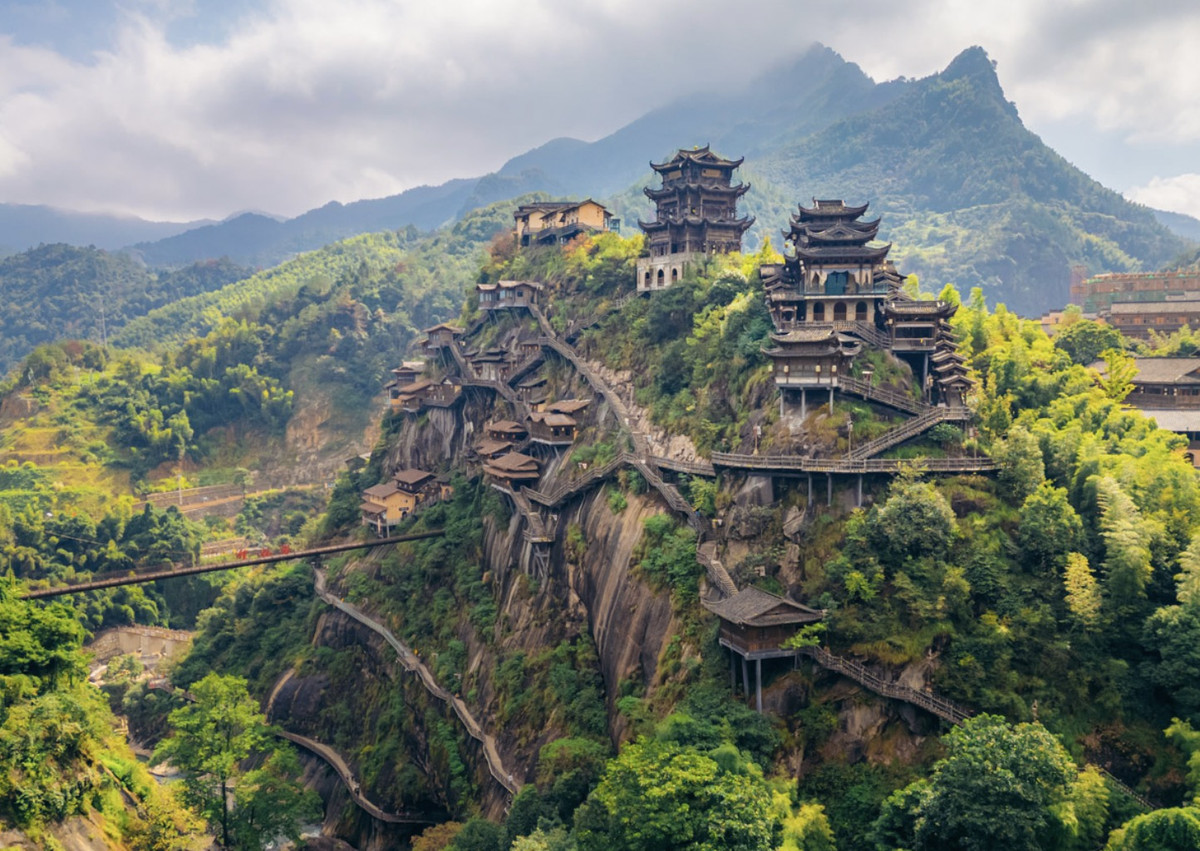
In eastern China, amidst the mountains of Jiangxi Province, lies a corner that is easy to mistake for a movie set or an image created by a neural network: multi-story wooden houses under dark tile roofs seem to be "stuck" to a steep rock face above a deep gorge. Looking at the photos, it's hard to believe in their reality. It seems that the architects ignored the laws of gravity, and the builders accomplished the impossible. Meanwhile, this incredible picture is real, although it was not born in ancient times. Behind the fairy-tale facade lies ten years of grueling engineering work, credits worth hundreds of millions of dollars, and a radical break with the previous way of life of the entire region. Until recently, the local landscapes were associated exclusively with heavy industry and decay - now hundreds of thousands of tourists come here for impressions, which sometimes include disappointment.
The Mountain Region
Officially, this resort in the northeast of Jiangxi Province is called Wangxianggu. Translated into Russian, it sounds poetic - "The Valley Where They Contemplate the Immortals". The toponymy refers to ancient legends about Daoist alchemists who sought eternal life among the local inaccessible gorges. Now it's not difficult to get here: high-speed trains from Shanghai arrive at the nearest major train station in Shangrao, and buses and taxis regularly run to the gorge.
Nature has unfolded this grand decoration at the foot of the Lingshan mountain range.
Since mountains occupy a good third of the province's territory, regional officials have long been trying to turn the complex terrain into a commercial asset. In the Chinese hierarchy, Wangxianggu holds the prestigious status of a 4A tourist attraction - this is one step below the main treasures of China, such as the Great Wall of China or the Forbidden City in Beijing, but for an object created almost from scratch, the result is phenomenal. However, in the early 2000s, there were no tourists there. On the site of the current floating hotels stood a remote mountain village of Yanpu, whose residents, instead of contemplating eternity, were engaged in a much more mundane business.
When the Stone Ran Out
For generations, Wanshan lived exclusively off granite. The flip side of this raw material prosperity was a local environmental disaster. Technological waste was dumped into mountain streams for years, resulting in the local water acquiring a persistent milky white hue, and the slopes of the gorge becoming covered in lifeless gray scars. The end to the industrial chaos came in 2007, when the Chinese authorities suddenly and completely banned stone mining in the area. For a region that knew no other craft, the decision was a shock. The closure of the quarries eliminated the last sources of income, and the population moved away. Surrounding villages like Shangzhen or Dazhi were abandoned, turning into classic ghost towns with boarded-up houses.
Before inviting demanding urban tourists, it was necessary to revive the disfigured landscape. Engineers started with a general cleanup, removing hundreds of thousands of cubic meters of mined rock from the bottom of the canyon, filling in deep pits, and clearing several kilometers of riverbed. The exposed rocks were planted with young pines and yew, after which the hospitality industry cautiously moved into the area. In 2010, a local tourist company launched the first modest attraction on the cleaned-up river - an extreme rafting trip on inflatable boats. The idea worked, but it was not profitable to transport people just for a short rafting trip. Then, in the mid-2010s, investors came up with a fairly crazy idea: what if they used the empty villages and the vertical walls of the former quarry as the foundation for an entire fairy-tale city? Full-scale construction began here in 2017.
The project's chief designer, Tian Fuzhen, later recalled that his team had to climb these slopes on foot, sketching out future quarters directly on site. The architects abandoned standard plans, opting for a manual fit of buildings to the capricious terrain. Small structures with ochre walls seem to be embedded in the mountain, and narrow streets stretch along the cliff, connecting with covered pedestrian galleries. It took almost ten years to implement the idea, and spot work is still ongoing. The authors boldly restored what was lost, for example, rebuilding the ancestral temple of the Hu family, which is why it is now difficult to distinguish between genuine history and high-quality replicas in Wanshan.
The visiting card of the complex has become the extreme cliff rooms on the White Crane Cliff, suspended at a height of over 110 meters.
At the start of the project, 12 cottages, a panoramic library, a restaurant, and an observation deck were built, although over time the number of rooms in the complex has significantly increased. From below, these secluded rooms, which have been welcoming guests since 2022, resemble swallow nests. The designers do not hide that they aimed for absolute photogenicity. At the same time, the developer still keeps the method of anchor mounting of structures to granite a secret, but the main value of Wansheng - the organic integration of stylized antique architecture into the sheer rock - cannot be denied.
The complex's official opening took place in the fall of 2020, and the instant commercial success exceeded all forecasts. The annual flow of visitors quickly exceeded the mark of 3 million people, bringing in more than $70 million in revenue. The former granite quarry's loud fame was ensured by global social networks, where viral videos with floating quarters gained millions of views. During the day, tourists walk along the suspended galleries over the abyss, examine waterfalls, and raft down the mountain river, and on the narrow streets, folk crafts fairs unfold. The main spectacle begins after sunset, when complex illumination flashes throughout the gorge and on the tops of the cliffs, turning the novelty into a living fairy tale. The entrance ticket to it costs a fairly democratic $18, but for an individual night in a "swallow's nest" on the rock, you will have to pay $120-300.
Of course, such a rapid rise has also generated polar reviews, because flawless short videos often clash with multi-hour queues at viewpoints and inflated prices in reality. While some guests sincerely admire the man-made wonder, others complain about service flaws and ongoing construction work right in the middle of the season. For a project whose internet popularity has clearly outpaced the development of infrastructure, such problems are inevitable.
The price of stone and the price of the view
The total investment in the project ultimately exceeded $370 million. A private investor could not handle such a budget alone, so the state stood behind the developer from the start, opening lines of long-term credit through major state banks, secured by land. The main thing is that the enormous investments justified themselves from a social point of view: the project immediately created more than 30,000 jobs in the area. Hundreds of residents returned to the once-dying villages, who had been searching for casual earnings in megacities for years. It turned out that hosting tourists, opening home cafes and guest houses, was more profitable and safer than being hired workers in cities.
However, even the creators themselves would not call this transition painless. The explosive influx of guests caught the infrastructure off guard: on peak days, the narrow mountain roads were completely jammed with multi-kilometer traffic jams, and there was a catastrophic lack of parking spaces. To unload the valley, the authorities had to urgently reprofile neighboring settlements, turning them into dormitory branches of the resort. And although after the abnormal post-pandemic boom, the attendance of the gorge has decreased slightly, no one plans to stop the conveyor belt. The authors of the project claim that only about a third of the total architectural concept has been implemented so far, and the construction of new batches of rock hotels is ahead. In the Chinese press, the path of Wanshan is now passionately described by the formula "From selling stone to selling life". The slogan is beautiful, but now the man-made rock village has to prove the main thing - the ability to retain the interest of a sophisticated audience, when the initial effect of novelty in social networks finally wears off.