Menu
In Skidel, they produce medical preparations for the whole country.
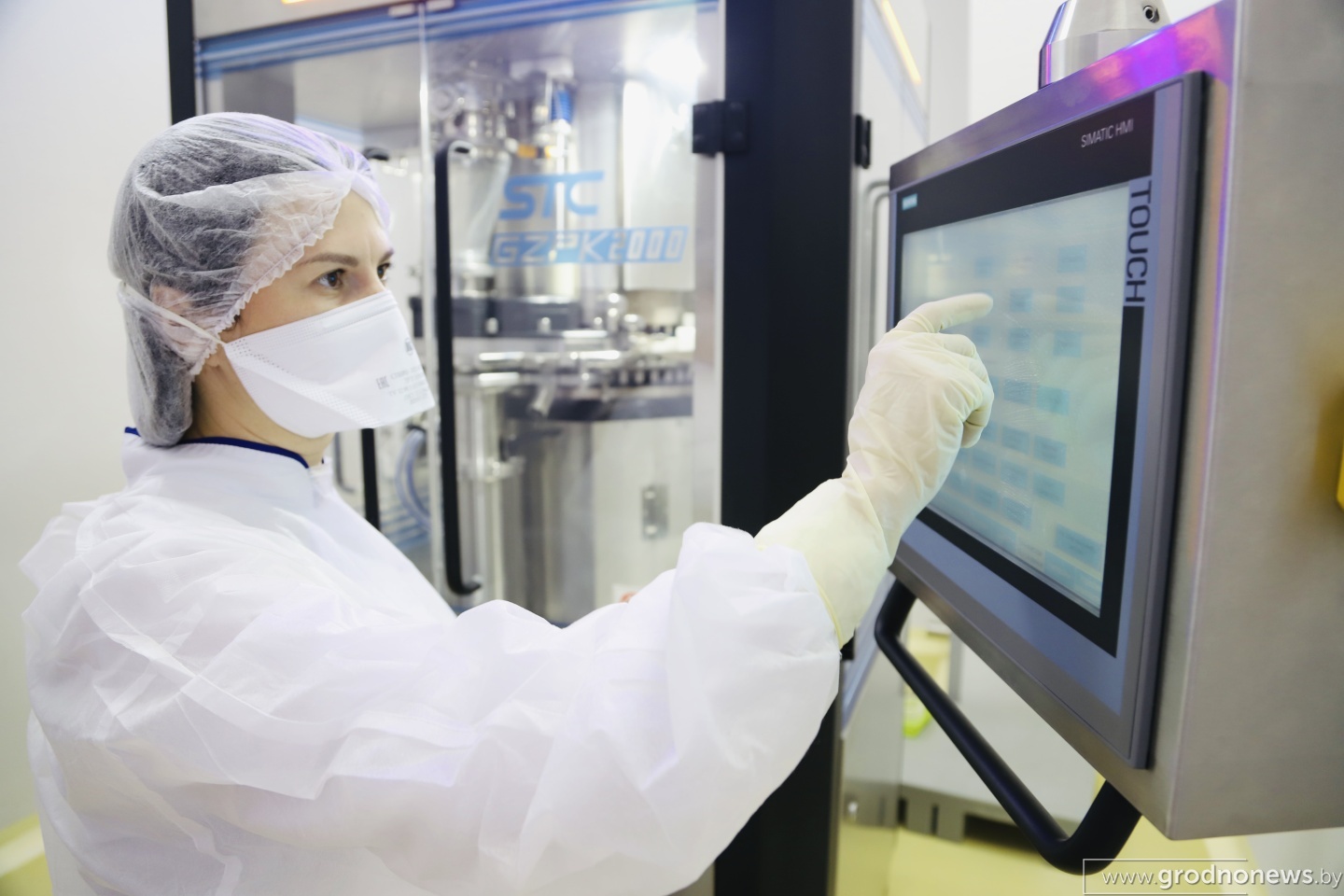
Today, a large-scale technical re-equipment is in full swing.
On the eve of the Day of Workers of the Pharmaceutical and Microbiological Industries, celebrated in Belarus on October 15, we went to Skidel. It is here that the production unit of the state-owned enterprise "Belmedpreparaty" is located. Raw materials in the form of the finest "flour" are brought here, and blisters with medications that are found in almost every home first-aid kit are produced as a result. Natalia Rak, the head of the Skidel production unit of "Belmedpreparaty," told us more about this.
Production Specifics
The history of the production site in Skidel spans more than two decades, and it became part of the large "Belmedpreparaty" family in 2010. Today, it is a compact, precisely calibrated facility where more than 130 people work. From the threshold, it is clear that pharmaceuticals do not tolerate haste.
– Our first unit is special. It only produces beta-lactam drugs – the penicillin series, for example, the widely known amoxicillin, – Natalia Rak said. – These antibiotics can cause severe allergic reactions even with microscopic inhalation of dust, so their production is isolated.
The second production building is a multi-profile giant. Here, they create the vital cardiac line, antipyretics, spasmolytics, analgesics, sedatives, and vitamins. The range of the Skidel workshop totals 73 names of medicines. A separate pride of the plant is the small-batch production unit. While in the main workshops, batches are mixed at 50–120 kilograms, here they work with micro-batches of just 5 kilograms with jewel-like precision, producing rare and specialized medications.
That very "pink ibuprofen"
The workshops smell of sterile cleanliness and a barely detectable sweetish aroma: it turns out they are packaging ascorbic acid with glucose and notes of the childhood favorite "Duchesse." But the real hit, for which patients hunt in pharmacies, is something else entirely.
– Analgin, acetylsalicylic acid, blood pressure medications – moxonidine, ramipril, verapamil, the cardiologist's warfarin, the psychoactive olanzapine – this is our daily work, noted the production manager. – But we have a special favorite of the public – ibuprofen in a pink film coating. Other factories produce it in white. Ours is bright pink. And when there were temporary supply shortages, people in pharmacies deliberately searched for exactly our Skidel drug: 'Give us only the pink one, we trust it!' We produce it in colossal volumes, about 150,000 packages monthly.
The lineup is constantly growing. Recently, Skidel mastered the production of the popular antibiotic azithromycin in 125 and 500 mg doses, as well as the metabolic agent Mildrocard, which helps restore performance and support the heart. In total, more than 1 million tablets and capsules come off the Skidel conveyors each year.
From a bag of substance to a blister
In response to the question about how tablet technology works, Natalya Nikolaevna smiled and offered a perfectly clear everyday analogy:
– Imagine you've decided to bake a pie in the kitchen. Where do you start? You buy high-quality flour. In pharmaceuticals, it's arranged exactly the same way.
To begin with, the pharmaceutical substance (active ingredient) arrives at the plant in barrels and bags as a white powder, visually indistinguishable from flour. But it doesn't go straight into production. About 30 laboratory specialists take samples: over five days, the powder undergoes the strictest incoming control based on chemical and microbiological indicators. If there is even a micron-level discrepancy from the quality standard, the batch is rejected.
It is technically impossible to make a tablet from just the medicinal powder, as it would simply crumble. Therefore, the technologists calculate the formula, adding excipients and a binding agent – up to 5% of natural starch paste.
The mixed mass is brought to a state of moist, crumbly curd and sent to the dryer. The dried "curd" turns into small, dense granules.
The resulting mass is sieved: large fractions are ground by a granulator, then the powder is "dusted" and fed into a high-speed tablet press. Afterward, metal punches compress the granules into the specified shape with great force. Thus, perfectly smooth tablets are born. On the packaging line, they are placed into neat blisters with foil on top.