Menu
In Minsk, salaries are 2.5 times higher than in Colombo. Lankietz on life in Belarus
Special Project
"In Minsk, salaries are 2.5 times higher than in Colombo." Lankiet on life in Belarus
Author: Polina Lesovets. Photo: Vlad Borisovich; personal archive of the hero
What do we know about Sri Lanka - the most beautiful island, which was previously called Ceylon? A former British colony. A country whose economy is based on tourism and precious stones: sapphires and rubies. The images that flash in the mind of a Belarusian are likely to include tea plantations, elephants, and beaches with palm trees. When chef Valavaga Sumudu Priyanta decided to move to Minsk from sunny Colombo, he knew even less about Belarus. What came of it? Read in the new issue of our joint special project with Betera, "Vot eto vas zaneslo!" (That's what brought you here!).
"In some sense, it was a 'luxury' life"
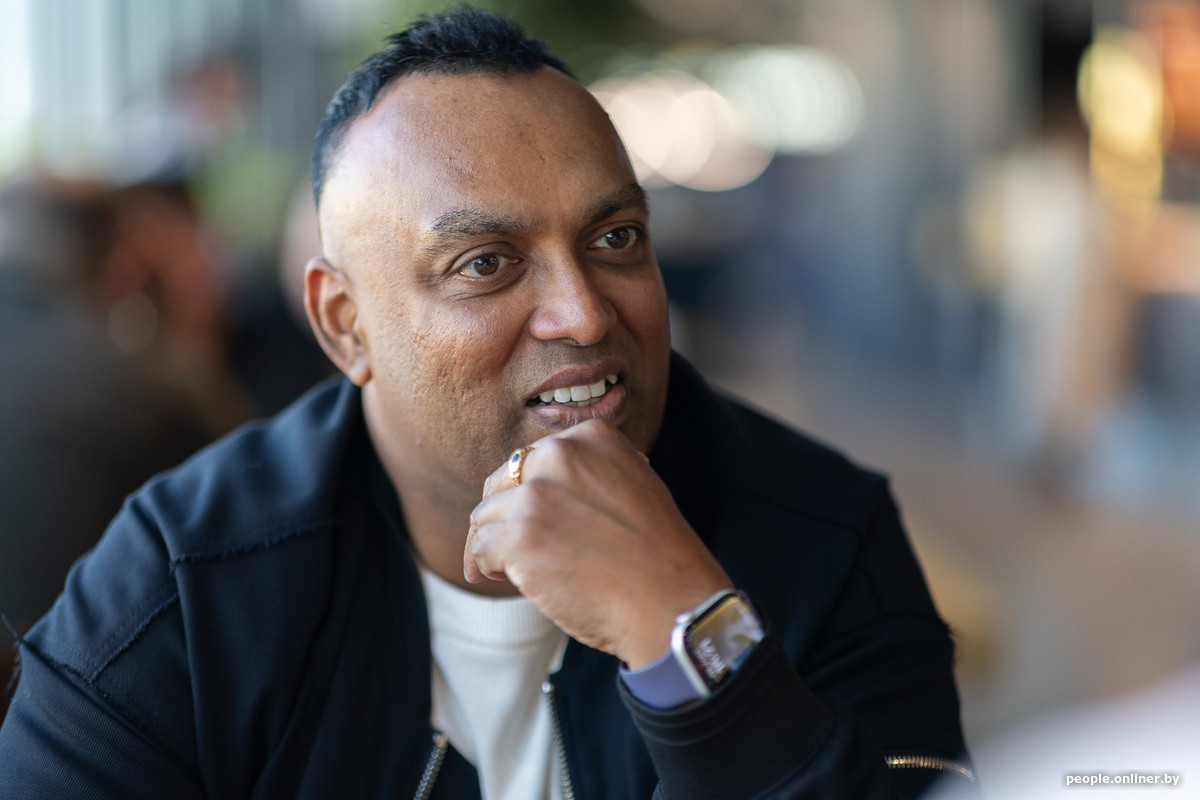
Meet Sumudu: a smiling, modest, and unassuming person, although he could have been a star: in Thailand, he worked in a Michelin-starred restaurant, and in Belarus, he twice became the best chef of the year.
"I grew up in a simple family in Colombo, the de facto capital of Sri Lanka," says Sumudu. "My father was a state inspector, working in the commission against corruption. We were content with little, but in some sense, it was a 'luxury' life: fresh shrimp, mango, papaya, and rambutan every day, the ocean and beach just a ten-minute walk from home... Europeans spend a lot of money to organize such a life for themselves on vacation.
After school, I studied for five years at the Ceylon Hotel School of Culinary Art - the coolest culinary school in Sri Lanka. I started from the very bottom: I worked as a cook's assistant in a hotel in Unawatuna - a popular tourist town. I cleaned, tidied, washed, and didn't shy away from hard work. Then I managed to pass an interview at the Hilton Colombo - that's where I saw the life of the guests, the real luxury life.
Sumudu was not yet 30, and he had already made a pretty good career for himself in Sri Lanka. What's next? It was time to find himself in Europe.
"To be honest, I didn't know anything about Belarus, had no idea what Minsk was like. I just wanted to go to Europe. In Colombo, advertising agents had arrived, promoting BSU. They said that Belarus was the center of Europe and that you could travel everywhere by train without a visa," our hero smiles.
"When the snow fell for the first time, we ran out into the street at night"
So, at the age of 29, Sumudu found himself in Minsk to enroll in the tourism management program at BSU. It was 2008.
I was shocked by the snow. I had never seen anything like it in my life. I remember when it snowed for the first time, we, students from Sri Lanka, ran out of the dormitory at 2 am and threw snowballs at each other. Wow! In Sri Lanka, it's +35 degrees Celsius all year round, and the temperature only drops to +25 during the rainy season. Minsk is different. The change of seasons, which you are used to, was amazing for me. It's very beautiful: the leaves turn yellow, then fall, and then the first snow comes, and all of this gives way to spring and velvet buds.
A big surprise for me was that a foreign student from Sri Lanka at Belarusian State University did not have the right to work full-time. The rules have changed now, but back then it was an unpleasant discovery. In any case, I'm not used to sitting idle. Soon I was already cooking Asian food at News Cafe in the evenings. I knew very little Russian, but I tried to learn at least the names of the products. The management liked how I cooked, and after a year, I became a sous chef. I witnessed the era when Grand Café, Tapas Bar, and Bistro de Luxe - the best restaurants of that time - opened in Minsk. I was even sent to learn Thai cuisine in Bangkok at Blue Elephant, a very prestigious culinary school, in order to return to Minsk and open Mai Thai.
In 2020, I started my small restaurant business - first under the name "Kokos", and now Thai Express. I have two locations: in "Konkors" and the "Zamok" shopping center. The menu includes authentic Sri Lankan cuisine, such as fried rice curry with beef tenderloin, as well as authentic tom-yam according to a Thai recipe. Very few establishments in Minsk make it correctly, exactly as it is done in Thailand. I plan to open two or three more locations. We'll see how it goes.
Papaya, passion fruit, mango, and cherimoya.
"For some reason, Belarusians don't drink tea with milk."
After almost 18 years in our country, Sumudu has become maximally "Belarusianized". Where else will you meet a Sri Lankan who with pleasure tells you about how he picks mushrooms in the Rogachev district? Of course, his wife Anastasia has made a big contribution to this. Their daughter Olivia is already 7 years old. She, like Sumudu, speaks Russian at home, and the girl only knows "how are you" and "hello" in Sri Lankan.
Sumudu has become so accustomed to Belarusian life that he even goes mushroom picking in the Rogachev district, and his daughter Olivia speaks Russian at home, just like her father.
I understand that the perspective of a foreigner is important to you. How do you, Belarusians, look in the eyes of others? Honestly, I've already gotten used to everything except perhaps the very strong cold, -25 degrees. This is really difficult.
If we're looking for differences, first of all, it's the level of salaries. In Belarus, it's significantly higher than in Sri Lanka. Based on my feelings, the median salary in Sri Lanka is around $300, while in Belarus it's over $770 in equivalent. The prices for buying and renting real estate also differ. For example, you can find ordinary accommodation on the island for $25-30 per day. But living on the first coastline in Sri Lanka is always very expensive. This is, shall we say, a luxury place: one night in a five-star hotel will cost $300-400. But high prices will also be found in Minsk, in some Hilton. For $500-600 on Sri Lanka, you can rent a very good house for a month - in Minsk, of course, it's more expensive.
Secondly, in Belarus, the internet is faster and there are no problems with electricity. In Sri Lanka, blackouts still occur, electricity disappears - all because 70% of the infrastructure is oriented towards hydroelectric power plants, and in dry seasons, the water level drops, they lack capacity. Now they're building new diesel power plants, but this is expensive, since Sri Lanka has no oil fields.
Thirdly, food. In Belarus, it's almost impossible to find normal fruits, seafood, and tea. It's hard to get used to this. Every March, on my wife's birthday, we all fly to Sri Lanka, including my father-in-law and mother-in-law. We try to eat our fill of fruits and seafood for the year ahead. When we return, one suitcase is filled with tea, and the other - with papaya and mango. If I return to Minsk without fresh papaya, my friends won't understand, - Sumudu laughs. - I really miss the Ceylon black tea, fresh, collected right from the plantation! We're used to drinking it with milk, in the English manner - for some reason, Belarusians rarely do this.
Yes, in Minsk, there's no normal papaya, but in the summer, in the village, at my mother-in-law's, everything grows: strawberries, cherries, blueberries, apples, pears, bell peppers, eggplants... And my wife's grandmother even grows very spicy small chili peppers - they're needed for us in Thai Express.
Moreover, in Belarus, the culture of breakfast is not as developed as it is in Sri Lanka. Enter any restaurant in Minsk - what will they offer you in the morning? Well, syrniki, blini, draniki, some kind of "big English breakfast" - and that's all. In Sri Lanka, there are 15 types of breakfasts - from string hoppers (thin rice noodles arranged in "nests") to chickpeas with coconut sambal (a sauce made from freshly grated coconut, chili peppers, red onions, and lime juice). In the mornings, it is customary to drink a "soup": 10-15 types of different greens are thrown into a blender, with some rice, coconut milk, and cane sugar added. This is called kola kanda.
Fourthly, medicine. In Sri Lanka, it is de facto paid. Yes, free state medicine also exists, but you have to wait in line for a year. At the same time, the island has high technology, and you can have a heart transplant at Apollo Hospital, but it is very expensive. In Belarus, I have a residence permit, and I have already had to go to the hospital twice, call an ambulance - everything is quick and free.
In fifth place, in Belarus, traffic is clearly regulated. Buses, trains - everything arrives strictly on schedule, as written in the timetable. In Sri Lanka, there is no such road system. For example, marshrutkas are called "crazy buses" because they drive chaotically, rush along the roads, honk very loudly, pick up as many passengers as they want, and stop right in the middle of the highway - regardless of whether there is a bus stop or not. This is dangerous. Trains can be late by an hour. Sometimes you see an old, old train breaking down - and it's really embarrassing. I love Sri Lanka very much - and at the same time, I see how Belarus has been developing in this regard over the past 18 years, while Sri Lanka seems to have stagnated with these old trains that were made by the English.
On the other hand, it is precisely this property of Sri Lanka that has allowed its inhabitants to preserve more of their original, natural, and natural state, Sumudu believes - while Belarusians are "slightly spoiled by civilization".
— In Sri Lanka, jungles are protected by law, and people do not go there. You can easily come across elephants, cheetahs, crocodiles, small black bears... For example, last March, my family and I stayed in the city of Hambantota. On one hand, there was a five-star Shangri-La hotel, its own golf course, several pools, and excellent food. On the other hand, we were immediately warned that there were crocodiles living in the nearby river, beyond the rice field. We swam there, jumped into the water from the tarzan swing — and they did not bother us.
This also relates to the absence of the ocean in Belarus. I really miss it. Although the high humidity and salty air in Sri Lanka lead to interesting "special effects": if you live on the first coastline, then after some time, your equipment can rust and become unusable — including MacBooks, TVs, and even cars.
We are finishing our conversation by discussing a well-known stereotype: is it true that Belarusians are gloomy and stern creatures with their Slavic faces?
— Yes, compared to the smiling and benevolent Sri Lankans, Belarusians are indeed gloomy. When I first arrived in Belarus, I tried to smile at everyone, but then I realized that it's not customary here. Maybe Belarusians lack sunlight and vitamin D?.. In Sri Lanka, the sun rose at 6 am, we smiled and drank tea, lived and rejoiced, although we had little money, and in my childhood, I couldn't go to the store and buy everything I wanted. But here, people have money, yet they still seem to be missing something. Why? I don't have an answer.
Project partner — Betera
The "ERA" project has arrived in Mogilev.
In October, the charitable project "ERA" carried out a large-scale forest planting in the Mogilev region with the support of the UN Global Compact Network in Belarus and the Ministry of Forestry as part of the "Give the forest a new life!" campaign.
More than 120 people — volunteers, company representatives, athletes, and forestry specialists — planted over 50,000 young trees. Additionally, "ERA" handed over a soil auger to the Mogilev forestry department — a real helper in the forest revival.
The special project was prepared with the support of LLC "Statuskvo", UNP 101011505.