Menu
How to preserve onions and garlic until spring: 7 mistakes during drying and storage that cause the crop to rot
How to Store Onions and Garlic Until Spring: 7 Mistakes in Drying and Storage That Ruin the Harvest
Anastasia Kutsarskaya August 31, 2026 10:20 After harvesting onions and garlic, many gardeners consider the work done. The crop is collected, so you can put it in boxes and store it in the root cellar until spring. In practice, it is at this moment that the main problem often begins.
If onion bulbs or garlic heads are not sufficiently dried, storing damaged specimens together with healthy ones, or leaving the harvest in a damp, unventilated room, soft spots, mold, and rot can appear within a few weeks. However, preserving the harvest until spring is not as difficult as it seems. The main thing is to properly go through several stages: harvest at the right time, dry it well, sort it, and create the correct storage conditions.
Why Onions and Garlic Start Rotting in Winter
After harvesting, onions and garlic are not yet fully ready for long-term storage. Moisture remains on the surface, the outer scales need to dry completely, and for onions especially, the neck must dry well.
Any damage—a bruise during harvest, a cut, crack, or soft spot—increases the risk of spoilage. A humid environment additionally creates favorable conditions for the development of microorganisms that cause rot.
Therefore, drying is not a formality but a crucial stage in preparing the crop.
For onions, the post-harvest drying period can take about 2–4 weeks, depending on the weather and conditions. Garlic usually requires about three weeks. It is best to be guided not only by the calendar but also by the appearance of the crop itself.
How to Properly Dry Onions After Harvest
The first rule is not to send freshly dug onions directly to the root cellar.
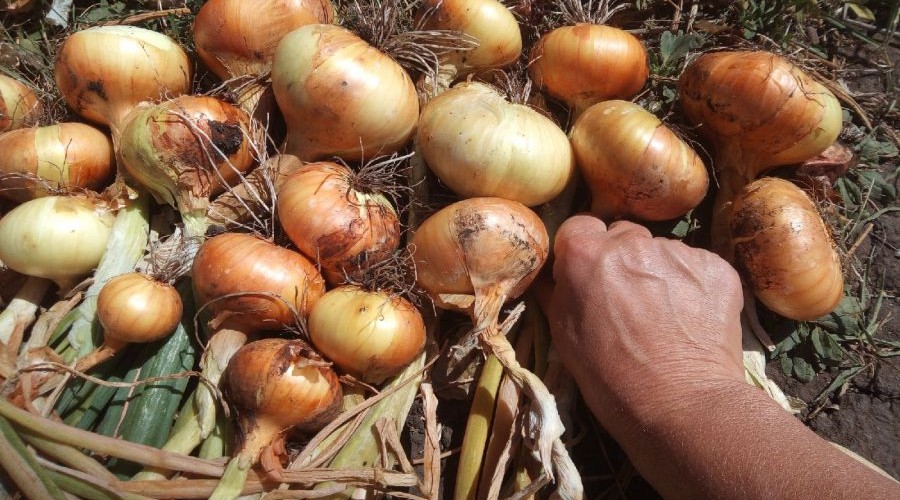
After harvesting, carefully shake off large clumps of soil and lay the onion bulbs in a thin layer. It is best to use wooden grates, trays, cardboard, or another dry surface that does not obstruct air movement.
The drying area must be:
dry;
well-ventilated;
protected from rain;
free of high humidity;
ideally without constant exposure to direct sunlight.
Do not pile the onion bulbs into a large heap. Inside such a pile, air practically does not circulate, so the lower layers can remain moist for much longer.
How to Tell When Onions Are Dry
The main indicator is the neck of the onion bulb.
It should become dry and dense. The outer scales should also dry well and acquire their characteristic papery texture.
Closing a root cellar in autumn and only opening it in spring is not the best idea. Periodically inspect the harvest and immediately remove any spoiled specimens.
Can onions and garlic be stored in the refrigerator?
For whole, dry onions and garlic, the refrigerator is usually not the optimal place for long-term storage.
It is much more convenient to find a dry, cool place with normal ventilation.
However, it is important to distinguish between a whole, dry bulb and a prepared product.
Peeled or chopped onions and garlic cannot be stored the same way as whole bulbs. For them, the rules for storing ready-to-eat food products apply.
It is worth mentioning separately the popular method of storing garlic in oil. Leaving homemade garlic in oil at room temperature is not allowed: under such conditions, there is a risk of the development of the bacterium Clostridium botulinum. For such preparations, it is necessary to use proven safe storage guidelines.
What to do if storage space is limited
There is no need to try to preserve the entire harvest whole.
Part of the onion can be used for canning or freezing. Chopped onions can also be dried in a dehydrator and used in winter for soups, sauces, and hot dishes.
Another option is dried garlic.
This method is especially convenient if the harvest turns out to be larger than can realistically be stored in a root cellar or pantry.
At the same time, any homemade preparations must be made in compliance with food safety rules. Special caution should be exercised with products stored in oil.
What will happen to the harvest after 7, 14, and 30 days
One should not expect that after a strictly defined number of days, any onion or garlic will be fully ready. The drying rate depends on the conditions.
After 7 days
For a properly laid-out harvest, the surface should already be noticeably dry. The outer husk of the garlic becomes drier.
But this does not always mean that the bulbs are ready for long-term storage.
After 14 days
For many batches of onions, signs of ripening are already well noticeable: the outer scales are dry, and the neck becomes denser.
If it is still soft and moist, continue drying.
After 30 days
Under normal conditions, a well-dried and sorted harvest can be placed for long-term storage.
But even after this, the work is not over. The supplies must be periodically checked.
How to preserve the harvest until spring
The most reliable scheme looks like this:
harvest in dry weather → dry carefully → sort thoroughly → choose the right container → ensure ventilation → check regularly.
It is precisely the sequence that matters.
There is no point in looking for a "magic bullet" against rot if the onions were laid down wet or if damaged heads are mixed in with healthy ones.
A properly prepared harvest can be stored for months without complex procedures.
How to use onions and garlic in your winter diet
Onions and garlic are not medicine and not a replacement for vitamin or mineral supplements. But they are useful products that can easily be incorporated into a varied diet.
They can be added to:
vegetable dishes; soups; grains; legumes; meat; fish; salads; homemade sauces.
The main advantage of having your own harvest in winter is the ability to use it gradually, without having to buy a small amount in the store each time.
At the same time, one should not attribute miraculous properties to onions and garlic. Their benefits are best realized as part of a complete diet with a sufficient amount of vegetables, fruits, whole grains, protein, and other sources of dietary fiber.
The main secret to long-term storage
If you boil all the recommendations down to one formula, it becomes very simple:
healthy harvest + careful harvesting + thorough drying + proper sorting + dry room + ventilation = much less rot in winter.
The most common mistake is trying to speed up the process.
Don't rush to send freshly dug onions and garlic to the cellar. Give them time to dry completely, and then leave only truly quality heads for storage.
And don't forget about checking after storage. A few minutes of checking every couple of weeks can save a significant portion of your harvest.
If your onions and garlic are already harvested, this is the perfect time to check them according to this scheme. Proper preparation now will help preserve your harvest until winter and significantly increase the chances that it will last until spring.