Menu
How to Set Up a Student's Workspace to Maintain Posture and Vision: Doctors' Recommendations
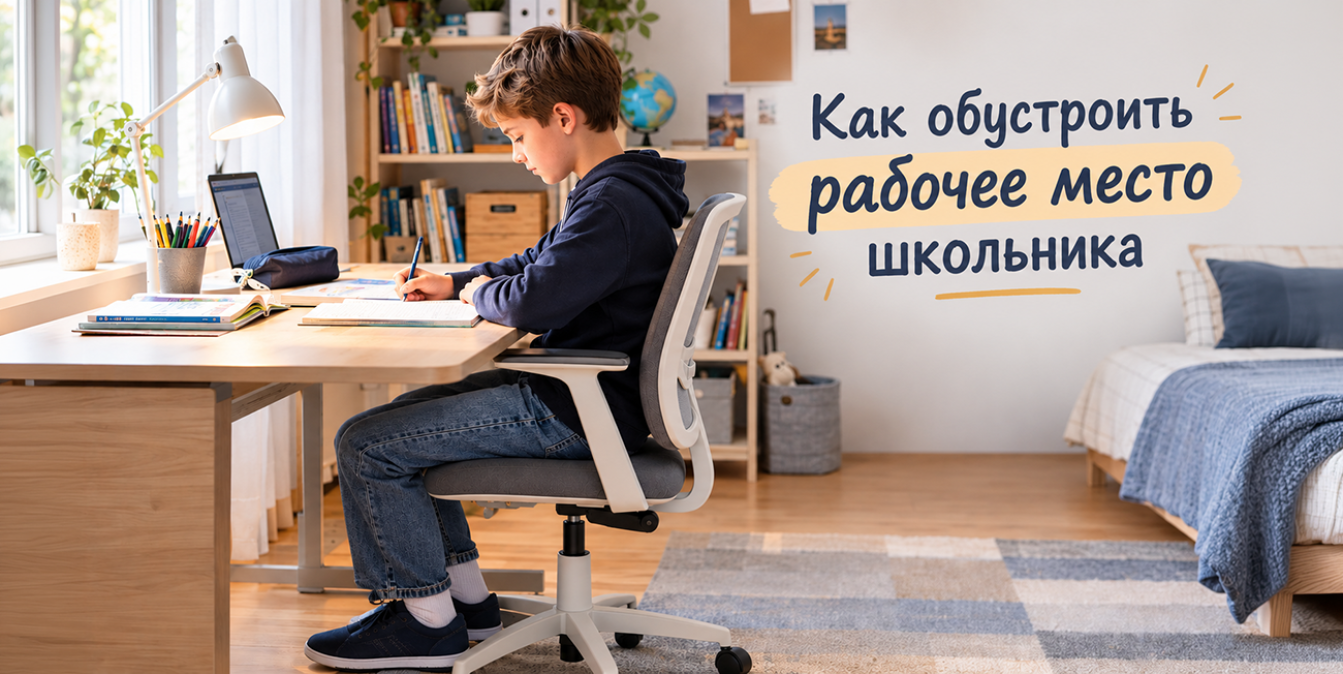
An incorrectly chosen desk, slouching, and prolonged sitting at a computer can affect not only a child's grades but also their health. Belarusian doctors have explained how to organize a child's home workspace to reduce strain on the spine and eyes.
The desk and chair should "grow" with the child
The main rule when choosing furniture is that it must correspond to the child's height. The child should sit so that their feet are fully flat on the floor, and the angles at the knees, hip joints, and elbows are approximately 90 degrees.
"It is important that the elbows are above the level of the desk, and the feet are fully flat on the floor. If the child's height does not yet allow their legs to reach the floor, a special footrest can be used," said trauma surgeon-orthopedist Artem Simonenko.
The specialist advises choosing adjustable desks and chairs. This will allow the height of the furniture to be changed as the child grows, preventing unnecessary strain on the lower back, neck, and shoulders.
The chair should have a backrest that supports the lumbar and thoracic regions. At the same time, a seat that is too soft is not suitable: the child should not sink into it and lose their correct body posture.
"The lower back and buttocks should be toned," noted Artem Simonenko.
Child trauma surgeon-orthopedist Yulian Putik explained in detail how to seat a child at a desk.
"It is essential that the chair has a backrest: we sit as close to it as possible, and the chair is closer to the table. It is important that the legs do not dangle; they should reach the floor or have a special platform under them. The feet must be at a right angle," the doctor noted.
The doctor advises not to overload the work surface. If there is enough space on the desk for both hands and elbows, it is easier for the child to maintain correct posture and avoid twisting while writing.
Separately, the specialist warned against the independent use of posture correctors. According to him, without a doctor's prescription, such devices can weaken muscles. A corrector is needed primarily after injuries or for specific medical indications.
Breaks are needed every hour
Even a properly organized workspace does not eliminate the need for movement. According to the orthopedist, after 45 minutes of study, the child needs a 10-15 minute break: to stand up, walk around, and do a few simple exercises.
Prolonged staying in one pose increases the load on the spine and can contribute to the development of posture disorders. Doctors note that the first signs of problems sometimes appear as early as ages 5-7, and adolescence becomes a particularly vulnerable period.
"45 minutes we played without interruption, 10-15 minutes walked, rested – and we can return to classes again," explained a specialist.
During breaks, it is helpful to do several stretches, stretch, walk around, or perform back-strengthening exercises. As an option, the doctor names the reverse plank, "boat" (лодочка), and hyper-extension.
How to prevent scoliosis
For the prevention of posture disorders, not only furniture and seating but also regular physical activity are important. Orthopedic traumatologist Ilya Kravets from UZ "25th City Pediatric Polyclinic, Minsk" recommends swimming and bodyweight exercises.
"Among methods for strengthening we propose the pool two times a week, bodyweight exercises: pull-ups, push-ups, crunches, plank, bars – all are permitted without any restrictions," said the doctor.
Parents should pay attention to the position of their child's shoulders and shoulder blades. They should be alerted to noticeable slouching, shoulder asymmetry, shoulder blade or waist triangle shapes.
In such cases, parents should not buy a brace or posture corrector themselves. A specialist must assess the child's condition and, if necessary, prescribe therapeutic exercise or other treatment.
Light should fall from the side
A work desk should be placed near the window. For right-handers, light should fall to the left, and for left-handers, to the right: this way the hand will not cast a shadow on the notebook.
When studying during dark hours, there needs to be both general room lighting and a focused desk lamp. Reading and writing while lying down, as well as studying with insufficient lighting, are not recommended by doctors.
The distance from the eyes to the notebook should be approximately 35 cm. A student should sit upright, leaning on the chair back, and not lean too close to the textbook.
How to reduce eye strain
One of the main mistakes is continuous reading or working at a computer without breaks. Specialists from the Minsk city center of hygiene and epidemiology advise alternating visual load with active rest and performing eye gymnastics every 20-40 minutes of study.
Simple version of eye gymnastics:
- Look up, down, and sideways several times without moving your head;
- Slowly move your gaze in a circle;
- Close your eyes for several seconds, then blink frequently;
- During rest, shift your gaze from a near object to a distant one.
These exercises do not replace treatment, but help give the eyes a brief period of rest.
Doctors advise against turning a break into additional screen time.
Even if a child has taken a pause during exercise, one should not immediately give them a phone. Lead pediatric ophthalmologist from the Ministry of Health, Victoria Krasilnikova, emphasizes that true eye rest requires changing the type of visual activity.
"A break means shifting the visual load to another activity. Physical activity serves as a good preventive measure against the development of myopia," the specialist stated.
When setting up a desk, it is important to consider not just the furniture height but also the position of the feet, back and hands. Pediatric traumatologist-orthopedist Yulian Pukit recommends placing a platform under the child's feet if they do not reach the floor, and avoiding unnecessary items on the table.
A well-organized workspace helps a schoolchild maintain proper posture, and regular breaks, walks and medical supervision by an ophthalmologist will reduce eye strain.
Computer use should also be limited. According to the Gomel City Center of Hygiene and Epidemiology, continuous visual load for school-aged children should be alternated with rest periods, and screen time should correspond...