Menu
How to protect yourself and your loved ones from scammers
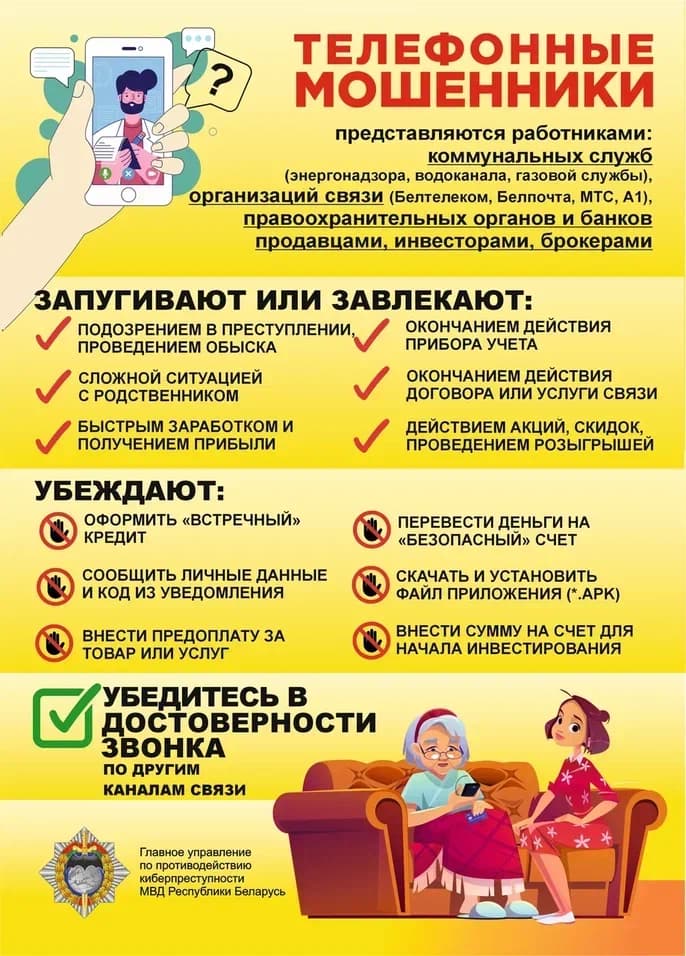
Fraudsters constantly improve their deception schemes to get your money. For communication, they may use not only internet calls in messengers such as Viber, Telegram, or WhatsApp, but also landline and mobile communications, and internet video calls. Most often they pose as employees of law enforcement agencies, mobile operators, government institutions, or banks.
At the same time, scammers continue to call citizens impersonating bank employees and law enforcement officers. They report an alleged problem and, having gained trust, offer assistance in resolving it. For example, a person might be told that they are suspected of involvement in a crime, and that a search and seizure of funds is therefore necessary. To "preserve" these funds, they are offered the option of transferring cash to a supposedly secure account or handing it over to an alleged bank employee for "declaration." Scammers may also inform the victim of a credit in their name, and to cancel it, they are asked to provide personal identification details and bank card information.
Attention!
Police officers and bank employees do not call through messaging apps, nor do they demand money transfers for "declaration" or "release from liability." They do not offer participation in "special operations" to catch scammers.
Police officers, bank employees, and mobile operators do not call subscribers through messaging apps.
Never install unknown applications at the request of strangers.
Do not share your personal data, bank card details, or SMS codes with anyone!
Do not click on links provided to you by unknown individuals.
Do not install applications on your device based on recommendations from strangers or received through messaging apps.
Fraud on Instagram involving a demand for prepayment is a common scheme used by criminals to deceive users. Here are the key aspects of this scheme:
Scammers create fake profiles with attractive photos that may showcase products and services. They often use images from the Internet to create an appearance of legitimacy.
Criminals offer goods or services at significantly reduced prices or run promotions that look too good to be true (for example, special offers on popular items).
Scammers purchase advertising and use popular hashtags to reach a wide audience and attract potential victims.
They create appealing posts and stories with bright images and tempting offers.
Scammers may create fake reviews and comments from fake accounts to create an illusion of positive customer experiences.
During communication with the victim, scammers may use various tactics to build trust, including friendly conversation and promises of fast delivery.
After the victim expresses a desire to purchase a product or service, scammers explain that a prepayment is required to confirm the order, which is made via a bank card by transferring funds.
Sometimes scammers may direct the victim to fake websites that look genuine, ostensibly for a refund due to delivery problems, where the victim is asked to enter their bank card details, but instead, all remaining funds are withdrawn from the victim's account.
After receiving the money, scammers cease communication, block the victim, or may delete their account.
How to avoid fraud on Instagram:
Look for reviews of the seller in open sources on the Internet. Pay attention to any negative reviews or warnings about fraud!
Under no circumstances transfer money before receiving the product!
If the price seems too low or the offer too good to be true, it could be a sign of fraud.
Scammers continue to extort money for "unlocking" an iPhone.
The scammer's acquaintance with the victim most often occurs on themed sites. Then the communication moves to a messenger, where the new acquaintance, under various pretexts (for example, urgent info is needed...