Menu
How to choose a floor-standing toilet: dimensions, outlet, and design features
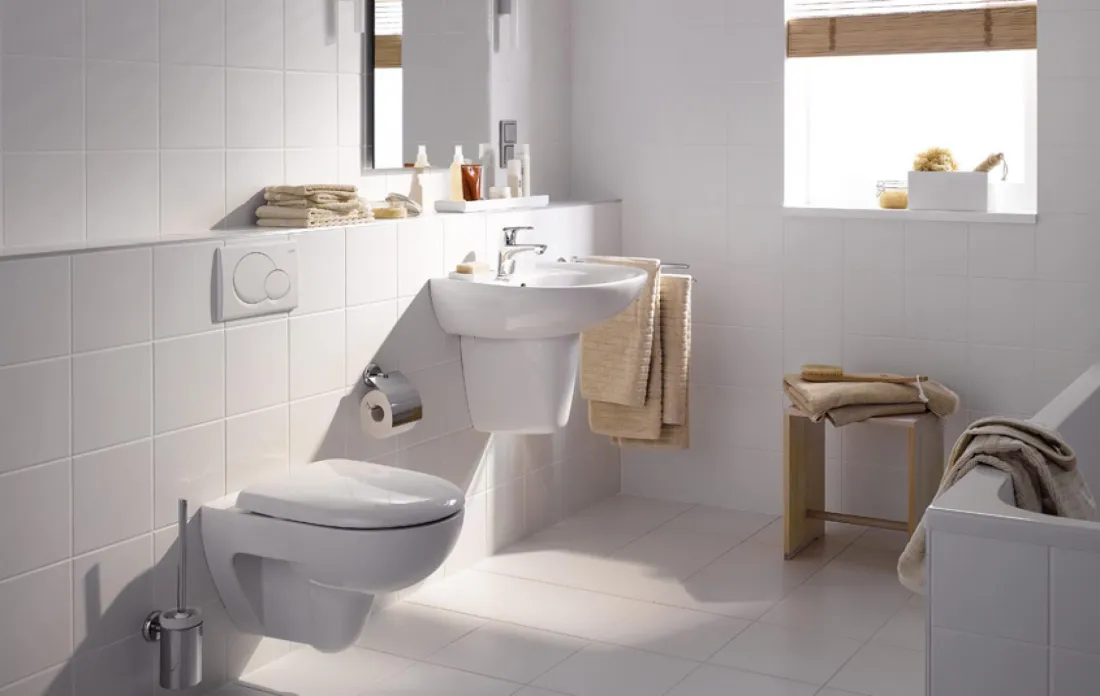
When updating a bathroom, the price of a floor toilet usually becomes one of the notable criteria, but starting comparisons only by cost is not advisable. Even externally similar models differ in connection method to the sewage system, dimensions, basin geometry, flushing mechanism and equipment. If technical parameters are checked first, unnecessary connectors, uncomfortable placement and additional costs during installation can be avoided.
First study the drainage outlet
The main technical parameter when replacing sanitary ware – the direction of discharge. It must correspond to the location of the sewage pipe.
Several options are common:
- horizontal – the hose is directed toward the wall;
- vertical – the connection goes down into the floor;
- slanting – the exit is located at an angle;
- universal – allows different connection schemes with corresponding fittings.
For example, Roca series products are released both with horizontal and universal Dual/Vario discharge.
Before purchasing it is advisable to measure not only the diameter of the pipe but also its position relative to the wall. Using a large number of connectors is technically possible, however it increases occupied space and complicates the connection.
Consider the full depth
For a small toilet, several centimeters can have significant meaning. During comparison, look at the size of the entire construction from the wall to the front edge, not just the length of the ceramic part.
Floor sets often have a depth of about 65–67 cm. For example, individual Roca models have dimensions 350 × 655 × 760 mm and 355 × 670 × 755 mm. The values are given only as examples: exact parameters should be verified at the specific location.
Before ordering it is useful to measure:
- the distance from wall to door;
- free zone in front of the basin;
- gap to the urinal or furniture;
- width of available area;
- place for convenient maintenance of the tank.
Too large sanitary ware visually and physically overloads a compact room, while an excessively reduced form
Another option is a close-coupled installation, which is placed flush against the wall and can work with a concealed cistern. Externally, the solution looks more concise, but it requires pre-prepared communications.
For a simple replacement of old plumbing, a compact model is usually more practical. During major renovations, you can consider a close-coupled scheme if you want to hide the technical elements.
Rimless or classic design
The traditional bowl has an internal channel under the upper rim. In a rimless design, there is no closed cavity, so the surface is easier to clean.
Roca notes that the Rimless technology removes internal corners and niches under the usual rim, and water is distributed across the open surface. In the relevant category, you can also filter models separately by the presence of a rimless design.
This option is particularly interesting if the priorities are:
- convenient regular cleaning;
- a minimum of hard-to-reach areas;
- simple geometry of the inner surface.
At the same time, the term "Rimless" itself does not describe all the operational features. It is important to consider the shape of the channels and the water distribution system of a specific manufacturer.
Evaluate the flush and water consumption
Efficiency depends not only on the cistern volume. The direction of the jet, the geometry of the inner walls, and the adjustment of the fittings are also important.
A common solution is a dual-flush system. For example, some Roca kits are designed for 4.5/3 liters, meaning they allow you to choose between a full or reduced flush. Other manufacturers have their own values and adjustment methods.
When choosing, it is useful to check:
- whether two flush modes are provided;
- how evenly the surface is rinsed;
- whether splash protection is included;
- what mechanism is installed in the cistern;
- whether spare parts for the fittings are available.
You should not rely solely on the minimum stated water consumption. The system should not only use little water but also perform its function effectively.
What "anti-splash" means
The anti-splash system is often mentioned in sanitary ware descriptions. Its operation is primarily related to the shape of the bowl, the water level, and the position of the flush outlet.
It is best to choose this function in conjunction with the overall geometry of the product. A very small water surface reduces the likelihood of splashes but can contribute to soiling the walls. Therefore, the most practical option is a balanced one, rather than a maximum reduction of the water surface.
In the range under consideration, the anti-splash feature is presented as a separate filter parameter, alongside a quiet flush and an antibacterial coating.
Check the water supply to the tank
This parameter is often remembered only during installation. The supply can be from the bottom or the side. A bottom connection is usually easier to conceal visually, while a side connection can be more convenient with existing plumbing.
Before ordering, it is necessary to determine:
- the location of the water outlet;
- the required length of the flexible supply hose;
- which side the inlet to the tank is on;
- whether the water can be shut off without removing components.
Some serial sets from a single manufacturer may be released with either bottom or side connection, so even within one collection, it is important to read the specifications carefully.
The seat is not always included
Two similar items can differ significantly in final cost due to their configuration. The specialized catalog offers options both with and without a seat; the micro-lift and quick-release mechanism are noted separately.
Useful functions:
- Soft Close ensures a smooth descent of the lid;
- Quick Release allows it to be removed for cleaning;
- top mounting simplifies installation in narrow...