Menu
How they extract submerged oak on Gomel land
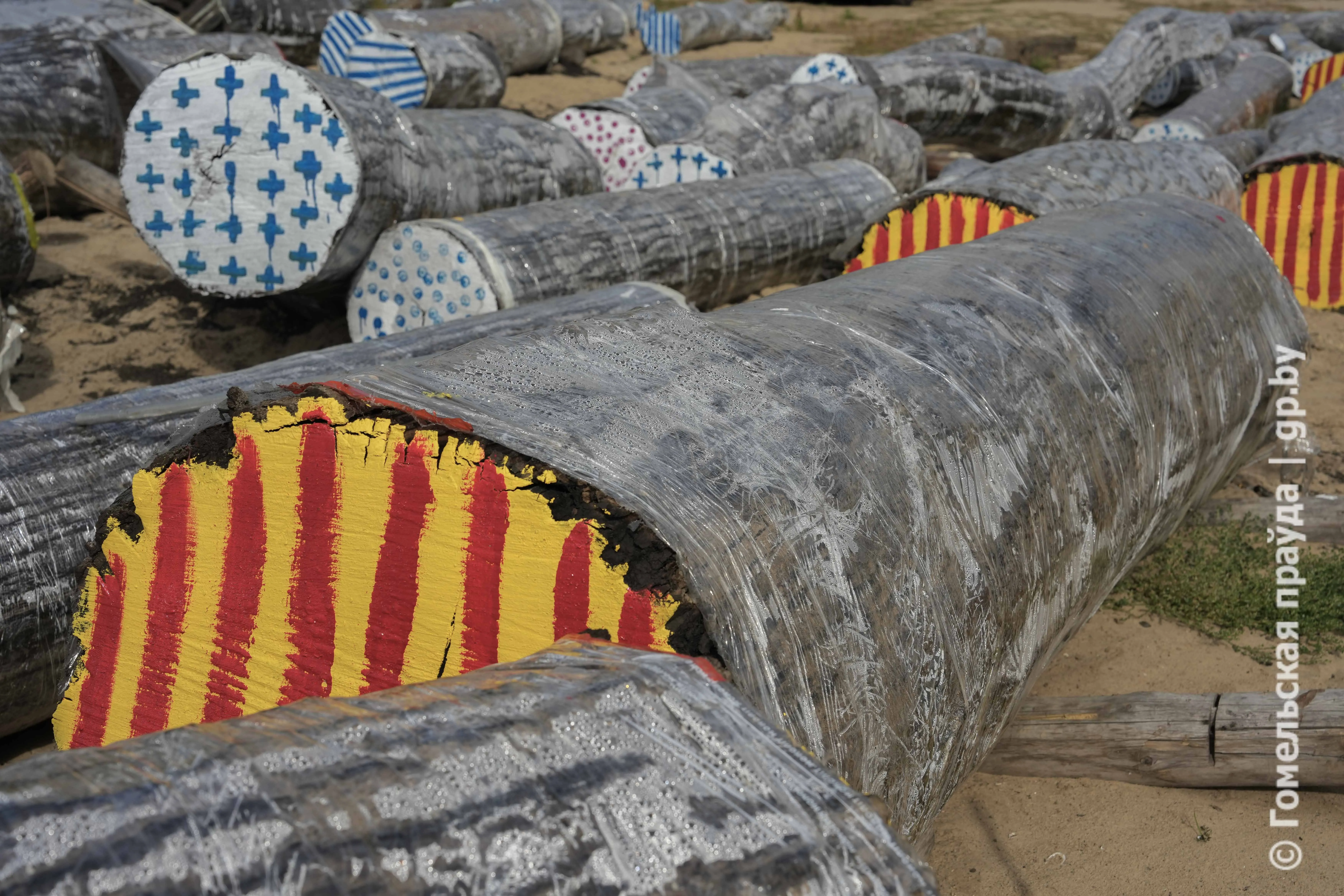
Nature takes thousands of years to create this unique material. Frozen oak is twice as hard as ordinary wood, comparable to some metals, and it also has a unique appearance that cannot be replicated artificially. The extraction and processing of this valuable timber has long been undertaken by the Gomel enterprise “Trans-Center,” headed by Alexander Dupanov.
Add “Pravda Gomel” to your Google Search sources so that current news appears more often in your recommendations.
Alexander Dupanov: “Our product is unique because it is an irreplaceable natural resource whose reserves are scarce worldwide.”
Europe has exhausted its resources
A series of coincidences led the entrepreneur into this craft. In his youth he worked as a builder, a scuba diver, led groups on water transport trips, and throughout his life he exclusively loved nature. It seems that the latter especially influenced his choice of profession.
One day friends from Germany came to him in Belarus and asked for 20 cubic meters of frozen oak lumber. The thing is that German legislation at the time allowed a serious postponement of major repairs in the future if the roof of a building was made of metal or oak. Europeans knew that our country was rich in this valuable material from the depths of the water. Getting the rare wood through specialized enterprises from Alexander at that time did not work out. However, it was at that moment that the entrepreneur became interested in the question of independent extraction and processing of this valuable timber.
“The product is unique because it is an irreplaceable natural resource whose reserves are scarce worldwide. Our country has long been renowned for its oak groves, so
The interlocutor also told that in the first years of his work, the European market was practically closed due to individual dishonest entrepreneurs who supplied low-quality products to Italy. At that time, Europeans haughtily decided that there was no submerged oak in Belarus and could not be. According to Alexander, this was a terrible discrediting of our national wealth. It took years to restore a good reputation abroad, but now no one in the world doubts that we have this valuable resource.
Nature spends thousands of years creating this unique material
There is no place for random people here
30 years ago, there was almost no information about such a craft in open access. It was necessary to act almost from scratch, by trial and error. There were cases when a diver found an oak, signaled about it, and all the necessary resources were brought to the extraction site, but when diving again, it was not possible to establish the location of the tree. Many nuances are also associated with the correct packaging of the oak extracted from the water, because even the slightest mistake can turn expensive material into unsalable goods. Alexander Dupanov admitted that to this day, every tree raised from the bottom presents specialists with new lessons for further work.
The entrepreneur notes that things are going well now, but he would not have been able to achieve any successes in any of the neighboring countries. And it's not just about the reserves of submerged wood on our territory. He said that from the first years of work, significant support was provided by representatives of local authorities, environmentalists, and the Administration of the President of Belarus.
"Previously, it was enough to obtain a special permit for 7 years and do your own business. Now the legislative framework is changing almost every year, and everything must be agreed upon, with the approval of the locations of stay and extraction, payment of all fees," Alexander Dupanov shared. "And I think this is correct, because in this way, random people who want to dishonestly enter the industry are weeded out. There are many examples where the wrong approach 'killed' a very high-quality product, and spoiled trunks can often be found near water bodies. We, in turn, take our work very seriously, have our own vision, aimed at the rational development of this sphere. We conduct scientific and research activities and have developed a technology that minimizes harm to the environment. All because we love nature, and for us, it is a great happiness to be engaged in this business.
To confirm the quality of the products, Alexander Dupanov emphasized that the President of Belarus has repeatedly presented souvenirs made by his enterprise to leaders of other states.
Moored oak is twice as hard as ordinary.
Searching for wooden gold.
The specialists at “Trans-Center” work with moored oak in various corners of our region and beyond its borders. Currently, their work site is located near the settlement of Chenkis in the Gomel region on the Sozh River. Along the shore, carefully packed sections of the trunks of those very trees are spread out. Some of them appear to the layperson completely unappealing: rough, uneven, some dark. It seems that if you find one isolated somewhere on the riverbank, lonely and broken under the sun, you wouldn't think that you have a valuable natural artifact before you. However, from such samples, with careful and professional handling, unique and expensive products are produced. One might think of the master who works with moored oak as a jeweler guarding a diamond. Naturally, before the product attains a premium look, many manipulations must be carried out.
First, specialists determine where moored oak might potentially be located. If its location is confirmed, they prepare everything necessary for the lift. For this purpose, for example, special powerful cranes have been developed that can lift up to eight tons. The wood extracted from the water is transported to a camp where preparatory work is carried out. The oak is cleaned with pumps, sand, silt, fishing hooks are removed – everything that the trunk has accumulated over hundreds or thousands of years. Specialists also perform an initial screening. It can happen that under the tree at the bottom of the water body, for example, a carcass of an animal has been there for hundreds of years. Then the material acquires a specific odor that cannot be eliminated. It will be felt even in finished products after processing.
– We extracted an oak tree that was 8110 years old according to the results of radiocarbon analysis. It's possible that we encountered trunks that were even older, but expertise is expensive and not every sample is analyzed, – noted Alexander Dupanov. – The thing is that currently, unfortunately, Belarus does not have its own specialized laboratory. Previously, carbon analysis was conducted by my good friend, a native of Gomel, geologist Nikolai Mikhailov. Once we sent him a material for examination, received the result, and then sent the same tree sample with a slightly different approach. We received a similar expert conclusion and understood that he was a professional. After he passed away, it became problematic to determine the age of an oak tree in our country. Such services are provided abroad, however, some laboratories approach their work unscrupulously. With Mikhailov, there were no problems. In Belarus, there are still very good specialists, but there is a lack of our own laboratory for radiocarbon scanning. Taking the opportunity, I would like to thank the forest products carrier Vyacheslav Nikitenko and the crane operator Grigory Yeremich, whose professionalism allows them to perform even extremely complex tasks.
Another problem raised by the interlocutor is the irresponsible behavior of some boat captains during underwater operations. According to the rules, after installing all necessary identification elements, ships should not approach closer than 50 meters, and they should also slow down when moving alongside to avoid creating waves. This is necessary to ensure that the lives of divers are not threatened. However, fans of active recreation can sail close by at a decent speed, despite all prohibitions.
Along the shore, carefully packaged parts of the trunks of those same trees are laid out
We have something to show
Alexander Dupanov told us that at different times he received offers from foreign companies specializing in wood processing. They were interested in the specialist's rich experience, which could be used to develop the industry in other countries, however, the Gomel entrepreneur is principled in his desire to work in his homeland. He wants to pass on his knowledge to future generations, and his sons have followed in his footsteps. The younger son, Sergei, is engaged in scientific research of moraine oak, and the older son, Denis, is responsible for the practical part in the production of souvenir products.
In the future, the entrepreneur plans to expand the range of possibilities of his enterprise and start manufacturing furniture from valuable wood. Additionally, he wants to open his own museum of bog oak in the regional center. According to him, there are two such museums in Russia, but in terms of richness, they are inferior to what our museum in Gomel could potentially offer.
Alexandra Gorbacheva