Menu
How Belarusians manage their income — social research data
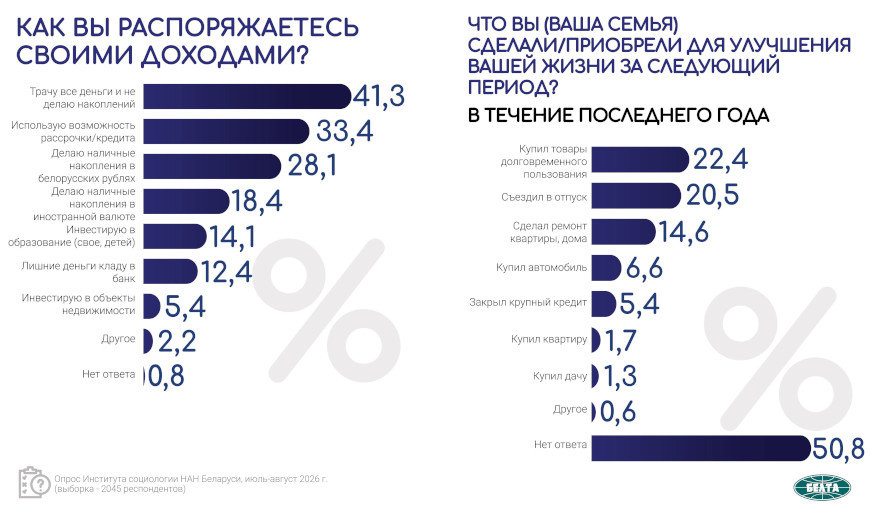
More than 28 % of the country’s residents keep cash savings in Belarusian rubles, said Alexey Avdonin, chairman of the board of the RGOO “Belarusian Society “Knowledge”, when commenting on the results of a nationwide sociological survey that address current issues of the country’s socio‑economic development.
Alexey Avdonin pointed out that the fact that 28.1 % of respondents keep cash savings specifically in Belarusian rubles indicates the stability of the Belarusian currency, trust in the ruble, and confidence in the financial‑credit policy pursued by the National Bank.
He noted that in rural areas this figure is higher—over 30 %. This shows that people in the countryside are more inclined to accumulate funds. By region, the highest proportion of cash savings in Belarusian rubles is made by residents of Brest Region—37.9 % of respondents—and Grodno Region—36.7 %.
Speaking about other results of the study, the chairman of the board of the RGOO drew attention to a global trend related to economic behavior oriented toward consumption of goods. “In us this trend persists. According to the answers, 41.3 % of respondents spend all their money and do not save, 33.4 % use the possibility of installment credit. This is not a peculiar exception for our Belarusian nation,” said Alexey Avdonin.
He emphasized that this global trend indicates that people now orient themselves toward consumption of goods, using credit, thereby they are confident about tomorrow, confident that they can provide for themselves through their wages and a stable future, and a stable socio‑economic situation for their family and children.
It is also important that 12.4 % of respondents direct surplus funds to bank deposits. This is a high figure for the global economy. It indicates trust in the banking system. And this, undoubtedly, gives Belarusians the opportunity to earn on deposits and provide a certain passive stable income, emphasized Alexey Avdonin.
When asked “How would you assess your family’s financial situation?”, 82.2 % of respondents answered “Good”, 17.7 % “Bad”.
“This indicates that the state’s policy, implemented over three decades, has always aimed at improving welfare. Our President has always said that the primary activity of the state apparatus should focus on raising welfare. And we see the results in the social survey. The indicators are high,” said the chairman of the board of RGOO.
He emphasized that the programs adopted at the VNS for the country’s socio‑economic development each five‑year period yield results: the population recognizes future stability. “There are no disproportions, uncertainties that would lead to negative outcomes. As a result—high material well‑being allows people to take other actions within the economic behavior of our population,” explained the expert.
82.1 % of respondents are satisfied with their current workplace, 17.9 % are dissatisfied. According to Alexey Avdonin, this indicates that Belarusian state policy is oriented toward creating new jobs while simultaneously protecting workers. The state pays great attention to ensuring the protection of workers’ rights. The result is that Belarusians cherish their jobs, invest in them, and in enterprises and organizations.
“In conclusion—there are sufficiently high rates of economic growth and the fulfillment of many key development indicators of our economy. The internal motivation to work well is expressed in increased labor productivity,” said the chairman of the board of RGOO.
When asked “What is most important and meaningful to you today?”, 54.3 % of respondents said “Earn a lot, even if it means working very hard and intensely”, 37.3 % said “Have a modest income but more free time and a lighter job”.
Commenting on the first indicator — 54.3 %, Alexey Avdonin explained that this is a key characteristic for Belarus. If more than 50 % of the working‑age, economically active population answers such questions, it means that the economy is properly structured and the working population is oriented toward maximizing income. This can manifest not only in raising wages at one’s own enterprises but also in seeking opportunities for legal earnings from a second job.
At the same time, it must be understood that the 37.3 % figure does not mean that such a number of respondents is not inclined toward hard work or high earnings. This figure may reflect a situation related to the fact that people in rural areas are focused on running subsistence farms, caring for children, their education, and upbringing. “And this indicates that our nation, our society is socially and economically structured correctly, and the motivation of our population is oriented toward raising the well‑being of their families and personal prosperity,” the expert explained.
There was also a question: “Do you know the exact cost of the main food products you regularly purchase?” 80.6 % of respondents answered yes, 19.1 % answered no.
The population knows and monitors prices in different stores, noted Alexey Avdonin. This provides the possibility of a more conscious, rational way of consumption, which is characteristic of those nations that know how to count money. From an economic standpoint, this is an extremely important indicator that primarily reflects a high level of rational budgeting, allowing for savings, the purchase of long‑term goods, and investments in children.
Another question concerned whether there were sufficient funds for everyday and large expenses. In particular, regarding food products, 93.6 % of respondents answered yes, 5.1 % answered no. In 2021, the first figure was 79.4 % and the second 18.1 %. Thus, over the years this indicator has improved, demonstrating the confidence of the population.
Regarding rent and utility payments, 89.5% of respondents said they have enough money, while 4.9% said they do not have enough. In 2021, these figures were 75.9% and 14.8%, respectively. This is also an indicator that over the past five years, the socio-economic situation of Belarusians has improved, confidence has increased, and awareness and understanding of the future and prospects have become more stable.
For clothing and shoes, according to the results of the social study, 79.6% of respondents have enough money (in 2021, this figure was 49.8%), while 16.1% do not have enough (in 2021, this figure was over 40%).
For medical treatment and medication, according to the social study, 65.6% of respondents have enough money (in 2021, this figure was 41.4%), while 23.7% (43.5% in 2021) do not have enough. According to the expert, the positive trend indicates that the population is aware of the increase in their well-being, takes care of their health, and is inclined to spend part of their income on medical diagnostics for themselves and their loved ones. The ultimate result of this trend is an increase in life expectancy.
For alcoholic products and tobacco products, 35.1% of respondents (in 2021, this figure was 24.7%) said they have enough money, while 6.3% (17.9% in 2021) said they do not have enough.
The expert also drew attention to an important indicator of economic behavior: 56.6% of respondents said they do not spend money on these purposes. "The choice of alcohol is always associated with uncertainty, which exists in a given society: economic uncertainty, military, political, chaos, and confusion lead to the need to get rid of stress, resulting in significant alcohol consumption. In our country, consumption is decreasing. Young people choose not alcohol, but a more rational approach - finding a new job, earning more money, self-realization through education, investments in themselves, the educational sphere, health, and physical fitness," emphasized Alexei Avdonin.
In response to the question of whether they have enough money to build a house or apartment, 10% of respondents said they do (in 2021, only 2.9% responded positively), 34.6% (49.9% in 2021) said they do not have enough, and 54% said they do not spend money on this.
Regarding what you (your family) have done or purchased to improve your life over the past five years, 36.7% said they renovated an apartment or house, 31.8% bought long‑term goods (furniture, appliances), and 26.4% went on vacation (health retreat, travel).
In July–August 2026, the Institute of Sociology of the National Academy of Sciences of Belarus, commissioned by BISI, carried out a comprehensive nationwide sociological survey. The study included 2,045 respondents from all regions of the country. Today in Minsk, the first part of the survey results—concerning current issues of Belarus’s socio‑economic development—was presented.