Menu
He replaced the kitchen in Turkey with Stolbtsy. We looked at how eastern sweets are made in Belarus
One summer day in the center of Stolbtsy, we were greeted by a sign with intricate script, the sweet smell of baked goods, and several people who know their stuff. In a small one-story building, a production facility was hidden, where up to 75 trays of Turkish baklava are made every day. Flour, nuts, and 40 layers of the thinnest dough are managed by a pastry chef from Turkey who came to Belarus specifically for this job. The results of his labor can be found on the shelves of a couple of Minsk shopping centers. We spoke with those who three years ago started making Eastern sweets in Stolbtsy.
The production room is small, and in hats and robes, we quickly find ourselves in the kitchen of Sultan Baklava. First, director Inna introduces us to chef Jumu, who came from the city of Gaziantep in southeastern Turkey. This place is considered the birthplace of Turkish baklava. The man has been preparing the dessert since he was 12 and has been doing it for 28 years. This dish is his specialty, although he can also make other sweets, such as cakes. "Baklava is easy. For you, it may be difficult, but for me, it's easy," says the chef, and in the next half hour, the kitchen will be filled with clarity and speed without chaos.
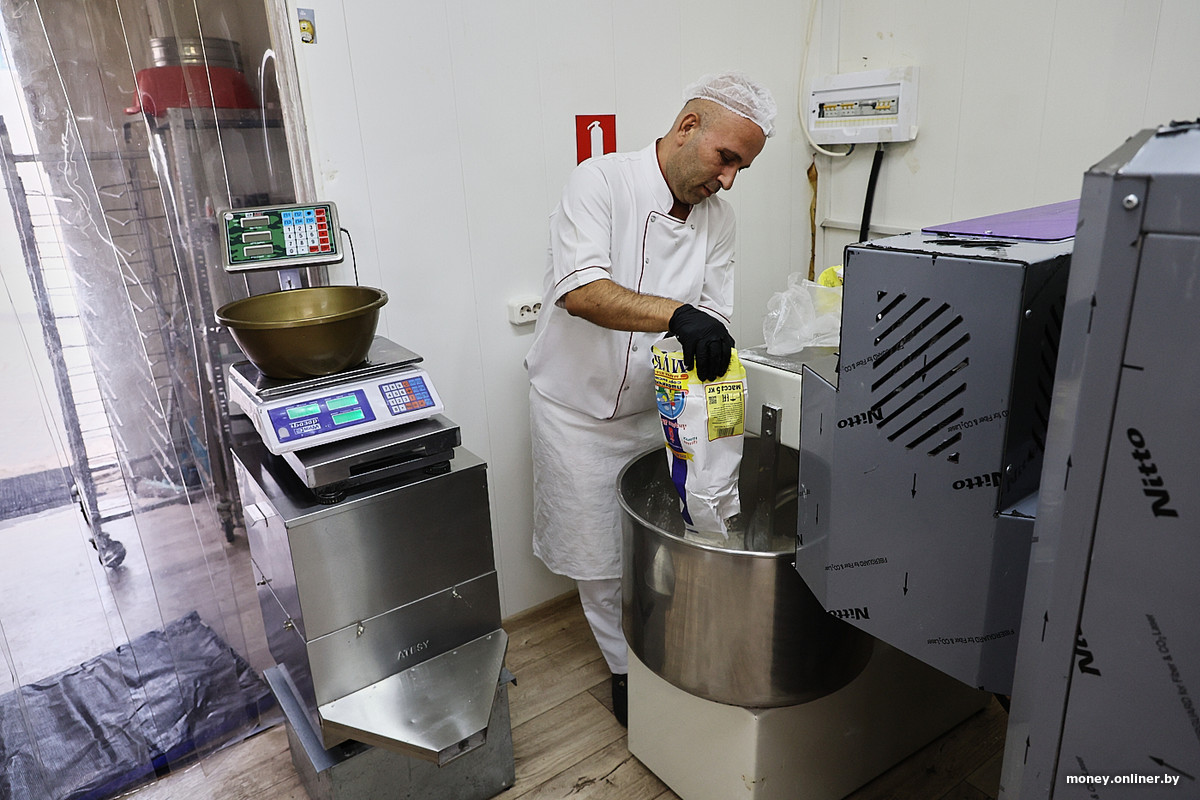
Jumu pours flour into a machine that kneads the dough. The main components are flour, egg, and water. This device is similar to a large planetary mixer. The ingredients are poured in entirely non-domestic quantities: a large package is poured in whole, followed by another and another.
Meanwhile, we figure out the difference between pakhlava and baklava. Both of these Turkish sweets are made from thin phyllo dough. The difference lies in the number of layers and the filling: pakhlava has 6-7 layers of sweet dough with layers of chopped walnuts and honey, while baklava has 40-50 layers of phyllo dough with a filling in the form of sherbet - a sugar syrup with the addition of citric acid. As we are explained, baklava is usually crunchier.
Inna tells us that the machine for rolling out the dough was bought in Turkey for $30,000 - it produces a sheet with a thickness of 0.04 to 1 millimeter. The dough passes through rollers and becomes as thin as paper, but does not tear. The secret of baklava lies in the fact that all 40 layers are not formed automatically, like in puff pastry, but are applied manually.
The dough is as thick as fabric
The center of the room is occupied by a large table where all the culinary magic happens. It is made of marble, and this is not just for aesthetics, but is part of the technology. The surface remains cool, even despite the warm summer day outside and the hot working oven nearby. According to the interviewees, this is necessary for convenient work with the dough, and besides, marble is not damaged by knives, and with time and work, almost no chips form on it - this is good from a hygienic point of view. The marble countertop cost around $2,000 four years ago.
The prepared dough is laid out by Juma on special metal trays. It rests for a bit, and then a dessert is formed from it. If the countertop is not for beauty, then the trays are partly for it. They look aesthetically pleasing, compact on glass showcases, no need to spend time on special serving, and the fragile crispy dessert retains its shape. There are 300 such trays in production, and all of them are used.
At some point, Juma hands the journalist a knife with the words "Don't be afraid". The knife is large and sharp, and it's needed to quickly and evenly cut a small roll of dough into separate dessert units. Of course, it doesn't turn out as beautifully and confidently as it does with the master, although he praises and encourages: "Everything is fine".
In the kitchen, the chef has an assistant, who is from Belarus (but at the time of our meeting, she is on vacation). The oven can hold eight trays of baklava at a time, but it's also possible to cook a smaller quantity - all the cells are turned on separately.
The baklava is baked in a special floor oven at a temperature of 250°C. While we wait for the first batch, we learn that Juma moved to Stolbtsy from Turkey for work, leaving his family - his wife and 8-year-old son - at home. The man smiles and says some words he has learned in Russian: "shell", "baklava", "hello", "excuse me", - and then we continue talking to the chef with the help of interpreters who know Turkish.
How do you cope with the separation from your loved ones?
It's hard, but I'm grateful that I can see them whenever I want. I was recently in Turkey. Everyone has their own desires, I want to make their lives better. There's a big difference between what I can earn there and here. For example, meat costs $30 per kilogram there, and people can afford it only once a week, - the confectioner says about Gaziantep, his hometown.
What impression have you formed of Belarus?
The place is beautiful, the weather is good, people are friendly. I like it here. I like offering people products, I like production and my job.
What didn't you like about our place?
The bread is very sweet, - the man smiles.
He also talks about his main dream - a house in Belarus. Not necessarily in Stolbtsy - rather wherever there's work. He hopes to reunite with his family here one day, but the plan is still unclear.
During the cooking process, the baklava is poured over twice. The first time - with melted butter of 99% fat content, which is purchased in Gorodok. By the way, Belarusian flour also comes directly from the factory.
For the second time, already at the very end, it's done when the syrup is boiling. The chef only needs a fleeting glance at the rosy dough to understand: it's time.
The scorching baklava crackles, steam rises - the chef deftly picks up all the baking sheets and sets them aside: the sweets need to cool down properly, and then you can eat them.
The volumes vary - sometimes they bake up to 75 trays of baklava per day.
There are dozens of types of baklava, they differ in shape and taste. For example, chocolate baklava is infused with cocoa. Sometimes there are unusual shapes, for example, in the form of a shell. Retail prices range from 5.40 to 11 rubles per 100 grams of product.
The chocolate baklava is in the middle of the top row.
Nuts are often used: pistachios, almonds, hazelnuts, walnuts. The most expensive, according to the interviewees, are pistachios, almonds and hazelnuts, which are considered mid-range, while walnuts and coconut are more budget-friendly.
- Have you felt the price increase for pistachios?
- Yes, there was a big jump. Over the past year, prices for them have risen by about 40 percent. There are also some nuances: we receive sifted pistachios in industrial boxes, we manually sort them, God forbid there's a chip or a pebble somewhere. And also, the nut can be spoiled somewhere, - says Inna, the production director.
- Have you raised prices for products with these nuts?
- No, we are the first to make baklava on an industrial scale, apart from us, there are masters in the country who prepare small volumes. We are developing and want more people to know this product, so we haven't raised prices. In three years - only once, by 5 rubles per kilogram.
Why the business of Turkish sweets appeared in Stolbtsy
The company currently employs 15 people, including management, accounting, and sales staff on the islands. The founders are from Turkey, with one of them living in Belarus. Baklava is not the only product they work with; they also import Eastern sweets to Belarus. They claim to have contracts with two leading Turkish manufacturers to supply loukoum, halva, and other products.
We needed to diversify our product range, and we decided to turn our outlets into a "piece of Turkey" so that people could find popular Eastern sweets and new products in one place - for example, various tahini pastes, pekmez (a syrup made from boiled grape juice), says Inna. Loukoum is mainly sold in Belarus as a Russian-made product, and people often ask us directly if ours is Turkish, and there is a high demand for it.
The idea that demand should be tested at the start, even before launching a business, is reflected in the experience of our heroes. They came up with the idea of launching their own Turkish baklava production after trying to sell a Russian-made product and seeing that it was in demand. Many Belarusians have vacationed or used to vacation in Turkey and are already familiar with this product.
The choice of Stolbtsy was due to its convenient logistics in the Minsk and Brest directions, and the fact that the director, who had previously worked as the head of a food production facility for a long time, lived in this city. The business founders had known her for a long time and immediately invited her to take on the role of director. Additionally, the region has lower rental costs compared to the capital. There was also another financial advantage: a seven-year exemption from paying taxes under Decree No. 6.
According to the director, the first steps were taken three years ago, which included obtaining documents. They acquired a quality certificate for production, which needs to be confirmed every year. They purchased their first equipment: a dough mixer, mixers. They developed recipes and technological maps, obtained certificates of conformity. Currently, their product range includes 27 types of baklava, each requiring a separate certificate.
The interviewee admits that the stage of document preparation was one of the most difficult, and the business expenses at the very beginning were approximately $2,000 equivalent. Additionally, renovations were needed in the rented building, including the installation of plumbing, which alone cost around 50,000 rubles. However, according to Inna, they were able to launch in just a few months because they worked on everything in parallel, including organizing sales points. In one of the shopping centers, the owners already had a location, which they simply repurposed.
Currently, the production facility in Stolbtsy operates on a made-to-order basis, so they do not keep any stock. It serves its four retail outlets: one near Stolbtsy, another in Baranovichi, and two in Minsk - these are kiosks in the Green City and Outleto shopping centers.
The location helps to cope with situational demand and not miss sudden orders: the store and kitchen are nearby, and the master also lives close by. According to the interviewees, there have been situations where they "received an order in the daytime, baked in the evening, and handed it over the next morning."
"Although the shelf life of baklava is a month, we don't wait. We deliver fresh supplies to our outlets five times a week."
"Is all of it sold out?"
"Yes, we deliver in small batches so that it sells out."
The company delivers orders to its own outlets itself - it has two cars for this purpose. They are also establishing distribution in the regions: they cooperate with individual entrepreneurs who sell their products at kiosks in local shopping centers, as well as with coffee shops. They receive orders from them and send the products, and the entrepreneurs then sell them on site. Elena, who is in charge of marketing at the company, notes that they have already accumulated a significant number of regular customers. They supply products to Grodno, Slonim, Mogilev, and Mozyr. Another long-term cooperation is somewhat unusual - with the Turkish Embassy in Belarus: they supply baklava for events, although not on a commercial basis.
Elena notes that there is seasonality in this business. Baklava is more often purchased during the cold season: due to the weather, people more often choose to walk in shopping centers, and during the vacation period, when people prefer sun and ice cream, demand decreases. The company has experienced this firsthand: "We were moved to a different location in the shopping center - and sales fell by 20%."
Onlookers noticed how people would walk by their stalls, saying "Look, pahklava". Let them call it that, not entirely accurately, but they are familiar with the product, so there was no need to create demand from scratch for an unfamiliar product. Those who have never tried the dessert are offered to taste it at tastings. Near the stalls, you can often see a seller handing out small squares of baklava.