Menu
HD display for 1,049 rubles. What's wrong with the new Infinix Hot 70?
The Infinix Hot 70 gives a strange impression: a large screen, fresh Android, a decent bundle, two cameras, and performance that is enough for everyday tasks. But when you look at the price, questions arise. Especially when, for the same money, there are smartphones with AMOLED displays and more convincing cameras on the market. Let’s find out what exactly the new Infinix offers and why its price is so hard to accept.
Appearance
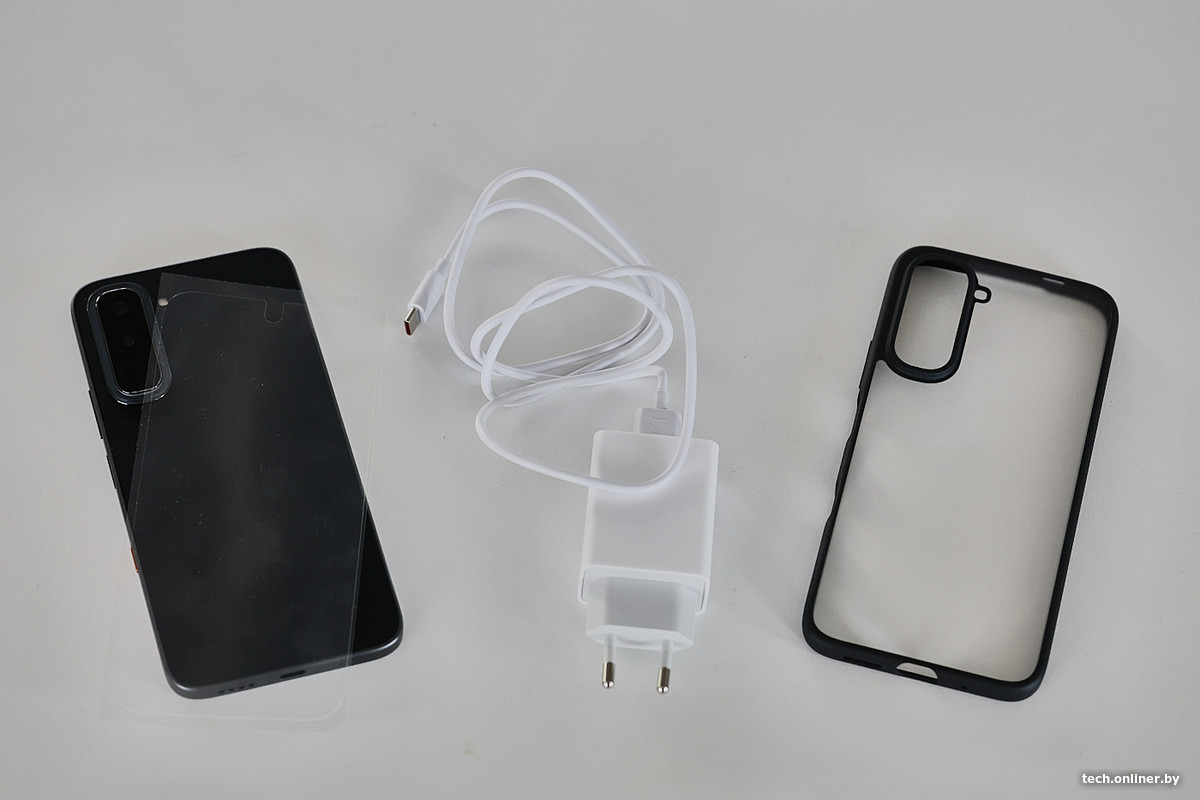
The package of the Infinix Hot 70 is generous by modern standards. The box contains a plastic case, a protective film, and a 45‑W charger. You won’t need to buy basic accessories separately.
Phone Infinix Hot 70 X6895B 8GB/128GB (black)
Android, 6.78‑inch IPS display (720×1576) 120 Hz, Mediatek Helio G100 Ultimate, 8 GB RAM, 128 GB storage, expandable memory support, 50‑MP camera, 6000 mAh Li‑ion battery, monoblock, IP65 water resistance.
The phone itself is unlikely to be called remarkable in appearance. It is a large black slab with ordinary bezels around the display and a droplet‑shaped cutout for the front
By itself, using an IPS panel is not a problem. The issue lies more in the combination of resolution, brightness, and price. In the Hot 70 segment, an AMOLED display no longer looks unusual, so such a screen is perceived not as a sensible saving, but as an overly noticeable compromise.
He doesn't lag, he's just slow.
Inside the phone is a MediaTek Helio G100 Ultimate – a budget chip primarily aimed at basic scenarios: browser, Telegram, TikTok, and other everyday apps run without noticeable stutters.
Limitations become especially apparent in games. Genshin Impact immediately offered low graphics settings, and the image looked frankly poor. After switching to medium settings, the picture noticeably improved, but the frame rate dropped to an uncomfortable level.
With Standoff 2 the situation is better. The game ran quite well even on high settings, so the outcome depends heavily on the specific project.
Based on the Geekbench test, the result can be compared to the Poco X3 – a phone that will turn six this year.
Battery life is fine on the Hot 70: in mixed mode, after 6 hours 17 minutes of use, the phone consumed 75 % of its charge. The battery will comfortably last through a busy day, and with more relaxed usage you can expect roughly two days.
Camera
On the back panel there are two cameras: a primary wide‑angle module and an additional portrait lens. At first glance it may seem there are three cameras. In reality, the third circle is not a lens but a decorative glowing block. It functions roughly like a simple glyph: it changes the lighting scenario depending on what’s happening with the phone.
The primary wide‑angle module’s image quality is mediocre. It’s sufficient for utilitarian tasks: you can capture meter readings, a document, or an advertisement, especially in good lighting. But for more demanding shots, the camera struggles. The photos noticeably lack sharpness, fine details quickly disappear, and textures look as if a watercolor brush lightly brushed over them.
AI processing within the OS doesn't save the situation either. After taking a photo, you sometimes have to wait a bit while the phone processes the frame before it appears in the gallery. The final image becomes slightly sharper, but fundamentally the quality doesn’t change.