Menu
From sowing to «Дожинок»: how Владимир Башлыков earned a ticket to the main holiday of grain farmers
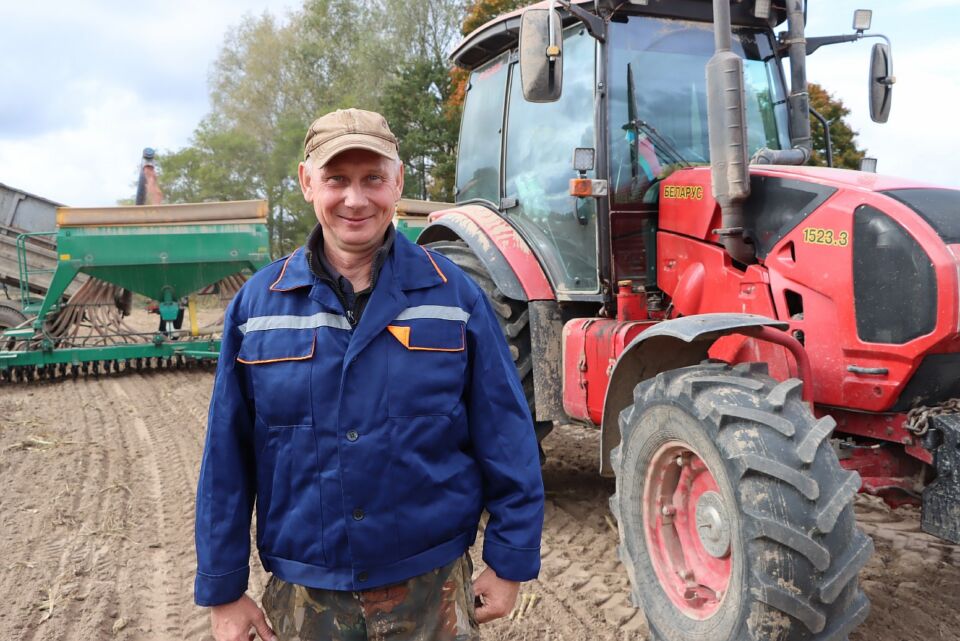
The combine harvesters had barely fallen silent on the fields of cereal crops when the land once again called us to work. The agricultural cycle knows no pauses, and today, on these sunny days, the farm is completing the sowing of winter crops. Inside the cab of the modern, powerful tractor, it is quiet and cozy. Vladimir Bashlykov confidently steers the machine across the wide field. Behind him, perfectly even, velvety stripes of land stretch out.
"Wheat is a grateful crop, if you approach it with soul," the tractorist reasoned to himself, checking the precision of the seed placement against the instruments. "The main thing now is to lay a reliable foundation for next year's, 2027, harvest. The land doesn't like haste; it respects precision." Vladimir stopped the tractor at the edge of the field to refill the seeder's hopper with seeds. He climbed out of the cab, crouched down, and took a handful of warm, loose earth. He looked out at the endless horizon.
He was born and raised in Khotimshchina, absorbing from childhood the beauty of these places and the heavy, yet noble, labor of the breadwinner. He didn't have to ponder the choice of profession for long—his heart was naturally drawn to machinery. He graduated from our vocational school, where the young, ambitious man eagerly absorbed knowledge about engines, hydraulics, and the intricacies of agronomy. He began his working life in the collective farm on the legendary, but stubborn, tracked DT-75. That old tractor became a true school of life for him. "If you can learn to get along with the 'DT-75,' you can handle a spaceship," his older colleagues used to joke. And Vladimir learned. The years passed, technologies changed, and it seemed that the entire history of Soviet and Belarusian machine-building passed through Bashlykov's hands. He sequentially moved on to various models of universal "Belaruses," taming the steppe giants "Kirovs." Vladimir studied each new machine down to the last screw, feeling the technology as an extension of his own hands.
Harvest has always held a special place in his life. For many years, he consistently moved from the tractor's steering wheel to the combine's controls to harvest grain. Harvest is a time that tests character. Short hours of sleep, scorching heat, dust flying from under the combine head, and an incredible, overwhelming sense of pride as the golden wheat flows endlessly into the hopper.
The green shoots of winter rapeseed, which will soon break through the soil, are the greatest reward for loyalty to one's chosen work. And the shoots are already there, and they are good. At the sight of them, Vladimir Bashlykov's eyes glow with pride—this, perhaps, is the very reward for which villagers work.
Khotimchina is proud of its hero and wishes Vladimir new labor victories, good health, and successful fishing.