Menu
From draniki to homemade dough. Which kitchen food processors are bought most often
From Potato Pancakes to Homemade Dough: Which Kitchen Food Processors Are Most Often Purchased
Cubed potatoes for Olivier salad, grated potatoes for draniki, or dough for homemade baking—everyone has their own reasons for buying a kitchen food processor. We looked at which models were most frequently ordered in the Onlíner Catalog from August to October 2026. The ranking includes both simple vegetable slicers and kitchen machines with meat grinders, blenders, and planetary mixers.
About This Article
The most purchased kitchen food processors. Model ranking
What types of kitchen food processors exist
What to consider when choosing
Kitchen food processor brand ranking
Top 10 models
This article was originally published on Onlíner and was updated in October 2026: we revised the ranking based on recent orders in the Catalog and supplemented the model descriptions.
The Most Purchased Kitchen Food Processors. Model Ranking
Based on orders in the Onlíner Catalog from August 1 to October 11, 2026.
- RAGEX R121—201
- Belvar ETB-3
- Moulinex FP827E10
- Bosch MC812M865
- Holt HT-FP-010
- Holt HT-FP-015
- Holt HT-FP-013
- RAGEX R112—900
- ProfiCook PC-KM 1063
- Holt HT-FP-012
Top 5 kitchen machines for the same period
- Holt HT-FP-010
- Holt HT-FP-015
- RAGEX R112—900
- RAGEX R106—110
- Kenwood Chef Patissier XL KWL90.004SI
What Types of Kitchen Food Processors Exist
The term "kitchen food processor" covers quite different appliances. Some quickly shred vegetables and chop ingredients, others knead dough and whip cream, while a third type can make soups and sauces with heating. To avoid paying for unnecessary functions, it's best to first understand what each type of equipment is designed for.
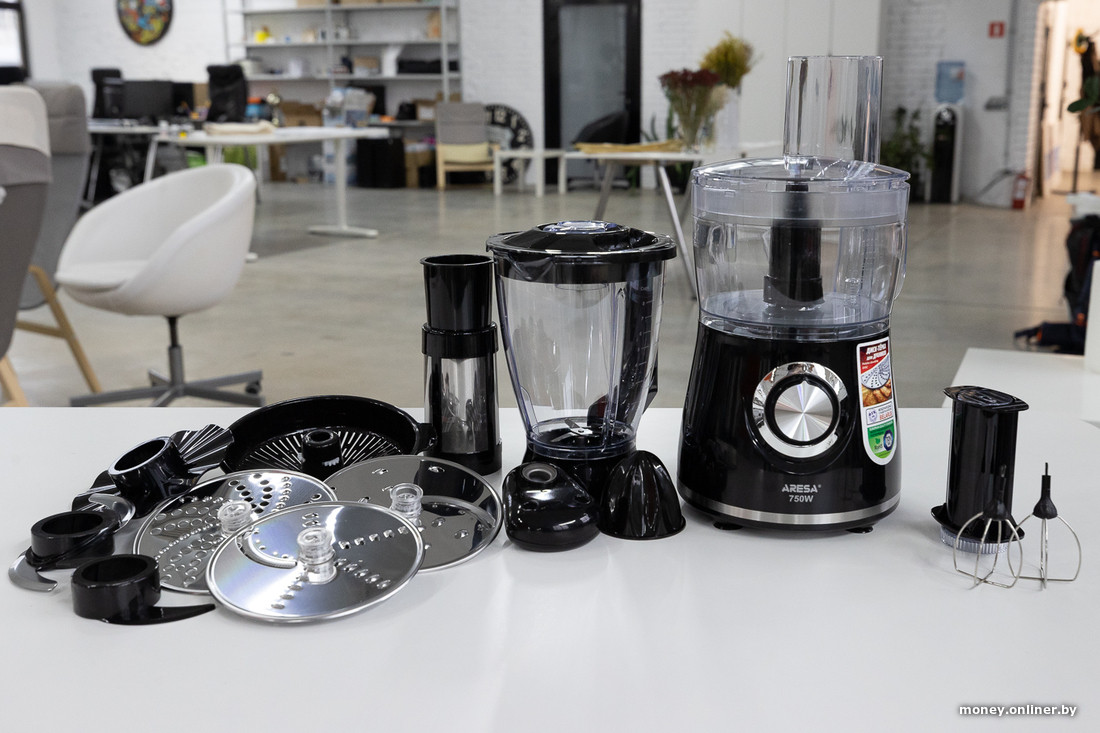
The classic kitchen food processor is for those who want to do less manual grating and chopping. Its core is a bowl with a chopping blade and discs for slicing, shredding, and rubbing. Depending on the model, the set may include a blender, juicer, meat grinder, and other attachments. Such a machine is useful for making potato pancakes, salads, vegetable preparations, sauces, and minced meat. The wider the capabilities, the higher, usually, the price—and along with it, the number of parts that need to be stored somewhere.
The planetary mixer is primarily for baking. It kneads dough, whips eggs and cream, and mixes ingredients for creams and desserts. The name comes from the movement of the attachment: it rotates around its own axis while also moving around the bowl, incorporating the mixture from different areas. A basic set typically includes a whisk, dough hook, and spatula. However, such a mixer cannot, on its own, grate a kilogram of potatoes or chop vegetables.
A dough mixer is primarily intended for kneading dough — for example, for bread, pizza, and buns. Unlike a planetary mixer, which also whips eggs and cream, mixes ingredients for creams and desserts, a dough mixer specializes in kneading.
A kitchen machine is a more versatile design, whose functionality can be expanded with additional attachments. Typically, it has a main bowl for mixing, kneading dough, and whipping, as well as the ability to connect additional accessories: a meat grinder, vegetable slicer, blender, and even pasta-making attachments. Here it is important to look at the specific model: some machines have a wide selection of attachments, while others have a limited one.
A cooking robot is an option for those who want not just to process ingredients, but to prepare a dish. Besides chopping and mixing, such devices can heat ingredients, boil, simmer, steam, and maintain a set temperature. Some models have built-in programs and scales, and step-by-step recipes are displayed on the screen. Essentially, this is an attempt to combine several appliances and part of kitchen processes in one housing. However, capabilities vary greatly: before buying, it is worth checking which operations the robot actually performs autonomously, and where you will still need to intervene.
These categories are not always mutually exclusive. For example, a kitchen machine can also be a planetary mixer, and some cooking robots can both chop ingredients and knead dough. Therefore, when choosing, you should look less at the device's category and more at its actual capabilities: what tasks it performs, what attachments are included in the kit, and what can be purchased separately.
What to choose? If you primarily need grating, slicing, and chopping of foods, consider a
The difference between models often lies in the details: the same task can take different amounts of time depending on power, and the bowl volume determines how much food you can prepare at once. Let’s look at which characteristics are worth considering when choosing.
Power
For simple tasks such as chopping soft ingredients and making sauces, a classic food processor with a power of around 400–600 W will suffice. If you plan to regularly grate hard vegetables and process large quantities of food, look at models from 700 W.
For kitchen machines, planetary mixers, and dough kneaders that will regularly knead dense dough, you can consider models with power from 1000 W. However, watts alone are not enough: check how much dough the appliance can handle at once and whether the manufacturer allows prolonged operation under load.
Bowl
Choose the bowl volume based on what you intend to prepare. For classic