Menu
Friends would regularly call him out for fights, even at night
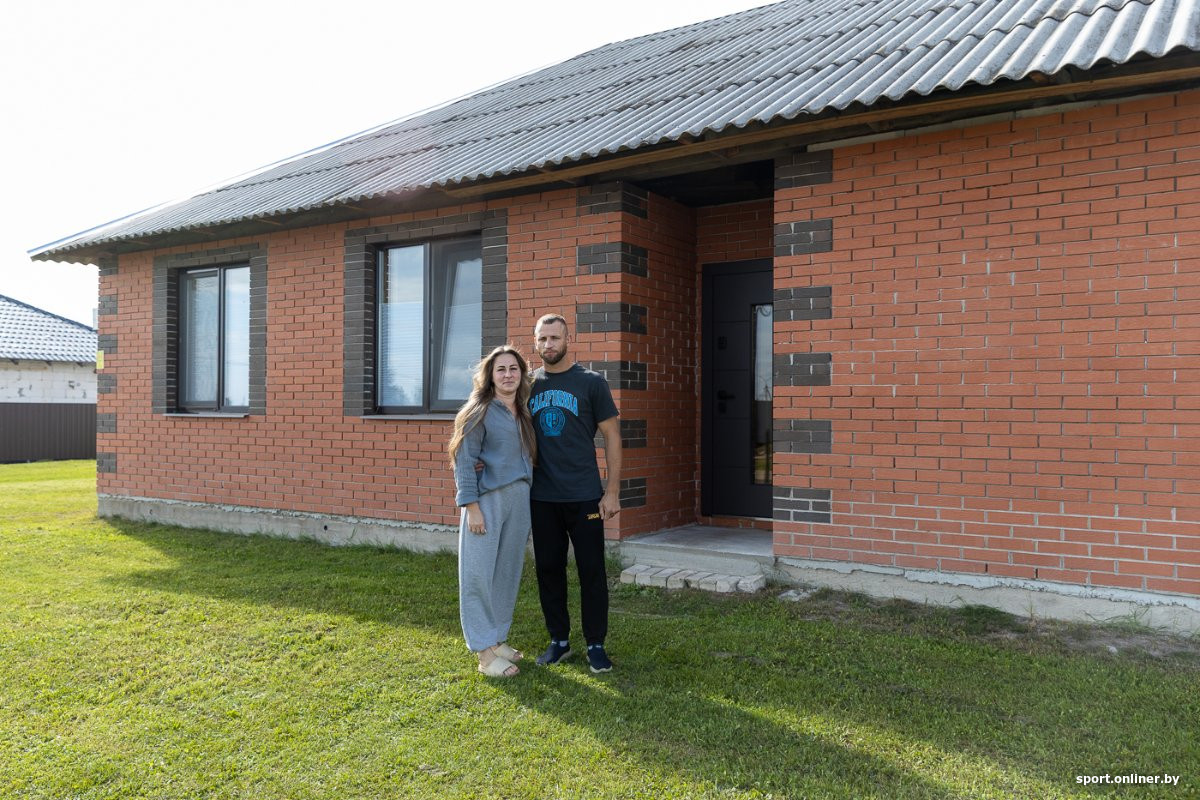
By day, he trains, by night, he works at a factory, and from time to time, he travels to international MMA tournaments. This is how 32-year-old Artem Buloychik from Byerazino lives. Once, he regularly participated in street fights, then for years, he performed as an amateur, and now he fights at a professional level, almost without a coach and sparring partners. We visited the unusual fighter and learned his story.
Friends would regularly call him to fights, even at night
We arrived in Byerazino at lunchtime, right after Artem's night shift. At the specified address, we see a neat brick house. As it turns out, our hero built it with his own hands.
Within a few minutes, we sit down at a table with Artem and his wife, Angelina, who, in her words, joined us to provide moral support for her husband.
Artem is 32 years old. He was born in the small village of Svetlitsa near Byerazino and moved to the district center at the age of ten.
"In the village, we had a private house, we had a farm: we had pigs, chickens, and geese. I helped my parents as much as I could - everything was like it was for Soviet children. But when we moved, we realized that we didn't want that anymore. We decided it was easier to buy all the products," the guy explains.
Artem started playing sports in the first grade when he joined the Greco-Roman wrestling and football sections. At some point, the coaches advised him to choose one, and Artem opted for martial arts.
"My father was involved in classical wrestling, my uncle in freestyle. The whole family, including five brothers, are athletes. I regularly fought and trained with my older brothers. But I didn't spar with them - you can't do that with your brothers."
Artem does not hide the fact that in his youth, he often got into fights and, as he believes, was raised by the street.
"I'm calm by nature, but I've always been able to stand up for myself and my friends. Therefore, I felt confident in the city. There was a lot going on, my youth was tumultuous. It happened that someone would provoke me at a disco - we'd go and sort it out around the corner. There were those who would try to pick a fight with me every year. By the way, thanks to martial arts, I got such a reputation that my friends would regularly call me to fights. Even at night - I'd immediately gather my things and go. Many people would quickly calm down when they saw me."
The last time they called was six months ago, asking for help, or at least just to stand by their side. But I've already refused - I've calmed down. After all, I'm a family man.
- Did you ever encounter worthy opponents on the streets?
- Yes, sometimes the clashes were good. I would come out slightly beaten, but a winner.
Such an active youth did not prevent Buloychik from engaging in wrestling. Artem met the standards for a candidate for master of sports, took prize-winning places at the amateur level, and then enrolled in the Olympic reserve school in Borisov. However, he only studied there for six months: it was financially difficult for his parents to support their son - after all, they had a large family. As a result, Artem returned to regular school, in the tenth grade. And before the eleventh grade, an unpleasant incident occurred: Buloychik was essentially expelled.
— At first, I didn't go to school for a month, and then I got into a fight with one guy. The deputy headmistress said, either we write a bad character reference, or you go somewhere else.
"People would come up and tell me they saw me on TV"
As a result, Artem enrolled in a construction lyceum in Cherven, where he began to engage in Eastern martial arts. But this did not last long: the teacher's university internship ended, and he left. It was not easy to find a new coach in a small town. After his studies, Buloychik returned to Berezino, but he did not abandon martial arts and began to participate in amateur tournaments.
— When I was 23-24 years old, my friend and coach Vladimir Bury proposed that I try myself in MMA. We contacted the matchmaker of the BFC league (the Belarusian martial arts league), he agreed to take a look at me and gave me the opportunity to perform in the contender - this is a special tournament where they scout newcomers. As a result, I was able to win there and become a professional. Then I was offered to fight against Magomed Magomedov, but my debut was unsuccessful - I lost. Then I beat Valery Bulat. In my third fight, against Tamerlan Khadzhimuradov, it turned out to be interesting: he thought that the judges' decision would be in his favor, but in the end, it was a draw. Tamerlan was so angry that he even threw bottles in the locker room. My fourth professional fight I held in Uzbekistan, for the title, but I lost to Jahongir Jumaev.
It turns out that if your friend had not suggested trying yourself in MMA at the time, you would have remained at the amateur level?
Most likely. Although a few years before that, another friend offered to move to Minsk and train, saying that I had everything for it. But due to family and children, I decided to stay in Berezino. By the way, the guys who trained with me in the local sports section unfortunately never made it anywhere.
How did you handle such a sharp transition from the amateur level to the professional level?
I didn't feel it particularly strongly, since there are competitions everywhere. The only thing was that I had to learn how to fight, not just wrestle.
Was there a time when, as a virtual amateur, you were pitted against a fighter with sponsors who had been competing at the professional level for a long time?
Yes. Especially those from Central Asia - they live in sports halls and have powerful sponsors. It happened that I would beat such opponents, but only by the judges' decision. And I don't consider that a full-fledged victory. In general, I don't care who I'm up against.
Throughout his career, which Artem began in 2020, he has already had more than 20 fights and won 11 victories. The last one was at a recent tournament in the Minsk Sports Palace against Mohamed Abdel Khalim. Despite regular performances, Buloychik tries not to publicize them and doesn't even tell some close relatives when he has upcoming fights.
If I tell them, then I think, what will people say? That's why I post something on social media at the very last moment, just before the fight. It's happened that I've gone to a competition, come back, and my relatives, it turns out, watched the tournament on TV and then ask: "Were you there?" I answer briefly: "Yes" - and that's it. As they say, the less you know, the better you sleep. Especially since my parents are already of age, and they don't need extra stress.
Do people in the city recognize you? Do strangers approach you?
We have a small city, so everyone knows who does what. But it's happened that people have approached me and told me they saw me on TV.
I work on a "day - night - sleep - day off" schedule and take on part-time jobs.
Another feature of sports life in a small town is the lack of usual conditions for a professional fighter. In Berezino, Artem has neither a permanent coach, nor a team, nor a full range of sparring partners. Therefore, most of the training has to be organized independently.
I train on my own. I go, punch the punching bag, and that's it. There's never a precise plan. Sometimes, I get together with a couple of local guys, we fight, but that's rare. The matchmaker suggests coming to Minsk to train, but it's still quite far, especially when I have a permanent job.
Artem works as a machine operator at the local enterprise "Zdravushka-milk", which produces dry milk. Periodically, he takes on part-time jobs, working in construction in Minsk. He says it's not easy to combine work and sports.
Of course, you need to allocate time for everything. A recent example: I was supposed to fly to a tournament in Uzbekistan the other day. I came, took a five-day leave at my own expense. Everything was signed without any problems, but in the end, my fight was canceled. There have never been any problems with my superiors, they always grant me leave at my own expense. There are two of us in my position, so while one is working, the other can be absent. Previously, we worked without a replacement, so it was more complicated, but now there's an alternative, we replace each other as needed, and I can take my days off calmly.
Maybe they're just afraid to refuse you? You're a fighter, after all...
I doubt it. (Smiles.) My boss is a woman, so she's not afraid of anything. And I'm on good terms with my superiors.
A logical question arises: does a person who regularly fights in good leagues need a side job? As it turns out, yes.
You greatly overestimate the fees. In the ACA league, the strongest in the CIS, they pay $1000-1500 for participating in a fight. If you win, you get the same amount on top. Plus, there are various bonuses. In the Belarusian league, they pay $500 for participating in a fight, regardless of the fight's status. It sounds solid, but a lot of money goes into preparation - the same food, especially when you're on a diet. Plus, there's family, children, equipment... Besides, you need to understand that we don't have fights every month. Maybe guys who have sponsors can live without a main job, but I don't have any.
It's worth noting that the expenses for training and preparation are significant, and the income from fighting is not always sufficient to cover them. This is why many fighters, including Artem, need to have a side job to make ends meet.
- And has it ever happened that half of your earnings went towards treatment after a fight?
— When I was in the hospital for almost two weeks with a concussion, I had to pay for my hospital room. I remember, I wasn't fully recovered yet, my head was spinning, but I could already move around. I asked when I would be discharged, and they immediately sent me home, and someone else was admitted to my room. But I haven't been so severely injured that I had to spend huge amounts on treatment.
- How often do you take on extra work?
— Irregularly and sometimes spontaneously. Let's say, my brother might call and say that there's an apartment where they need extra hands. And I agree. The last time it happened was quite funny: my brother's partner went on a binge, and they needed to finish the project. So I went.
"I went to a tournament in India alone. My second kept shouting one Russian word throughout the fight: 'Come on!'"
Artem mostly performs in the CIS, but he has also made two long trips - to Serbia and India. The second trip to India was particularly memorable for Buloychik.
— It so happened that I went there alone. I arrived right on the day of the weigh-in. I immediately felt that I was in India - it was unusually dirty, and it smelled unusually.
I asked people to be my seconds, but they didn't understand Russian. Throughout the fight, they shouted only one word in Russian: "Come on!"
As for the return trip, I barely made my flight. I arrived at the airport and started looking for the third terminal. They showed me where it was with gestures. I don't speak English well, so it was difficult. I tried to ask how far it was, but it didn't work out right away. I found a taxi driver, and he immediately asked: "Are you looking for the third terminal?" I said yes. And I had no local currency left, and I couldn't find an exchange office. But I learned that I could get there by bus with a ticket. In the end, I barely made it - just in time.
- Did your coworkers ask you about such trips?
- Not especially. They might ask if I won or lost, and that's it.
- Did you get an extra day off for your victories?
- Unfortunately, that doesn't work.
"Each time you think: 'Well, this is the last fight'"
When asked about his dreams and goals in martial arts, Artem thought for a long time. And he admitted that he no longer has any special ambitions.
— I'm not rushing anywhere too much now. I plan to participate a bit more, possibly even for the championship belt. We'll try our best. The desire to quit is always there: both when I was an amateur and now. Especially in the first days after a loss, you think: "Why do I even need this?" But something holds you back, pushes you to move forward, and each time you think: "Well, just one more fight." After injuries, I even have to tell my wife that it's definitely all over now. But then I still return to the octagon.
- Didn't you think about becoming a coach after retiring from your career?
— You need specialized education for that. Although six months ago, I was offered to go coach a section, but that question is on pause for now. Plus, there are young guys with whom I was asked to work out and substitute for the coach. I come to the training session, look around, and see that the kids are on their own, they don't care about anything. I explain that there should be discipline in everything, and they respond that I'm not their coach. I think that if I became a coach, I would immediately kick everyone out. (Laughs.) Or maybe I would leave only the most resilient one. We'll see. Maybe in the future, I'll try this job too. But for now, I'm still a professional fighter.