Menu
Flax harvesting plan in Belarus 98% complete
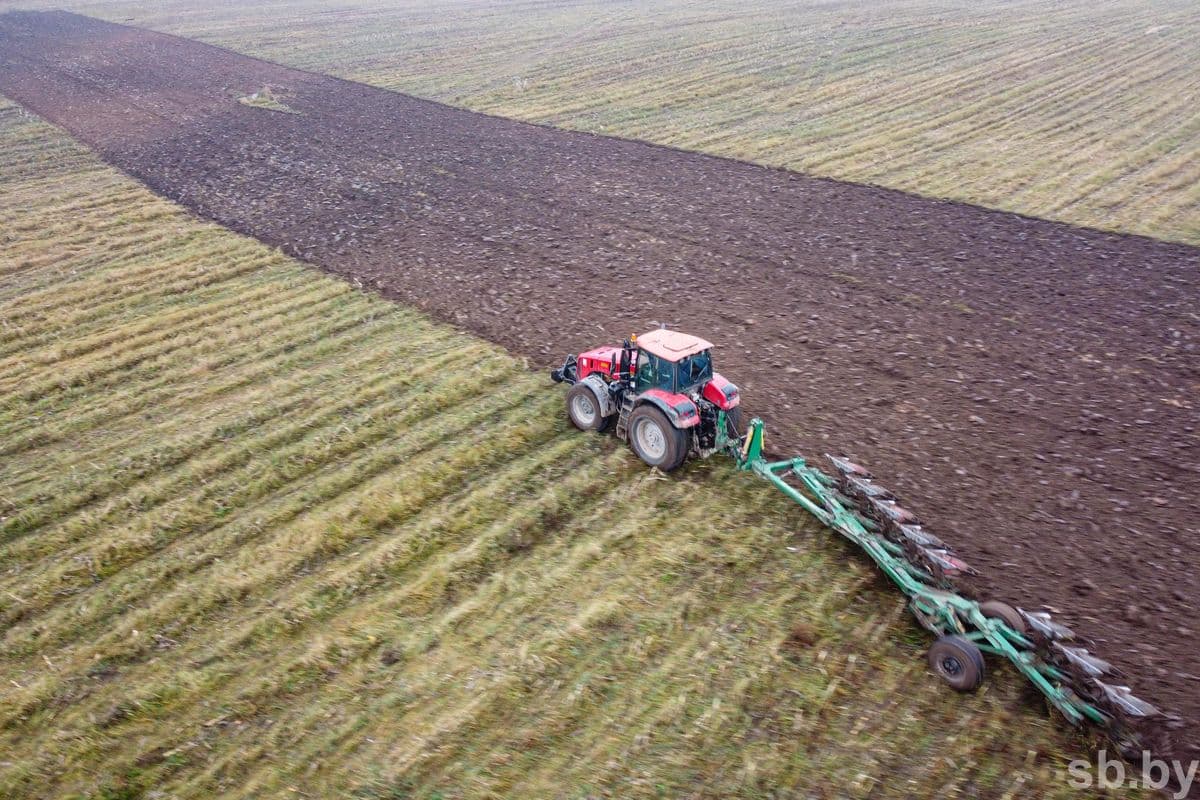
The advantages of fallow plowing are obvious. They consist of an increase in the future harvest, savings of resources during spring field work, and a reduction in costs for plant protection products. In addition, fields prepared in the fall significantly relieve machinery and machine operators in the spring, allowing sowing to be carried out within tight agrotechnical deadlines. That is why even late autumn plowing has an indisputable advantage over spring soil cultivation.
According to operational data from the Ministry of Agriculture and Food as of November 25, the country plans to plow 1 million 436 thousand hectares of fallow land. The task has already been completed by 98 percent, which exceeds the figure for the same period last year. More than planned was plowed in the Gomel, Brest, and Minsk regions.
Meanwhile, in the north of the country, autumn plowing continues. Fallow plowing is actively underway at KUSHP "Pridneprovsky" in the Dubrovensky district. The pace of field work depends on a whole range of factors, notes the farm's machine operator Dmitry Gusentsov:
"On average per shift I manage to cultivate about 20-25 hectares. The output is affected by soil composition, field shape, terrain, and soil moisture. Our machinery is modern, high-powered, but we cannot chase speed at the expense of quality: the quality of plowing must always come first."
This thought is shared by the manager of KUSHP "Pridneprovsky", Evgeny Shlemenkov. Due to rains, the pace of work at the farm had to be reduced, but with the onset of dry
Why must plowing of fields for the future spring sowing be carried out specifically in the autumn? Autumn soil cultivation solves a whole range of tasks, notes Deputy Director General for Scientific Work of the National Center for Agricultural Sciences of the National Academy of Sciences of Belarus, Dmitry Luzhinsky. First, it is necessary for maintaining the phytosanitary situation on the land. Incorporating crop residues, insect pests, and fungal disease spores at a greater depth leads to their death. Second, autumn plowing allows for better moisture accumulation in the soil: during its cultivation, loosening occurs, density decreases, more pores appear, which are filled with moisture. Over winter, this moisture accumulates, and in spring it will be used by plants for more uniform germination and provision (at least at the early stages of growth) with a sufficient amount of water.
— Another important point: autumn cultivation is necessary for incorporating mineral and organic fertilizers, — emphasizes the interlocutor. — By regulation, they, except for nitrogen ones, are applied in autumn. Fertilizers are distributed over the surface, and then during plowing they are evenly mixed throughout the entire soil profile. A no less important task is saving time on the main soil cultivation in spring. The fact is that in spring one can start cultivation only when the soil reaches physical maturity: it dries out enough for machinery to be driven onto the fields. But this is precisely the time when sowing should already be underway, while we are only starting cultivation. As a result, if autumn cultivation is not carried out, the sowing deadline is usually shifted by 10–12 days to a later date. And the final point. If autumn cultivation has been carried out and moisture has accumulated, in spring it is sufficient to carry out only one or two shallow cultivations to a depth no greater than the seeding depth. Thus we do not overdry the soil in spring.
СБ