Menu
Digital twin: how the NTEC CyberRing cyber polygon trains to repel hacker attacks
Even if a company has purchased cutting‑edge software and built a robust technical defense, one critical vulnerability remains in the system – the human factor. Most successful hacks worldwide start in a standard way: an accountant opens an archive from a suspicious email, a department head clicks a link in a messenger, and an engineer plugs an unverified external drive into a work computer. Without basic digital hygiene skills, staff can inadvertently compromise the organization’s network, wiping out costly IT investments.
For managers, this means one thing: the security of assets directly depends on the competencies of their subordinates. Recall that under Belarusian law, employees responsible for information protection and cybersecurity in enterprises are required to undergo professional development at least once every three years. Failure to meet this requirement poses a direct legal and administrative risk for the manager.
Investments in Human Capital
The National Traffic Exchange Center (NTEC) tackles this challenge comprehensively through its own cybersecurity ecosystem. The foundation for thorough training and compliance with legal requirements is the International Education Center ROZUМ, where specialists, regular staff, and top management receive training. As is well known, theory must be reinforced through practice. Therefore, most ROZUМ training programs are practical and practice‑oriented. The primary technological foundation for consolidating the material is the CyberRing cyber‑polo infrastructure – a proprietary development of the National Traffic Exchange Center (NTEC). Moreover, on the basis of the CyberRing, NTEC conducts national and international cyber‑exercises, as well as corporate cyber‑trainings.
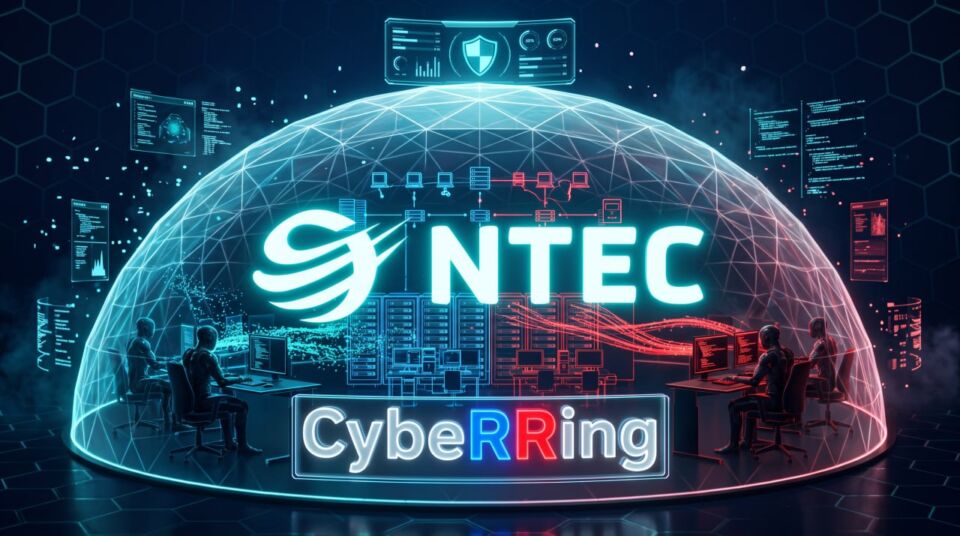
The CyberRing cyber‑polo is a unique interactive environment designed so that IT specialists can safely practice threat‑countering skills in conditions that are as close to real life as possible. Practical training on the polo is built on three key principles:
Confrontation scenarios: Red teams versus Blue teams. CyberRing’s cyber‑poligon offers a unique opportunity to practice infrastructure‑defense scenarios in a team and to view the system from the attacker’s perspective. Red Team members simulate the actions of a malicious actor, testing the system’s resilience and uncovering hidden vulnerabilities. In contrast, IT specialists in Blue Teams analyze attack chains, defend the infrastructure, and devise measures to prevent and mitigate the consequences of cyber incidents. Even if a specialist’s job is solely investigation, it is extremely useful in an interactive format to master both roles, to understand the mindset of a potential adversary and to spot hidden gaps in defense.
Digital twin: creating a copy of the enterprise’s infrastructure. A key advantage of the cyber‑poligon is that CyberRing’s platform combines powerful physical servers and virtual resources to build an exact replica of a specific enterprise’s IT infrastructure or a real sector of the economy—whether industry, energy, telecom, or government administration. IT specialists hone their skills in an isolated environment that mirrors their actual workplace, eliminating any risk to the continuity of the organization’s ongoing processes.
Objective assessment of knowledge and individualized recommendations. After the cyber‑training, the enterprise leader receives not just an abstract pass/fail result but an official final report. Platform moderators conduct a detailed analysis of vulnerabilities, assess the team’s knowledge level and real cohesion during a crisis. The leader receives tailored recommendations for fixing weak points in defense and clear areas for professional growth of their staff. Thus, CyberRing enables an objective evaluation of the organization’s readiness for a real threat and multiplies the reduction of financial and reputational risks.
In today’s reality, a single mistake by an IT specialist can cost an enterprise colossal financial losses, halt critical processes, and paralyze the organization entirely. CyberRing’s cyber‑poligon eliminates this risk entirely. By making mistakes in a controlled cyber‑poligon environment, employees bring their defensive actions to automation. In the event of a real attack, a trained specialist does not waste precious time in panic but responds confidently, accurately, and professionally.
The highest league of security
Over the past period, the CyberRing cyber polygon has proven its highest efficiency on the national and international arena. In 2026, the company NTEC, under the auspices of the Operational-Analytical Center under the President of the Republic of Belarus, held the country's first international cyber exercises "CybeRRing" on its own domestic cyber polygon. The exercises were attended by more than 50 professional teams from leading agencies and organizations of the country, as well as representatives of foreign states: Russia, Kazakhstan, Uzbekistan, and Azerbaijan.
The highest status of training is confirmed by NTEC's strategic partnership with the country's leading profile higher education institutions: BSU, BSUIR, and BGAS. Moreover, NTEC itself has a license for educational activities and conducts training at the ROZUM base, after which the listeners receive a certificate of advanced training of the state standard.
Our series of publications on the NTEC cybersecurity ecosystem has consistently revealed all its components and shown that there are ready, accessible, and reliable domestic solutions for the digital security of enterprises in the Republic of Belarus: services of the NTEC Cyber Security Center, NTechnology SIEM, and other products of the domestic software line, as well as training at the ROZUM International Education Center and at the CyberRing cyber polygon.