Development of livestock farming in the Shklov district: how facility updates are changing approaches to agricultural production
zilmogilev.by
September 3, 2026 12:26
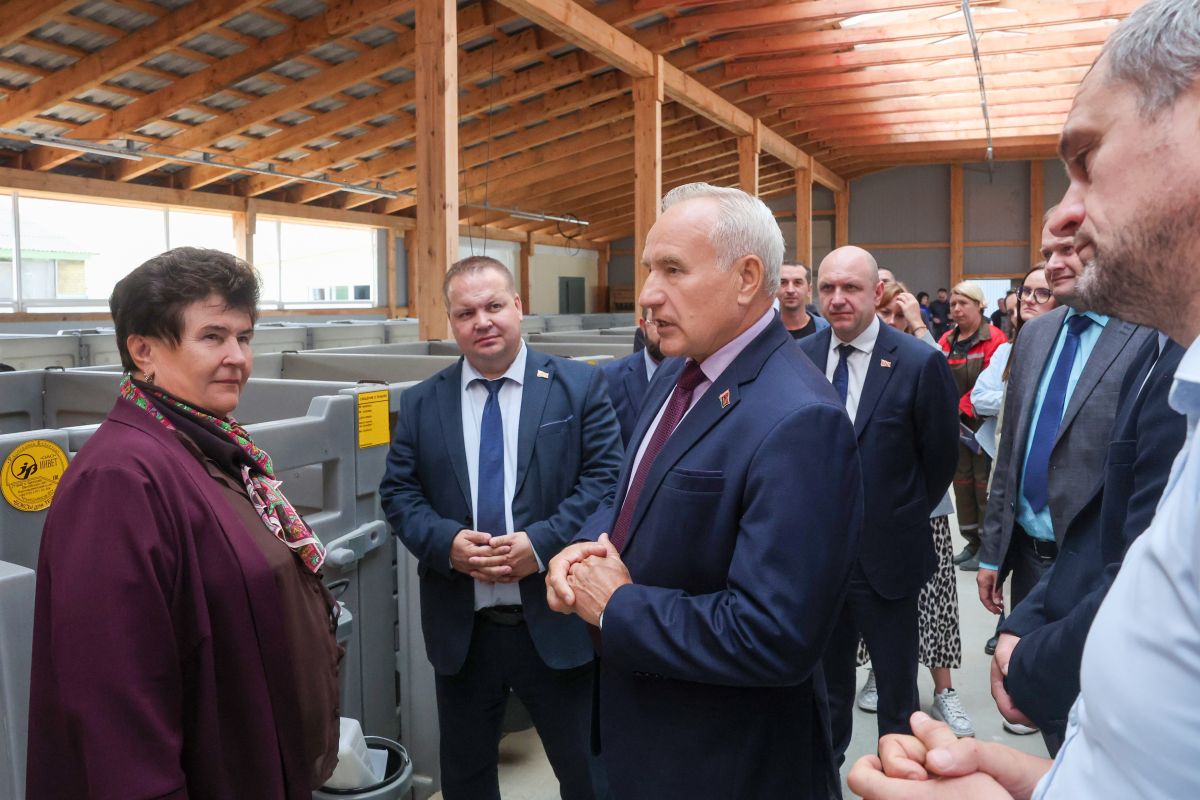
Republican holiday of the XXXIII Day of Belarusian Written Language The reconstruction and modernization of old farms, the construction of modern calf nurseries, the creation of comfortable working conditions, and the work of a large repair unit. These were the main topics during a visit to livestock facilities in the Shklov district and the district agricultural service by Yuri Nazarov, Head of the Presidential Administration, Nikolai Sherstnev, Deputy Head of the Presidential Administration, Nadezhda Kotkovets, Assistant to the President — Inspector for the Mogilev Region, and the leadership of the Shklov District Executive Committee.
In the Shklov district, a large-scale reconstruction of livestock facilities at a number of farms, including those within the structure of the Presidential Administration, is ongoing. The task is comprehensive: to create modern production facilities where both specialists and animals will feel comfortable. For attracting personnel to the agro-industrial sector, Deputy Head of the Presidential Administration Nikolai Sherstnev emphasized that comfortable working conditions are essential:
— Therefore, we have defined a plan of measures for all dairy complexes in the Shklov district. It is necessary not only to streamline the technology of producing products, but, first of all, the technology of animal husbandry, to also create the necessary microclimate and replace equipment.
People will work in modern conditions, receiving a decent salary, and they will ensure the production of the products needed by the state. This is not only our country's food independence, but also its export component. And that means currency, money, which are so necessary for the country.
A large-scale reconstruction took place at the "Staroselie" dairy complex of the "Lyubinichi-Agro" joint-stock company. A warehouse for storing feed, mineral additives, sawdust, and bedding material was built, along with a modern calf nursery. Additionally, concrete flooring was poured for manure areas, silage trenches, access roads, and weighbridges.
— Visually it's not so noticeable, but these are huge material costs, — Nikolai Sherstnev emphasized. — We are confident that the local authorities, the leadership of Shklov district will bring our plans to final implementation and perhaps come up with something more technological to improve and multiply our work. Our entire policy is aimed at achieving maximum production, reducing costs, creating comfortable working conditions for people, and ensuring they receive decent wages. This way we create prestige for working in livestock farming.
The upgrade of the old farm also took place at OAO Novogorodishchenskoye — the TF Novoselki got a new life. The director of the agricultural enterprise, Anatoly Mkhitarov, noted the financial benefit of complete reconstruction of three destroyed barns instead of building new facilities. He pointed out that this made it possible to create a modern complex and independently grow heifers for their own needs, saving funds and ensuring the future of the enterprise through milk production as the main source of gross revenue:
— The updated facilities house young stock aged 4 to 14 months. Currently, there are 419 head here. Average daily gains are one kilogram, which makes it possible to reach breeding age at 14 months. This is even slightly earlier than the technological standards of 15 to 16 months.
Another strategic facility in Shklov is the district agricultural service. This is a unique multifunctional complex for equipment servicing using the newest materials, modern approaches, and lean manufacturing principles. The central repair workshop has already been commissioned, where almost the entire fleet of equipment is repaired: forage and grain harvesters, tractors, even municipal road graders. However, construction is not yet finished. Ahead lies the commissioning of a service station for passenger vehicles, and an exchange warehouse for large spare parts is also under construction, along with a workshop where production of working implements for all trailed equipment will be established. All of this, in the opinion of the head of the Main Department of Technical Progress and Energy, State Supervision of Technical Condition of Machines and Equipment at the Ministry of Agriculture and Food, Stanislav Karpovich, will bring the facility to a new level:
— Today, those buildings and structures that have been built and restored allow for technical service at a new level. Because now, agricultural industry is receiving equipment that is equipped not only with mechanical transmissions but also electronics, hydraulics and other complex components. That is why agricultural organizations cannot restore it under their own conditions. And it is agricultural service that should become the link between the manufacturer and the restoration of agricultural machines, tractors and other self-propelled equipment. The equipment here is serious, and it allows for quality performance of work.
Based on media materials
Tags Agriculture