Menu
Deputy Chairperson of the Supreme Court Natalia Sarnavskaya answered questions from citizens and businesses in Grodno.
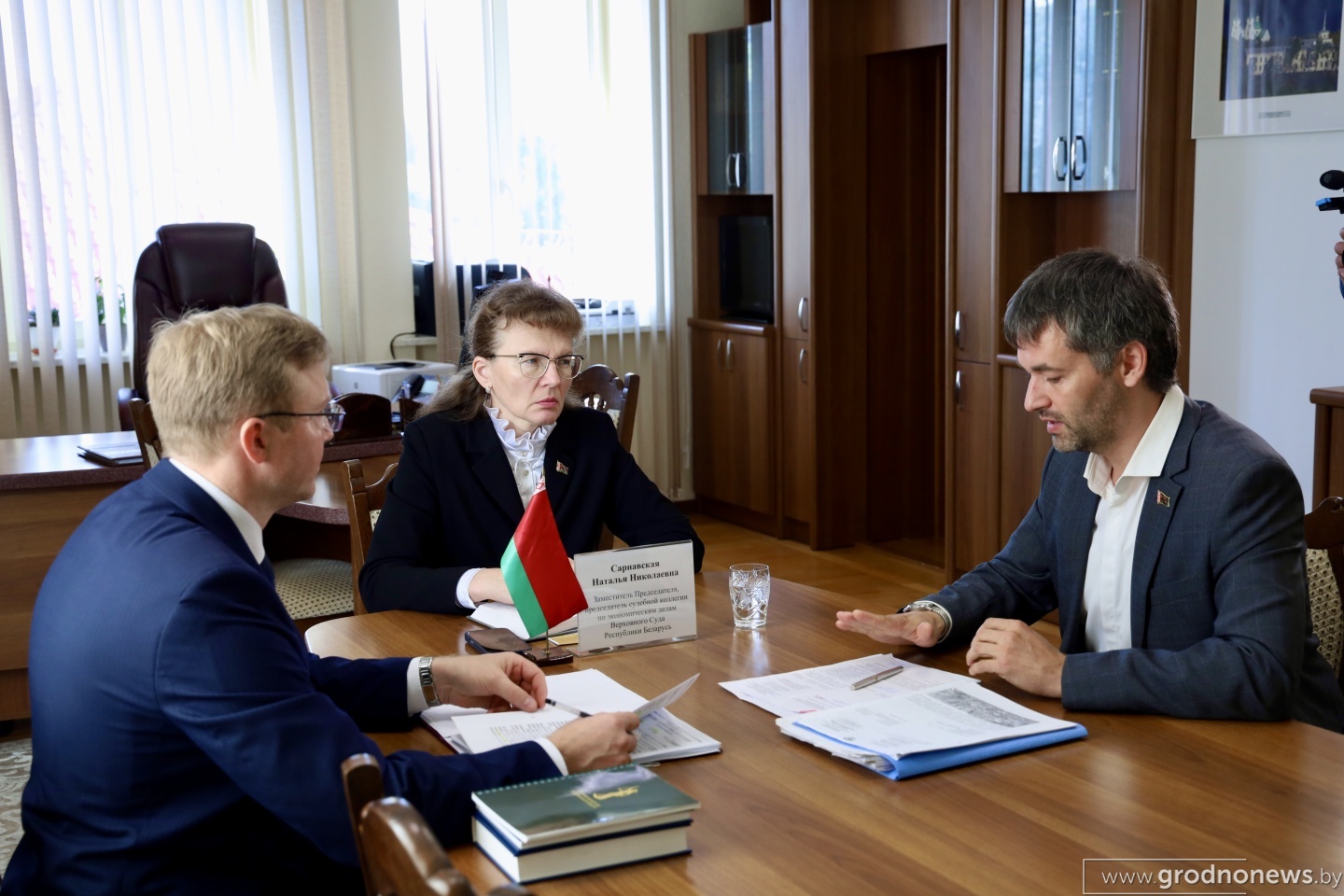
At the Economic Court of Grodno Region, a mobile reception of citizens was held, conducted by the Deputy Chairperson of the Supreme Court of the Republic of Belarus, Chairperson of the Judicial Panel on Economic Affairs, Natalia Sarnavskaya. This format of work of the highest judicial instance ensures direct contact with the regions, helping to thoroughly examine complex legal situations faced by citizens and representatives of the real sector of the economy in practice.
The reason for one applicant's appeal was ordinary inattentiveness when transferring money. The organization sent the payment to the wrong place: it mistakenly indicated the settlement account of another bank, although all other recipient data were filled in correctly. As a result, the money went to a completely different person.
What is the difficulty here? By law, if money is received by mistake, it is considered unjust enrichment – that is, someone else's property that must be returned. However, in this situation the organization got confused with the bank details. Now it must be determined whether these funds can be recovered, given that the error was made by the sender itself, not the bank or the recipient.
Another case was related to environmental protection. The situation involved illegal waste disposal, for which the economic court's decision had compensated the damage caused to nature. Later the court ruling was overturned, but the claim was filed again. Therefore, a question arose about the further fate of the amount already transferred to the budget.
The topic of bankruptcy was also raised. The applicant came with a question about how to properly draft a company rescue plan (sanitation) and a payment schedule if the debt amounts in the enterprise's accounting and in the official list of creditors do not match. He was also interested in judicial practice concerning cases related to the transfer of a bankrupt company's property to municipal ownership.
For enterprises, the consequences of terminating contractual relations are especially important. In particular, during the reception, issues were considered regarding the return of funds and the actions of the parties after the termination of a lease, as well as the procedure for appealing court decisions.
In practice, the moment of contract termination often becomes the start of a new dispute. Partners have to figure out who owes whom, which clauses of the agreement are still in effect, and who is responsible for past violations or unfulfilled promises.
- Since January 1, 2026, the work of courts has been reorganized. First of all, this affected economic courts, which consider disputes involving enterprises and organizations. Their decisions largely determine production, jobs, and people's economic well-being. The main guideline in such work is to make balanced decisions and, if possible, avoid unjustified damage to enterprises," emphasized Deputy Chairperson of the Supreme Court Natalia Sarnavskaya. "- At the same time, the court must curb abuse of rights by dishonest participants in the process who seek to gain at others' expense. Simultaneously, the court's task is to restore the rights of those who conscientiously fulfill their obligations and comply with contract terms.
These approaches are also reflected in the new resolution of the Plenum of the Supreme Court of the Republic of Belarus 'On the Practice of Application by Courts of the General Provisions of the Civil Code of the Republic of Belarus on Lease,' adopted on September 24.
As Natalia Sarnavskaya emphasized, lease agreements are widely used in life and especially in the real sector of the economy. Therefore, disputes arising around them have great practical significance. Usually, the cause of conflict is money. But situations can vary.
- For example, after a change of ownership of the premises, the new owner may want to increase the rent. First, the parties try to reach an agreement and conclude an additional agreement with the new rate. If the tenant disagrees, in practice there have been cases where they began to cut off electricity, water, and other essential resources. Another situation is related to the liquidation of the landlord. There have been cases where the owner decided on liquidation, expecting thereby to terminate the existing lease agreement. As a result, a conscientious tenant could end up in a situation where they would have to vacate the premises. Thereafter, the liquidation was canceled, and a lease agreement was concluded with a new tenant on more favorable terms. The Supreme Court has given a clear assessment of this issue. The
Separately clarified the situation with reorganization. If the landlord wants to replace himself in the contract with another person, for this it is necessary to obtain the consent of the other party to the contract. In the absence of such consent, the obligations continue to be performed by the former party.
Unfair behavior is also encountered on the part of tenants. Sometimes they use the premises for a long time, but do not pay rent and do not reimburse utility and operating expenses. When the dispute already reaches court, new claims against the premises may arise. For example, the tenant claims that he is not satisfied with the lighting, the quality of the floors or other characteristics of the object. At the same time, initially upon transfer of the premises an acceptance and transfer act was signed.